In this article (11 sections)
- What is a peptide, and how could it affect hair?
- Copper peptides (GHK-Cu): the most studied hair peptide
- What the clinical evidence shows
- Topical copper peptide vs GHK-Cu injections
- Copper peptide serum for hair: what to look for
- Where a copper peptide topical fits in a treatment plan
- How to use a copper peptide topical
- What to keep in perspective
- Considering medical assessment
- Related reading
- Key references
Peptides have become one of the most searched-for ingredients in hair care, and the interest is easy to understand. As the "skinification" of hair routines has grown, copper peptides in particular have moved from serums for the face onto the scalp, where they are marketed as a gentler way to support thicker, healthier-looking hair. If you have been looking into a peptide for hair loss, the most relevant one to understand is GHK-Cu, a copper peptide with more research behind it than any of the others sold for hair.
This page explains what copper peptides actually are, what the published evidence does and does not show, and where a copper peptide topical realistically fits alongside the treatments with the strongest track record. The short version: copper peptides may have a supportive role for some people and are usually well tolerated, but they work best as an adjunct to a core plan rather than as a standalone answer to pattern hair loss.
What is a peptide, and how could it affect hair?
A peptide is a short chain of amino acids, the same building blocks that make up proteins, just far smaller. Some peptides act as signaling molecules: they bind to receptors on cells and nudge those cells toward a particular activity, such as producing collagen or responding to injury. That signaling role is the reason peptides are studied in skin and scalp biology at all. The scalp is skin, and the hair follicle sits inside it surrounded by the same connective tissue, blood supply, and immune activity that peptides can influence.
For hair specifically, the peptides that reach the market are almost always applied topically in a serum, tonic, or leave-on solution. The theory is that by improving the local environment around the follicle, reducing low-grade inflammation, supporting the small blood vessels that feed it, and helping the surrounding matrix, a peptide could make conditions more favorable for growth. That is a plausible mechanism. Whether it produces a meaningful, measurable difference in a person with active thinning is a separate question, and that is where copper peptides earn most of their attention.
Copper peptides (GHK-Cu): the most studied hair peptide
GHK-Cu is a naturally occurring tripeptide, glycyl-L-histidyl-L-lysine, bound to a copper ion. It was first identified in human blood plasma and has been studied for decades in wound healing and skin remodeling, well before it was marketed for hair. The mechanisms researchers most often cite for a possible hair benefit include:
- Anti-inflammatory effects on scalp tissue, which matters because chronic low-grade inflammation is thought to worsen follicle miniaturization
- Signaling that supports dermal papilla cells, the cells at the base of the follicle that help direct the growth cycle
- Improvements in the extracellular matrix proteins that surround and anchor the follicle
- Support for the small blood vessels that supply the follicle
In laboratory and animal studies, GHK-Cu has produced effects that are at least consistent with supporting hair growth. When people search for the "best peptide for hair growth," GHK-Cu is usually the honest answer to that question, not because it is proven superior, but because it is the copper peptide with the most supporting biology and the longest history of study. The other peptides sold for hair, including acetyl tetrapeptide-3 and biotinyl tripeptide-1, rest on thinner evidence still.
What the clinical evidence shows
Here is the part worth being clear about. There is no large, high-quality randomized controlled trial of a copper peptide product for androgenetic alopecia that meets the standard applied to minoxidil or finasteride. The clinical literature on peptides for hair is dominated by small studies, case series, and trials of multi-ingredient formulations in which the peptide is only one component. When a product is one of several active ingredients, any improvement seen in a study cannot be attributed to the peptide on its own.
This does not make copper peptides worthless. It means the current evidence supports them as a reasonable, low-risk adjunct rather than a primary treatment, and it means marketing claims deserve a careful read. When a serum states that "clinical studies show" copper peptides regrow hair, the underlying citations are often laboratory data or combination-product trials rather than a controlled test of that specific formulation. Results vary, and expectations are best kept modest. Copper peptides sit alongside several other approaches at a similar stage of evidence, which we cover in new hair loss treatments in research.
Topical copper peptide vs GHK-Cu injections
A growing number of searches ask about GHK-Cu injections rather than topicals. This is worth addressing directly. Copper peptides for hair are studied and sold as topical products applied to the scalp. Injecting GHK-Cu for hair growth is not an established or approved use, the evidence for it is essentially absent, and injecting unregulated peptide products carries risks that a leave-on topical does not, including infection, dosing errors, and reactions to impurities in products that are not pharmaceutical grade.
For almost anyone considering a copper peptide, a topical is the more sensible starting point: the safety profile is favorable, the application is simple, and it aligns with how the ingredient has actually been studied. If you are ever weighing an injectable peptide, that is a conversation to have with a licensed clinician before doing anything, not a decision to make from a supplement retailer.
Copper peptide serum for hair: what to look for
Most searches for a copper peptide serum are about skin, and most of the serums on the shelf are face products. That matters if your goal is your scalp. A face serum is built to spread across bare skin, often in a thicker or richer base, and on a head of hair it tends to coat the strands rather than reach the skin underneath, where the follicle sits. A serum made for hair is usually lighter, leave-on, and comes with a dropper or applicator nozzle so it can be parted onto the scalp in the thinning areas.
A few things are worth checking before choosing one:
- Whether the strength is stated. Many cosmetic serums list "copper peptide" without saying how much is in the bottle. A stated concentration of GHK-Cu tells you far more than a front-label claim.
- What else is in it. Fragrance and high alcohol content can irritate a scalp that is already being treated with other topicals. Simpler formulas are easier to layer.
- The color. GHK-Cu is naturally blue, so a blue tint is expected rather than a sign that something is wrong.
- How it fits with what you already use. If you apply minoxidil, the serum should go on at a different time or once the first product has dried, so neither is diluted.
The same limits on evidence apply to every copper peptide serum for hair, whatever the label says. It is a supportive option, and a reasonable one to discuss with a clinician, rather than a treatment for the DHT-driven process behind pattern loss.
Where a copper peptide topical fits in a treatment plan
The most useful way to think about copper peptides is by leverage. The steps with the strongest evidence come first: prescription medication when medically appropriate, consistent scalp care, and one or two supportive practices. A copper peptide topical is a reasonable optional addition on top of that foundation, particularly in a few situations:
- Alongside topical minoxidil, where minoxidil does the work documented in trials and the copper peptide is a low-risk supportive layer
- As part of a post-microneedling routine, since the temporarily disrupted skin barrier may improve how well topical ingredients absorb
- For people who are not yet ready to start medication and want a gentle, well-tolerated first step, provided expectations stay realistic
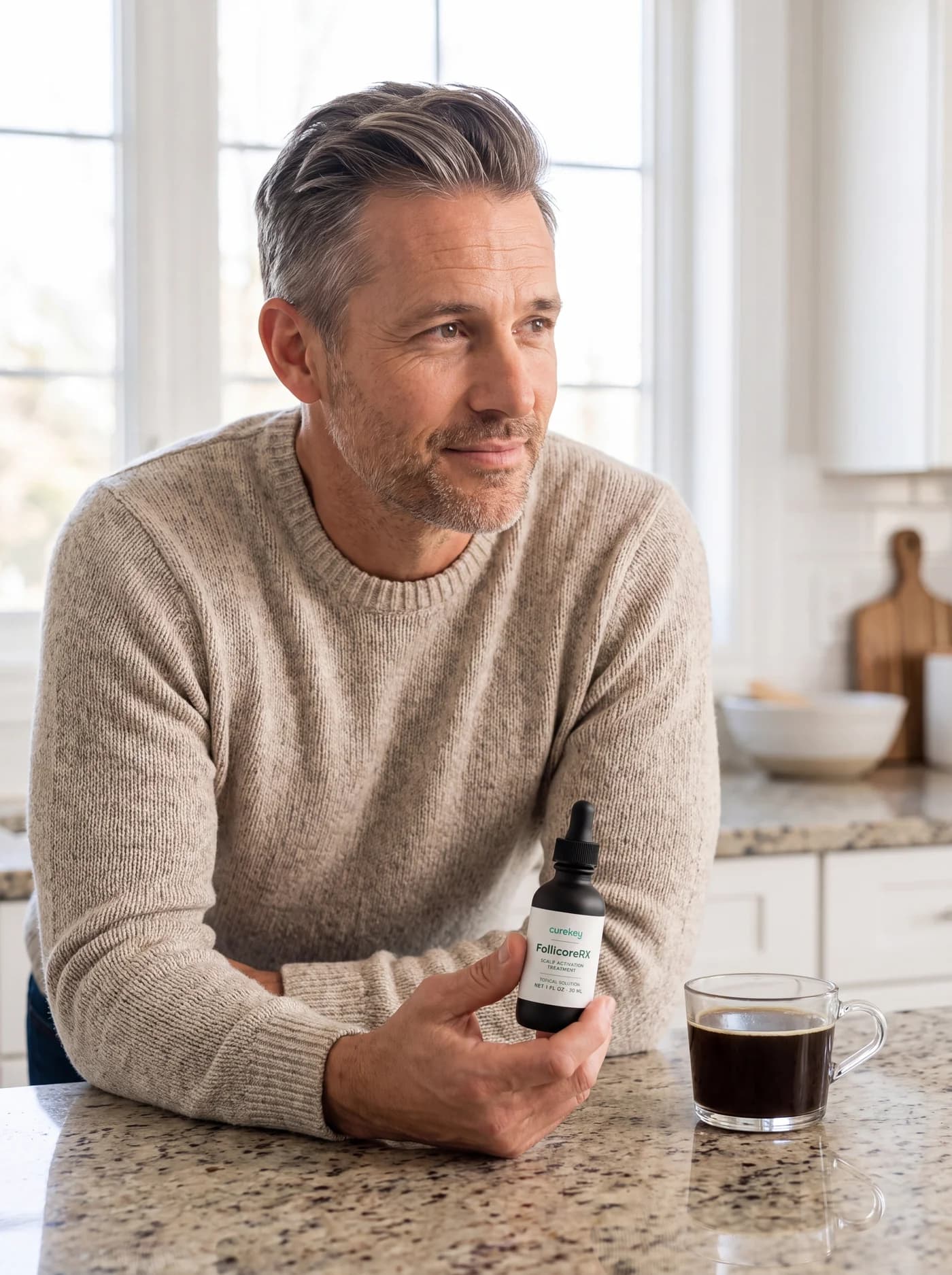
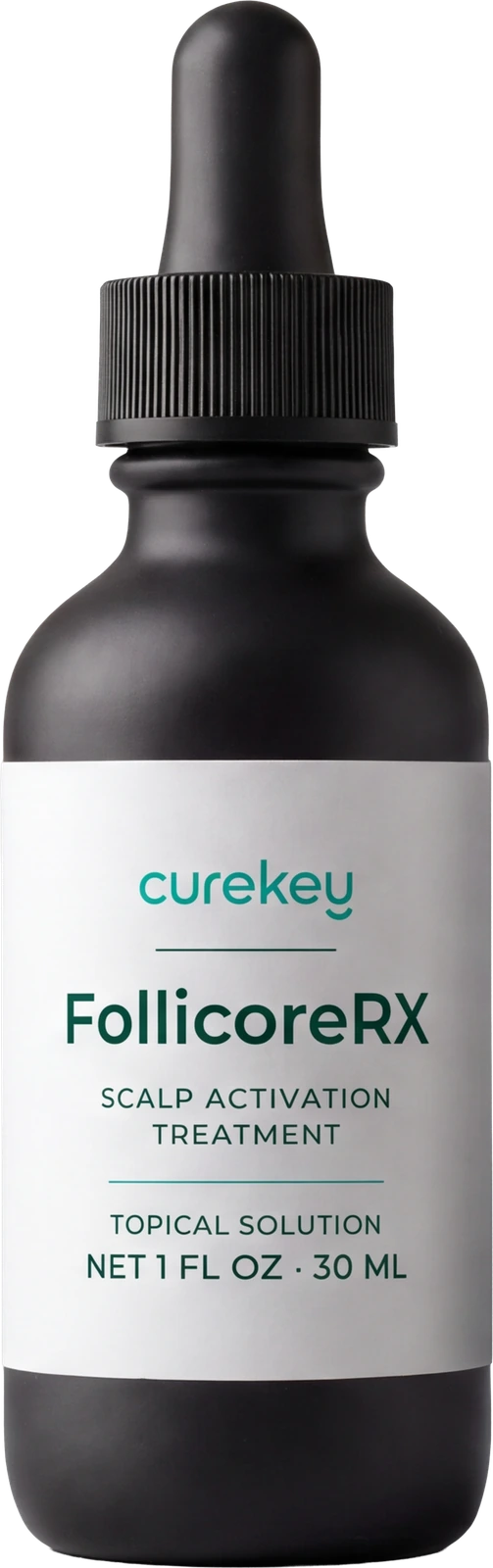
At Curekey, that topical is Peptide Boost, a pharmacy-grade GHK-Cu 2% serum for the scalp. It can be part of a treatment plan when a licensed clinician reviews your case and considers it a sensible fit alongside the core options. It is offered as a supportive layer, not as a replacement for the treatments that have the strongest evidence for active follicle miniaturization. The assessment is where that decision gets made based on your specific situation rather than a generic recommendation.
How to use a copper peptide topical
If a copper peptide topical is part of your routine, a few practical points help you get the most from it:
- Apply it to a clean, dry scalp and focus on the thinning areas rather than the hair length, since the follicle sits in the skin
- Give any new addition a fair trial window, usually around six months, before judging whether it is worth continuing, because hair changes slowly
- Be mindful of layering. Copper peptides and certain strong antioxidants are sometimes said to interact, so if you use multiple actives, spacing them (for example, one in the morning and one at night) is a cautious approach
- Read the ingredient list, not just the front-of-package claim. A peptide listed far down the list or after preservatives is likely present in name more than in a meaningful dose
What to keep in perspective
Copper peptides are one of the more interesting supportive ingredients in the hair-care space, and GHK-Cu is a genuine molecule with real biology behind it, not a marketing invention. At the same time, a peptide for hair growth is not a substitute for addressing the underlying driver of pattern loss, which is follicle sensitivity to DHT. The people who tend to be happiest with a copper peptide are those who use it as a complement to a solid core plan and keep their expectations proportionate to the evidence. Used that way, it is a low-risk, well-tolerated option. Treated as a standalone cure, it usually disappoints.
Considering medical assessment
The most reliable next step for anyone noticing visible thinning is a structured medical assessment that distinguishes pattern hair loss from other causes, such as hormonal shifts, stress-related shedding, and medication side effects, and identifies which treatments are appropriate. From that base, an optional layer like a copper peptide topical can be evaluated honestly rather than relied on in place of the higher-leverage steps. Curekey's hair assessment is a one-minute starting point, and the how it works page covers what happens after a clinician reviews your case.
Related reading
- Hair loss alternatives overview
- Microneedling and derma rollers
- Do hair loss supplements work
- Scalp care for thinning hair
- How minoxidil treats hair loss
- Follicle miniaturization
- New hair loss treatments in research
- How it works
Key references
- Pickart L, Margolina A. Int J Mol Sci, 2018. Regenerative and protective actions of the GHK-Cu peptide.
- Pyo HK et al. Arch Pharm Res, 2007. The effect of tripeptide-copper complex on human hair growth in vitro.
- Dhurat R et al. Int J Trichology, 2013. A randomized evaluator-blinded study of microneedling in androgenetic alopecia.
- Olsen EA et al. J Am Acad Dermatol, 2002. A randomized clinical trial of 5% topical minoxidil versus 2%.