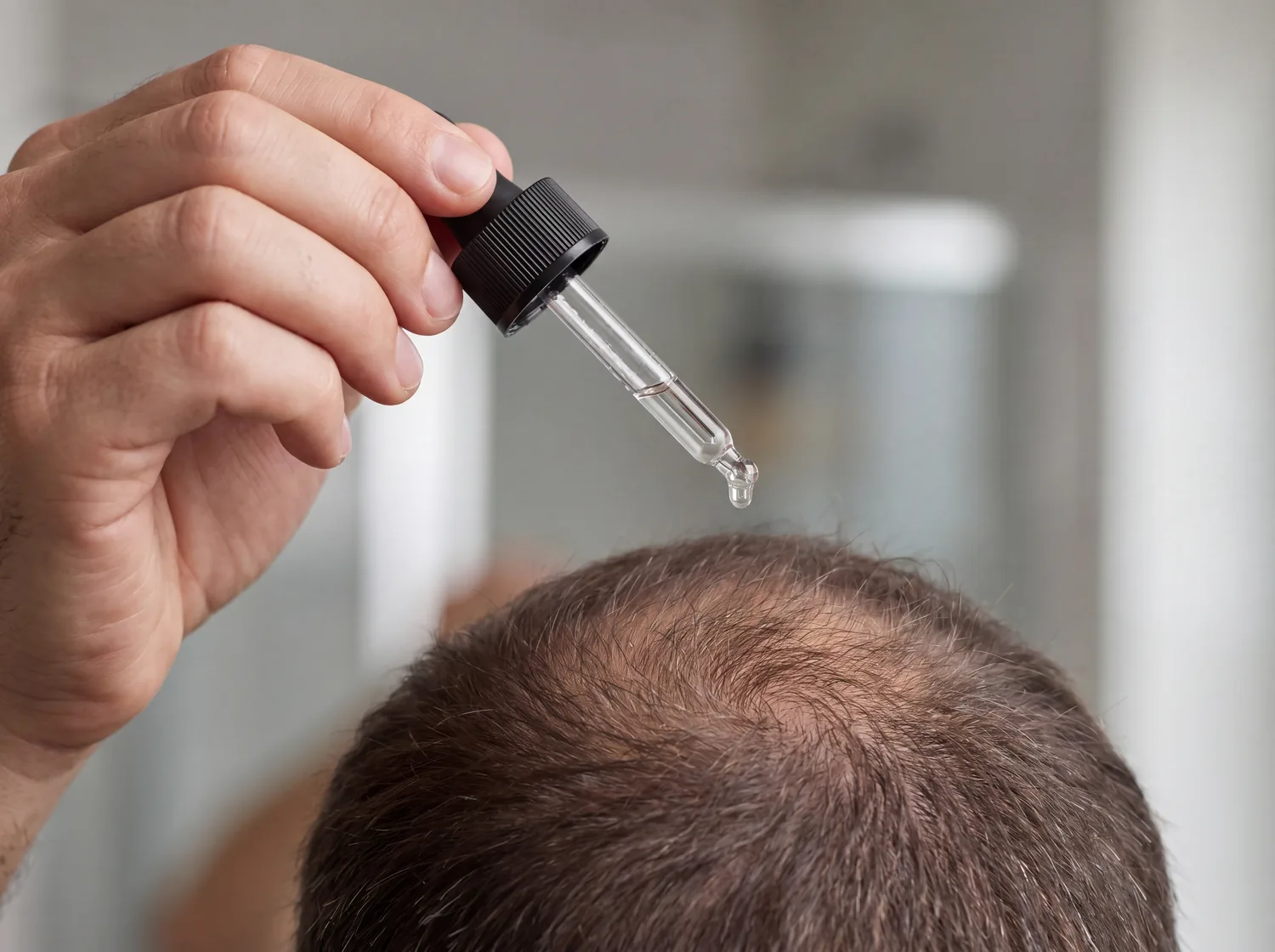
Minoxidil is one of the most studied medications in dermatology and the only topical agent with FDA approval for androgenetic alopecia in both men and women. It has been in clinical use for hair loss since 1988, and over the past decade physicians have also begun prescribing it as a low-dose oral tablet for patients who don't tolerate or don't respond to the topical form. This guide explains what minoxidil is, how it works on the hair follicle, the differences between formulations, who tends to be a candidate, and what current evidence suggests about realistic outcomes.
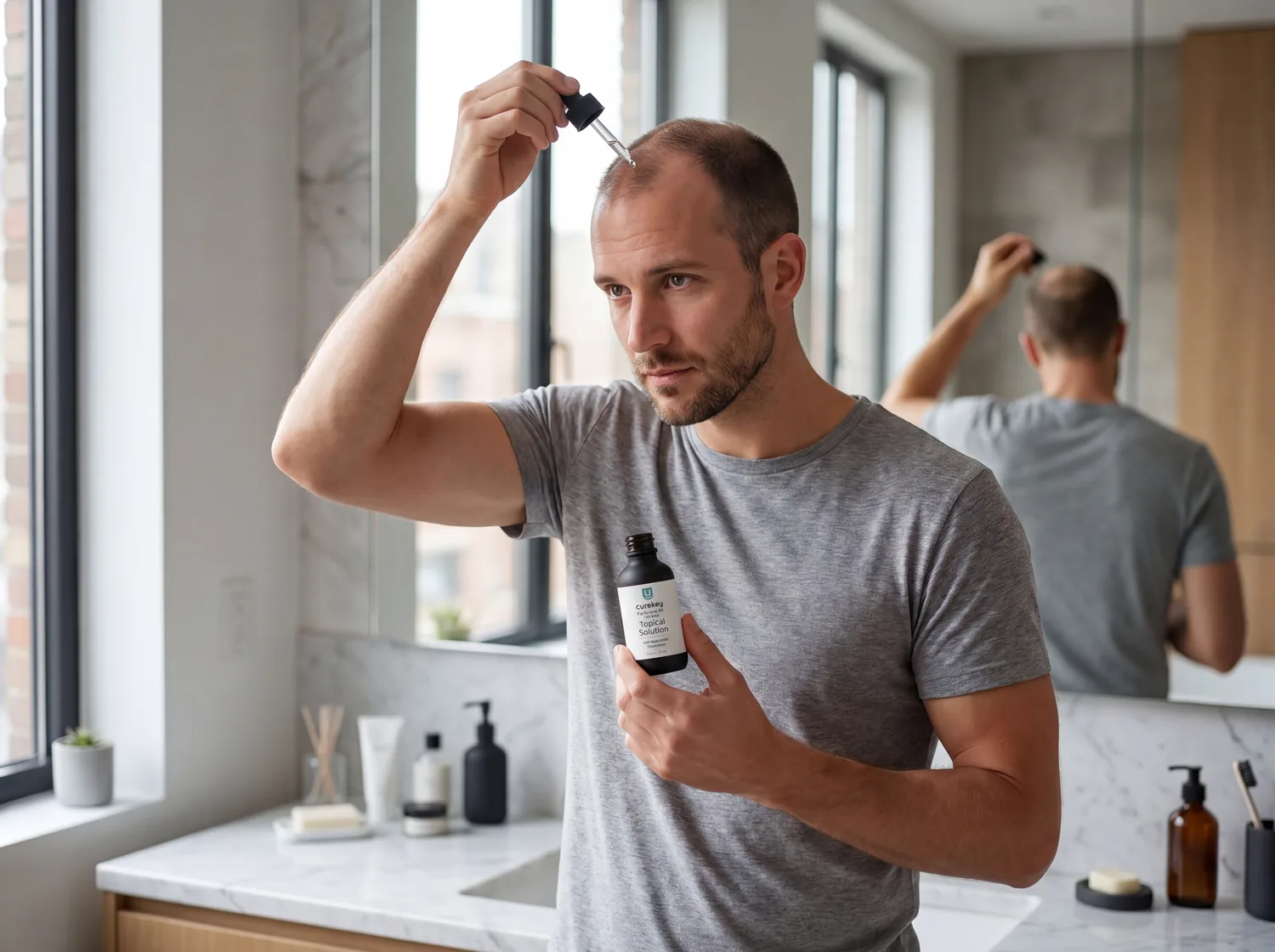
What minoxidil is
Minoxidil was originally developed in the 1970s as an oral antihypertensive medication. Researchers and patients noticed an unexpected side effect: increased body and scalp hair growth in people taking it for blood pressure. That observation led to the development of a topical formulation specifically for scalp use, which was approved by the FDA at 2% concentration in 1988 and at 5% concentration in 1997, reaching over-the-counter sale in 1998. Today, topical minoxidil is available without a prescription in the United States, while oral minoxidil for hair loss is prescribed off-label by physicians at much lower doses than were historically used for hypertension.
The medication does not act on the hormonal pathway that drives most pattern hair loss. Instead, it works directly on the follicle and surrounding scalp environment, which makes it complementary to medications like finasteride or dutasteride that block dihydrotestosterone (DHT). For many patients with pattern hair loss, the standard of care involves both classes of medication used together, since they address different parts of the same underlying biology.
How minoxidil works on the hair follicle
The exact mechanism of minoxidil on hair growth is still being clarified, but several effects are well documented. Minoxidil is a vasodilator: it widens small blood vessels and increases local blood flow. In the scalp, this is thought to improve oxygen and nutrient delivery to the follicle, though vasodilation alone does not appear to be sufficient to explain the regrowth seen in clinical studies.
More importantly, minoxidil shortens the resting (telogen) phase of the hair cycle and extends the active growth (anagen) phase. Follicles that had been spending more of their time in telogen, which is a hallmark of follicle miniaturization, are pushed back into anagen and produce thicker, longer hairs over successive cycles. Minoxidil also appears to increase the diameter of individual hair shafts, so even hairs that don't visibly multiply often become more substantial over months of consistent use.
At the molecular level, minoxidil is converted in the scalp by the enzyme sulfotransferase into its active form, minoxidil sulfate. Variation in sulfotransferase activity from person to person may help explain why some patients respond strongly to topical minoxidil while others see modest benefit. Researchers are exploring whether sulfotransferase testing could one day predict responders, though this is not yet routine in clinical practice.
Because the topical form has to cross the skin barrier to reach the follicle, anything that improves absorption may improve the response. That is the reasoning behind pairing topical minoxidil with microneedling, where a derma roller creates temporary micro-channels in the scalp before the medication is applied. Small randomized trials suggest the combination may outperform topical minoxidil used alone, and it is the adjunct with the strongest supporting evidence for patients already using the topical form.
Topical formulations: solution and foam
Topical minoxidil is available in two main vehicles: a liquid solution and a foam. Both deliver the same active ingredient, but they behave differently on the scalp.
Liquid solution (2% and 5%)
The liquid is applied with a dropper or spray and contains propylene glycol as a carrier. The 2% concentration is generally used for women, while 5% is the standard for men and is also used off-label for women under physician guidance. The solution spreads readily through hair, which can be an advantage for people with thinning hair across a broad area, but propylene glycol causes scalp irritation, itching, or flaking in a meaningful minority of users.
Foam (5%)
The foam was developed in part to address propylene glycol intolerance. It contains no propylene glycol and tends to be better tolerated on sensitive scalps. It dries faster than the liquid and is less likely to drip onto the forehead or pillow. For some users with very fine or very dense hair, the foam can be slightly harder to work down to the scalp surface, which is the layer where it needs to absorb to be effective.
A detailed comparison of the two vehicles is covered in our article on minoxidil foam vs. liquid.
Oral low-dose minoxidil
Oral minoxidil at low doses, typically 1 to 5 mg daily, has emerged in the last several years as an option for patients who can't tolerate topical application, find the daily routine impractical, or haven't responded adequately to topical therapy. It is not FDA-approved for hair loss; physicians who prescribe it are using it off-label, which is a legal and accepted practice when supported by clinical evidence.
Recent randomized data suggest that low-dose oral minoxidil produces results comparable to 5% topical minoxidil for many patients with pattern hair loss. Because it is systemic, oral minoxidil reaches the follicle through the bloodstream rather than through the skin, which can be helpful for patients with poor topical absorption.
The trade-offs are different. Oral minoxidil can cause increased body hair (hypertrichosis), mild fluid retention, and in some patients changes in heart rate or blood pressure. For these reasons, physicians prescribing it generally check baseline blood pressure and may monitor periodically, particularly in patients with cardiovascular risk factors. Our deeper comparison is at oral vs. topical minoxidil, and the topical vs. oral minoxidil guide covers additional clinical context.
Who minoxidil is typically prescribed for
Minoxidil is most commonly used for androgenetic alopecia in men and women. It is also used off-label for telogen effluvium, traction alopecia, and as a supportive medication after hair transplantation, though evidence in those settings is more limited.
Within androgenetic alopecia, minoxidil tends to perform best in patients with:
- Earlier-stage thinning rather than advanced baldness
- Crown or vertex involvement (the area where clinical trials measured most carefully)
- Intact, miniaturized follicles still capable of producing some hair
- Realistic expectations about timeline (response is typically measured at 6 to 12 months, not weeks)
Patients with very advanced loss, where follicles have been dormant for years and may have become fibrotic, generally see less benefit. Minoxidil cannot regenerate follicles that no longer exist, which is why earlier intervention tends to produce stronger results. The article on minoxidil for the crown covers vertex response in more depth.
What the evidence base looks like
Topical minoxidil has been studied in dozens of randomized controlled trials over more than three decades. Across those studies, roughly 40 to 60 percent of users see visible improvement after 6 to 12 months of consistent twice-daily use, with another portion seeing stabilization without further loss. Outcomes vary based on the duration of hair loss, age at treatment initiation, and individual biological factors including sulfotransferase activity.
Compared with finasteride, minoxidil tends to work somewhat better at the crown and somewhat less well at the hairline, and the two medications have additive effects when used together. Compared with dutasteride, the comparison is between different mechanisms entirely, and dutasteride is generally reserved for cases where finasteride has not been sufficient.
Common questions about starting minoxidil
Will I shed when I start?
Yes, often. The shedding phase is a recognized and expected part of starting minoxidil. It happens because the medication pushes resting follicles back into the growth phase, and the old hair shafts have to fall out to make room for new ones. This is covered in detail in our minoxidil shedding article and in the broader guide why hair sheds when you start treatment.
How long until I see results?
Visible results from minoxidil typically take 4 to 6 months to begin appearing and 12 months to evaluate fully. The first 8 to 12 weeks may include the shedding phase, during which it can look like the medication is making things worse. Our guide on the first 6 months of treatment walks through the typical timeline.
What happens if I stop?
Minoxidil works only while it is being used. Stopping the medication generally leads to a return of baseline hair loss over 3 to 6 months, since the follicles revert to their previous cycling pattern. The article on what happens if you stop treatment covers this in detail.
Are side effects common?
Topical side effects, when they occur, are usually local: scalp itching, flaking, dryness, or rarely contact dermatitis to the propylene glycol vehicle. Switching from solution to foam often resolves these. Systemic side effects from topical use are uncommon. Oral minoxidil has a different side-effect profile, summarized in our guide on minoxidil side effects.
Considering medical assessment
Minoxidil is widely used, but the decision to start is still a medical one. A clinician can confirm the diagnosis of pattern hair loss, rule out other causes such as iron deficiency, thyroid dysfunction, or telogen effluvium, and recommend whether topical, oral, or combination therapy makes sense. They can also flag medical conditions that influence the choice between formulations, particularly cardiovascular history when oral minoxidil is being considered.
Treatment for pattern hair loss is generally most effective when started early, before significant follicle loss has occurred. If you're noticing thinning at the crown, hairline, or in a diffuse pattern across the top of the scalp, a clinical evaluation can help you understand where you are in the process and what realistic options look like for your specific situation. Curekey's how it works page describes the consultation process in more detail.
Related reading
- How minoxidil treats hair loss
- Topical vs. oral minoxidil
- Minoxidil foam vs. liquid
- Minoxidil shedding
- Minoxidil for the crown
- Oral vs. topical minoxidil
- Minoxidil vs. finasteride
- Microneedling and derma rollers for hair loss
- Hair loss overview
- How Curekey works
Key references
- Olsen EA et al. J Am Acad Dermatol, 2002. A randomized clinical trial of 5% topical minoxidil versus 2%.
- Vañó-Galván S et al. J Am Acad Dermatol, 2021. Safety of low-dose oral minoxidil for hair loss: a multicenter study.
- Randolph M, Tosti A. J Am Acad Dermatol, 2021. Oral minoxidil treatment for hair loss: a review.