Foam and liquid minoxidil work about equally well. Both deliver the same active ingredient at the same 5% concentration, and head-to-head studies find comparable regrowth at the crown and across thinning areas of the scalp. The real difference is the vehicle, the inactive base that carries the medication into the skin: the foam is formulated without propylene glycol, so it irritates less and dries within seconds, while the liquid solution spreads more precisely from a dropper. That is why the choice usually comes down to scalp tolerability and daily routine rather than whether the medication will work. The sections below break down how the two compare on absorption, irritation, ease of use, and which formulation tends to suit which type of user.
The short answer: is foam or liquid better?
For most people neither vehicle is clearly "better," because the two deliver the same drug at clinically comparable levels when each is rubbed into the scalp. The practical difference is tolerability and routine. The 5% foam tends to be gentler because it is formulated without propylene glycol, so it causes less scalp itching and flaking and dries within seconds. The 5% liquid (also called the solution) spreads more precisely from a dropper, which can suit very dense or oily hair and diffuse thinning across the whole top of the scalp. If you have had irritation before or want a fast-drying option, the foam is often a reasonable starting point. If precision across many thinning zones matters more, the liquid solution may fit better.
At a glance:
| Factor | 5% foam | 5% liquid solution |
|---|---|---|
| Scalp irritation | Lower (no propylene glycol) | Higher in propylene-glycol-sensitive users |
| Drying time | Seconds to a minute | Roughly 5 to 15 minutes |
| Dripping / pillow transfer | Minimal | More likely if over-applied |
| Precision on diffuse thinning | Good with deliberate technique | Easier with a dropper |
| Effective drug delivery | Comparable when worked into the scalp | Comparable when worked into the scalp |
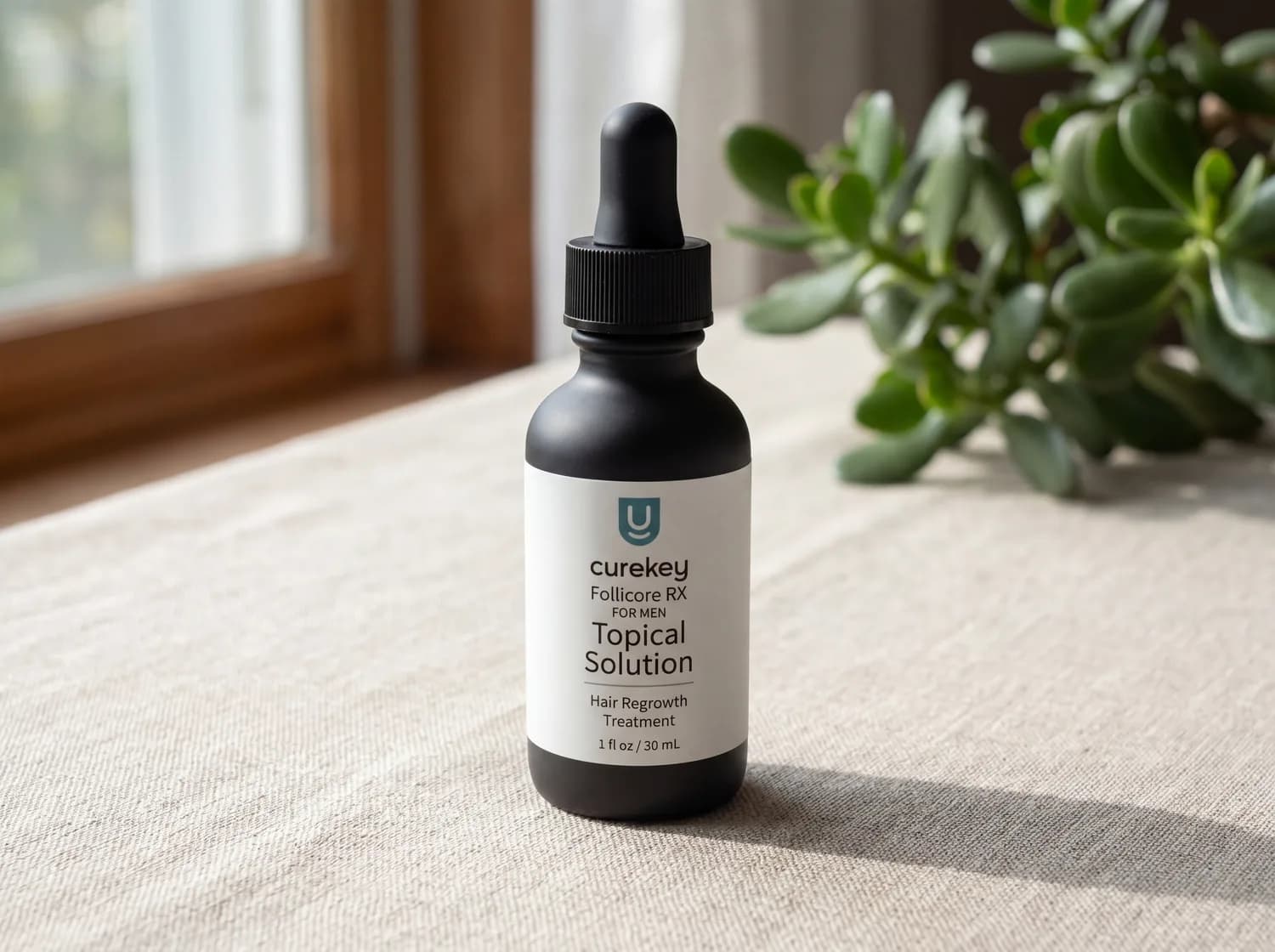
The sections below walk through how the two formulations compare across each of these dimensions, and how physicians typically guide patients toward one or the other.
What's actually different between foam and liquid
The active ingredient, minoxidil, is identical in both products. The difference is entirely in the inactive carrier system.
Liquid solution
The 5% liquid solution is a clear, alcohol-based formulation that contains propylene glycol as one of its main carriers. Propylene glycol helps minoxidil dissolve, distribute evenly, and absorb through the stratum corneum (the outer layer of the skin) into the deeper scalp where the follicle resides. It's a workhorse pharmaceutical excipient used in many topical products. The trade-off is that propylene glycol is one of the more common causes of scalp irritation in long-term minoxidil users.
Foam
The 5% foam was developed in part to provide a propylene-glycol-free alternative. It uses a different vehicle system: a mixture of alcohol, water, and butane-based propellants that allow the product to expand into a foam at room temperature. Because the propellants evaporate quickly, the foam dries much faster than the liquid and leaves less residue. The absence of propylene glycol means a substantially lower rate of contact dermatitis and scalp itching for users who are sensitive to it.
Both formulations are FDA-approved for androgenetic alopecia at the 5% concentration in men, and the foam is also approved for women at the 5% concentration applied once daily.
Absorption and effective delivery
A common assumption is that one formulation must absorb better than the other. The clinical evidence does not support that assumption strongly in either direction.
Studies that have measured percutaneous (through-the-skin) absorption of minoxidil from both vehicles find that the amount of drug reaching the deeper scalp is broadly similar between the two when applied correctly. The propylene glycol in the liquid is an effective penetration enhancer, but the foam's alcohol base also delivers the drug through the stratum corneum at clinically meaningful levels. In head-to-head efficacy studies, hair counts and patient-rated improvement after several months of use have been comparable.
There is one technique-related caveat. Foam can be slightly less effective if it's applied to the hair rather than worked down to the scalp surface. Because the foam dries quickly, users who apply it to the surface of dense or oily hair may inadvertently leave more of the drug on the hair shaft than on the skin, where it needs to be absorbed. Liquid, especially when applied with a dropper, tends to reach the scalp more directly because of its lower viscosity. For users with very dense hair, this is one reason a clinician may recommend the liquid.
Scalp irritation and tolerability
Tolerability is where the foam and liquid diverge most clearly.
Itching, flaking, and dermatitis on the liquid
The liquid solution's propylene glycol content causes irritation in a clinically meaningful subset of users. Surveys and clinical studies have reported scalp itching, dryness, flaking, or redness in roughly 7 to 15 percent of users on the 5% liquid, with severity ranging from mild and self-limited to a frank contact dermatitis that requires stopping the medication. People with eczema-prone skin or a history of sensitivity to skincare ingredients tend to be at higher risk.
The flaking that develops on the liquid can sometimes be confused with seborrheic dermatitis or dandruff, since the appearance overlaps. A clinician can usually distinguish between minoxidil-induced irritant dermatitis and an unrelated scalp condition, and a switch to foam (or a temporary break) often clarifies which one is responsible.
Foam tolerability
The foam's irritation rate is meaningfully lower in head-to-head comparisons. For users who have developed propylene glycol intolerance on the liquid, switching to the foam often allows continued treatment without symptoms. For users without propylene glycol sensitivity, both vehicles tend to be well tolerated, and the choice can be made on practical grounds.
A small number of users will react to the foam's other ingredients, particularly the alcohols, but this is uncommon.
Is foam less irritating than liquid? What the evidence shows
Yes, for most people the foam is less irritating, and the reason is propylene glycol rather than the minoxidil itself. When dermatologists patch-tested patients who developed itching, redness, or scaling on the liquid solution, propylene glycol was the actual contactant in the majority of cases, not the active drug (Friedman et al., J Am Acad Dermatol, 2002). Because the 5% foam is formulated without propylene glycol, it removes the ingredient most responsible for minoxidil-related scalp reactions. This is why a clinician will often move a patient who flared on the liquid straight to the foam: the active ingredient and concentration stay the same, and only the irritating carrier is dropped. It also explains a common point of confusion, that a "minoxidil allergy" is frequently a propylene glycol sensitivity, so the same person can usually keep treating with the propylene-glycol-free foam without symptoms.
Ease of daily application
Topical minoxidil only works if it's used consistently, so practical factors that affect adherence matter as much as pharmacology.
How fast each one dries
Foam dries within seconds to a minute or two after being worked into the scalp. The liquid takes considerably longer, often 5 to 15 minutes depending on how much was applied and the humidity in the room. Users who apply minoxidil before getting dressed, putting on a hat, or going to bed often find the foam less disruptive to their morning or evening routine.
Drips and pillow staining
The liquid is more prone to dripping if too much is applied or if the user lies down too soon after application. It can transfer to pillowcases, foreheads, and ears, which is a hygiene and dosing concern. The foam is much less prone to drips.
Spreading evenly across thinning areas
This is one place the liquid has an edge. For users with diffuse thinning across the entire top of the scalp, the dropper makes it easier to deposit small amounts of medication at multiple points and rub it through. The foam can cover the same area, but it requires a slightly more deliberate technique to ensure the medication reaches the scalp at every spot rather than collecting on the hair.
Once-daily vs. twice-daily
The 5% foam in women has FDA approval for once-daily use, while the 5% liquid in men is labeled for twice-daily application. Many physicians prescribe once-daily 5% foam for men off-label as a compliance compromise, though clinical response is generally somewhat stronger with twice-daily dosing in trials. This is worth discussing with the prescribing clinician.
Cost and availability
Both formulations are available without a prescription in the United States, and generic versions of each are widely sold. Cost differences are usually modest. Foam is sometimes priced slightly higher per month than liquid, but generic competition has narrowed the gap. For patients using minoxidil through a telehealth program, both formulations are typically available, and the choice is made on clinical fit rather than cost.
Storage and travel are similar between the two. Both should be kept at room temperature and away from direct heat. The foam's pressurized canister is technically a flammable aerosol, which can be relevant for air travel rules, but standard travel-size minoxidil products comply with carry-on regulations.
Who tends to do better with each
Based on clinical experience and the trade-offs above, certain patterns tend to emerge:
Foam may be a better fit if you:
- Have had scalp itching, flaking, or contact dermatitis on the liquid
- Have eczema-prone or sensitive skin
- Need a fast-drying option for morning routines
- Are concerned about pillow transfer at night
- Find liquid drips or runs uncomfortable
Liquid may be a better fit if you:
- Have very dense or oily hair where foam tends to sit on the surface
- Prefer the precision of dropper application across multiple thinning zones
- Have not had any irritation on previous propylene-glycol-containing products
- Are using a once-nightly application schedule and don't mind a longer drying time
- Have a clinician's preference based on your specific scalp findings
For users who have not started either, the foam is often a reasonable default because the irritation profile is gentler and the drying time fits more easily into daily routines. If response is inadequate after 6 to 12 months on the foam, switching vehicles is one of several adjustments a clinician might consider, alongside adding oral minoxidil or a DHT blocker like finasteride.
What to expect either way
Whichever vehicle you start with, the underlying biology is the same. Both formulations cause the shedding phase early in treatment, both take 4 to 6 months to begin showing visible improvement, and both work only as long as you keep using them. The decision between foam and liquid is about fit, not about whether the medication will work. The article on how minoxidil treats hair loss covers the underlying mechanism in more depth.
Considering medical assessment
If you've tried one vehicle and run into problems with tolerability or response, a clinician can help interpret what's happening and suggest a structured next step. They can also rule out unrelated scalp conditions that mimic minoxidil irritation, evaluate whether the diagnosis is consistent with pattern hair loss, and discuss whether oral minoxidil or combination therapy makes sense for your situation. Curekey's evaluation process, described on our how it works page, includes a review of medication tolerability and a clinician-guided plan.
Related reading
- Oral vs. topical minoxidil
- Minoxidil shedding
- Minoxidil for the crown
- How minoxidil treats hair loss
- Minoxidil vs. finasteride
- Common minoxidil side effects
- Minoxidil overview
Key references
- Olsen EA et al. J Am Acad Dermatol, 2002. A randomized clinical trial of 5% topical minoxidil versus 2%.
- Friedman ES et al. J Am Acad Dermatol, 2002. Allergic contact dermatitis to topical minoxidil solution: etiology and treatment.
- Vañó-Galván S et al. J Am Acad Dermatol, 2021. Safety of low-dose oral minoxidil for hair loss: a multicenter study.
- Randolph M, Tosti A. J Am Acad Dermatol, 2021. Oral minoxidil treatment for hair loss: a review.