How can we help?
Answers to the questions patients ask most, from applying your treatment to billing and delivery. Tap a question to see the answer.

Using my treatment
Applying it, the dermaroller, timelines and results.
How do I use the dermaroller Curekey sent me?
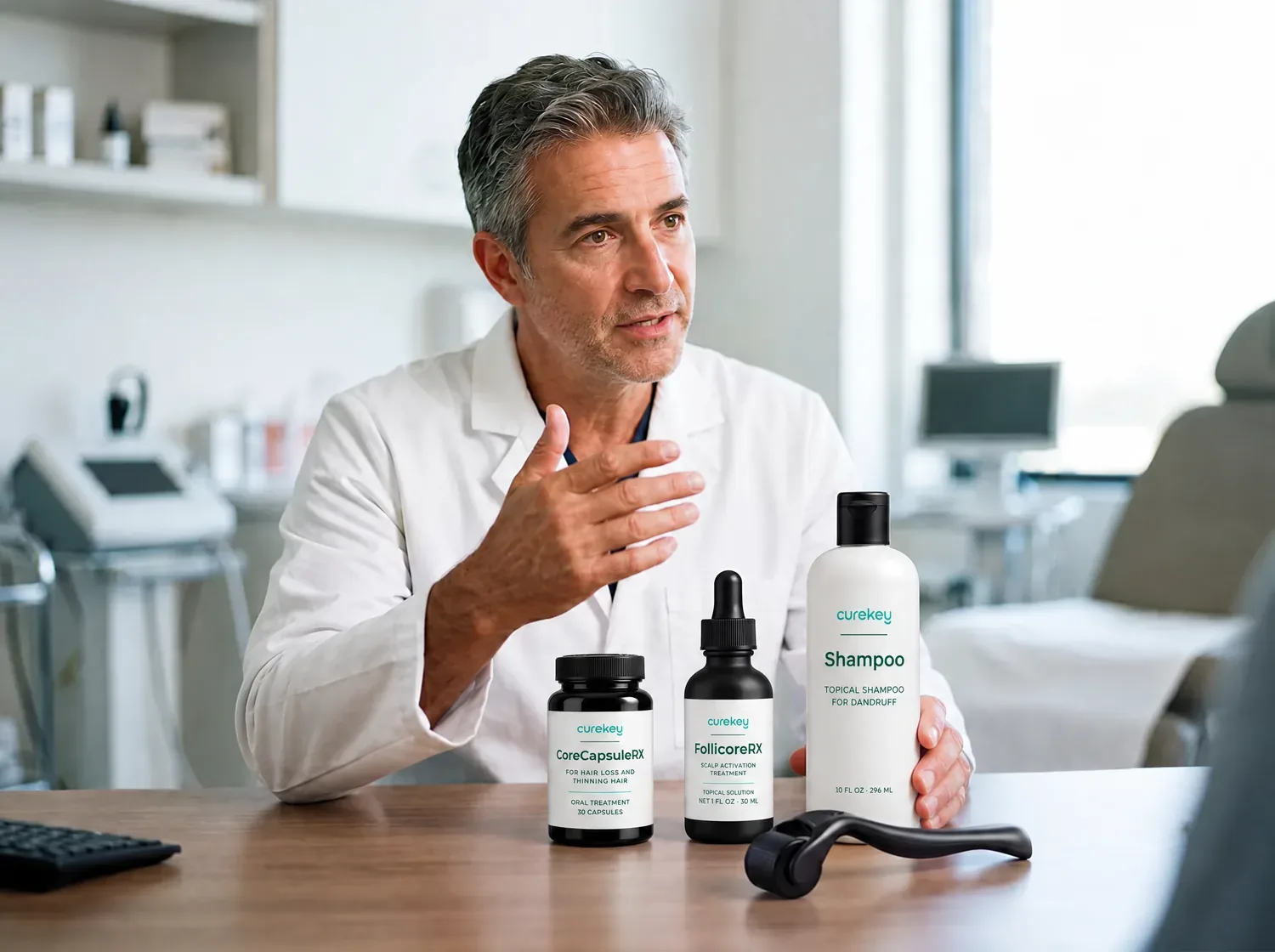
Curekey ships a 0.25 mm dermaroller with your topical treatment as an adjunct to the medication. Disinfect the roller head in 70% isopropyl alcohol for 5 to 10 minutes before use and let it air dry. On a clean, dry scalp, roll gently over thinning areas: 6 to 8 passes vertical, 6 to 8 horizontal, and 6 to 8 in each diagonal direction, lifting between passes. With the 0.25 mm roller, you may apply your topical medication immediately after dermarolling. If your scalp is sensitive or you notice significant irritation, wait 1 to 2 hours before applying. Use the dermaroller 1 to 2 times per week; on the other days, continue your usual once-daily topical application. Full step-by-step guidance is in our dermaroller how-to guide.
How often should I use my dermaroller?
Use the 0.25 mm dermaroller Curekey ships with your treatment 1 to 2 times per week. On the days you dermaroll, you can apply your topical medication immediately after; if your scalp is sensitive or feels irritated, wait 1 to 2 hours before applying. On the other days of the week, continue your usual once-daily topical application. A once-weekly morning dermarolling session followed by the topical that evening is also medically reasonable, but is more conservative than necessary for a 0.25 mm needle depth.
How much topical should I apply per dose?
The prescribed dose is 1 ml per application, once daily. On your dropper, 1 ml equals approximately 22 drops, and most droppers also have a volume marking on the side. Use whichever measurement your dropper shows: draw up to the 1 ml line, or count out roughly 22 drops. Apply the full dose across the entire top of the scalp, spreading it evenly from the hairline through the crown. Using more than the prescribed dose does not improve results and can waste medication.
Where on my scalp should I apply my topical?
Apply the full prescribed dose directly to the scalp, spreading it evenly across the entire top of the head, from the hairline through the crown. Do not concentrate the dose only on visibly thinning spots. Even application treats the areas of visible thinning while also supporting maintenance across the areas commonly affected by pattern hair loss, which often continues to progress beyond the spots you can currently see.
Should I apply my topical on wet or dry hair?
Apply the topical to a completely dry scalp and dry hair. Applying an active topical spray or solution to wet or damp hair dilutes the product and causes it to run off the skin rather than absorb into the hair follicles. If you have just showered, towel-dry thoroughly and give your scalp several minutes to fully dry before applying the medication.
Should I apply my topical in the morning or at night?
Both work. Applying at night on a clean, dry scalp gives the medication plenty of time to absorb overnight and reduces sun exposure risk from the tretinoin in the formula. If you apply in the morning, wait until the topical is fully dry before styling your hair or leaving the house, and use sun precautions (SPF on exposed scalp, a hat, or shade). Consistency at the same time each day matters more than which time you pick.
How long should I wait to wash my hair after applying my topical?
Wait at least three hours before washing your hair after applying the topical. This lets the medication absorb into the scalp. Most absorption happens within 4 to 8 hours of application, so an evening application followed by a shower the next morning is well within the safe window. If you sweat heavily during a workout, most residual medication will already be gone by the time you shower, so a post-workout wash is fine.
Can I wear a hat while using my topical?
Yes, but wait until the topical is completely dry, which usually takes 1 to 4 hours. Wearing a hat too soon can cause the fabric to absorb the medication, reducing its effectiveness and potentially staining the hat. Once the topical is dry, a hat is fine and will not affect the treatment.
Is it safe to go in the sun after applying my topical?
The FollicoreRX topical contains tretinoin, which makes the scalp more susceptible to sunburn and UV damage. Sunlight also degrades tretinoin, reducing its effectiveness. Applying at night avoids this entirely. If you apply in the morning, protect the scalp with SPF on any exposed area, a hat, or by staying in the shade during peak UV hours.
Is my topical treatment safe around pets?
The topical can be toxic if it comes into contact with cats and dogs, so keep pets away from your scalp during and after application. Wash your hands thoroughly after applying, and avoid letting pets lick or rub against your head, especially before the medication has fully absorbed and dried. If a pet does come into contact with the medication, contact your veterinarian.
How does Curekey hair loss treatment work over time?
Hair loss treatment generally follows a phased timeline. In the first several weeks some patients experience temporary shedding as the hair growth cycle resets. Over the following months, hair loss may stabilize. Visible improvement, when it occurs, is typically seen between 3 and 6 months of consistent use, with optimal results often visible by 6 to 12 months. Timelines and outcomes vary between individuals.
Is shedding normal during hair loss treatment?
Not all patients experience shedding, but it is a recognized response to hair loss treatment in some cases. When it occurs, shedding usually begins within the first 4 to 8 weeks of starting medication and reflects the hair growth cycle resetting. Hairs in the resting phase are pushed out earlier than they would have been and are later replaced by new growth. The shedding period typically resolves within a few weeks. Persistent shedding beyond 3 months should be discussed with the prescribing physician.
What happens if I miss a dose or application?
Missing an occasional dose or application is not a problem. Resume your treatment as soon as you remember and continue your regular schedule. Do not double up to compensate. Consistency over weeks and months matters more than perfect daily adherence; sustained use is what allows treatment to take effect.
What happens if I stop treatment?
Hair loss treatments are effective only while they are used. If treatment is discontinued, hair loss typically resumes within a few months and any benefits accumulated during treatment are gradually lost over the following 6 to 12 months. Pattern hair loss is a chronic condition, so most physicians recommend ongoing use as part of a long-term plan.
What is Peptide Boost?
Peptide Boost is a pharmacy-grade topical containing GHK-Cu, a copper peptide, at 2%. It is prescribed only after a licensed physician reviews your case, as a supportive addition to a hair loss treatment plan rather than a replacement for core treatments such as minoxidil or finasteride. Evidence for copper peptides is still limited to small studies, so results vary.
Can I use Peptide Boost with FollicoreRX?
Yes, when your physician prescribes both. Peptide Boost is designed as an add-on to a core treatment such as FollicoreRX. Many patients apply the two at different times of day, for example one in the morning and one at night. Follow the directions on your prescription and message your care team if you have questions.
What if my treatment is not effective?
Response to treatment varies between individuals. Some patients experience visible improvement, others mainly achieve stabilization, and the primary goal is to slow or stop further hair loss rather than guarantee regrowth. If you don't see meaningful change after 6 months of consistent use, contact Curekey to message your physician for a follow-up review.
Does Curekey guarantee results?
No medical treatment can guarantee results. Curekey provides access to clinically recognized treatments, prescribed after physician review, but individual outcomes vary. Results depend on factors such as the stage of hair loss when treatment begins, consistency of use, and individual biology.
Who is Curekey suitable for?
Curekey is designed for adult men in the United States experiencing androgenetic hair loss who are seeking a medically supervised telehealth solution. It may not be appropriate for all types of hair loss or for individuals with certain medical conditions; suitability is assessed during the medical questionnaire and physician review.
Orders and billing
Shipping, your subscription, cancelling and your data.
How is my treatment shipped?
Treatments are shipped from licensed U.S. pharmacies in standard packaging. Shipping is included with most subscription plans and is initiated once the prescription has been approved and processed.
How long does shipping take?
Once a prescription is approved and processed, shipments typically arrive within 5 to 10 business days. Delivery times vary by location and carrier. Tracking information is sent by email once the order is dispatched.
Is the packaging discreet?
Yes. Packages are shipped in plain, unbranded outer packaging. There is no medical or product identification visible from the outside.
Do you ship outside the United States?
Curekey currently ships only within the United States. International shipping is not available.
Is Curekey a subscription service?
Yes. Curekey operates on a subscription model to support continuity of care and ongoing treatment delivery. There is no minimum commitment and patients may cancel at any time.
When am I charged?
Patients are charged only if a physician approves the prescription. Subscription renewals occur according to the selected treatment plan.
How long is my prescription valid? Can I get refills?
Prescriptions are typically valid for up to 12 months, depending on the medication and state regulations. As long as your subscription is active and the physician determines treatment remains appropriate, refills are issued and shipped on the schedule of your selected plan. The reviewing physician may request a follow-up before issuing additional refills if your medical situation changes.
Can I pause my subscription instead of canceling?
Yes. You can pause your subscription through your patient portal or by contacting Curekey support. Pausing temporarily delays future shipments and charges without closing your account.
Can my treatment plan change during my subscription?
Your plan stays as prescribed unless something changes. If you notice side effects, are diagnosed with a new condition or start a new medication, message your care team through the patient portal, and a physician can review whether a different prescription is appropriate.
How can I cancel my Curekey subscription?
Patients can cancel their subscription at any time through the patient portal or by contacting Curekey support at support@curekey.com.
If I cancel my subscription, will I receive another shipment?
If cancellation occurs before the next billing date, no additional shipment will be sent. If an order has already been processed or shipped, that shipment may still be delivered.
Will I be refunded if I cancel?
Canceling stops future charges. Refunds for shipped or processed orders are subject to Curekey's refund policy and applicable regulations. Contact support for specific cases.
Is Curekey HIPAA compliant?
Yes. Curekey handles all personal and medical information in accordance with applicable healthcare privacy regulations, including HIPAA. Medical data is used only for treatment purposes and is not sold or shared for marketing.
Is my medical and personal information secure?
Yes. All personal and medical data is handled securely and confidentially, in accordance with applicable healthcare privacy regulations. Information is never sold or shared for marketing purposes.
Who has access to my medical information?
Your medical information is accessible only to the licensed physicians involved in your care, the licensed pharmacy fulfilling your prescription, and authorized Curekey staff for support and account purposes. It is never sold, traded, or shared for marketing.
How long is my data stored?
Medical records are retained for the period required by applicable healthcare regulations, which varies by state but is typically at least seven years. Account information is retained for as long as your account is active.
Can I delete my account and personal information?
You can request deletion of your account and personal information by contacting Curekey support. Note that medical records may need to be retained for the period required by healthcare regulations, even after an account is closed.
Prescriptions and safety
Physician review, side effects, and oral vs topical.
Do Curekey hair loss treatments require a prescription?
Yes. All prescription treatments offered through Curekey require completion of a medical questionnaire, review by a licensed U.S. physician, and approval before any prescription is issued. Patients are charged only if a prescription is approved.
What happens after I complete the medical questionnaire?
Your responses are reviewed by a licensed U.S. physician. The physician evaluates your medical history, hair loss pattern, and any relevant contraindications. If treatment is medically appropriate, the physician issues a prescription that is fulfilled by a licensed pharmacy. If it isn't appropriate, you'll be informed and not charged.
Can I edit my answers after submitting the questionnaire?
Once submitted, your responses are sent to the reviewing physician. If you realize an answer was incorrect or incomplete, contact Curekey support before treatment is dispatched. After treatment has been prescribed, you can update your medical information through the patient portal so future reviews reflect the most accurate details.
How long does physician review take?
Most reviews are completed within 24 to 48 hours of submission. Cases that require additional information may take longer. You'll receive a notification once the review is complete.
What if my prescription is not approved?
If a physician determines that prescription treatment isn't appropriate for your case, you will not be charged. The physician may recommend alternatives, such as in-person dermatology consultation, depending on the specific findings.
Are there side effects associated with hair loss treatments?
Like all medications, hair loss treatments may cause side effects, although most patients tolerate them well. Potential side effects depend on the specific treatment and dosage. Reported effects with oral 5-alpha reductase inhibitors include sexual side effects in a small percentage of users; topical minoxidil can cause scalp irritation. The prescribing physician evaluates suitability and risk before issuing a prescription.
What should I do if I experience side effects?
If you experience any side effects, contact Curekey support or the prescribing physician through your patient portal. Many side effects resolve when the medication is adjusted or discontinued. For serious or unexpected reactions, seek medical attention promptly.
Can I take Curekey treatments with other medications?
Most hair loss medications are well tolerated alongside common prescriptions, but interactions can occur. Disclose all current medications, supplements, and medical conditions in your questionnaire. The reviewing physician will assess for relevant interactions before prescribing.
Can I use minoxidil or finasteride bought elsewhere with my Curekey treatment?
Combining medications obtained from different sources is not recommended without physician oversight. Different products can contain different concentrations or formulations, and stacking treatments without medical review can increase the risk of side effects. If you are already using a hair loss product, disclose it during the medical questionnaire so the reviewing physician can plan a coherent regimen.
Are these medications FDA-approved?
Several treatments commonly prescribed through Curekey are FDA-approved for hair loss, including topical minoxidil and oral finasteride. Some treatments, such as low-dose oral minoxidil and dutasteride, are prescribed off-label for hair loss in the United States. Off-label prescribing is a routine and legal medical practice supported by clinical evidence and physician judgment.
Can Curekey treat all types of hair loss?
Curekey focuses primarily on androgenetic alopecia. Certain conditions, such as scarring alopecias or autoimmune forms of hair loss, may not be suitable for treatment through telehealth and require in-person dermatological care. The reviewing physician will indicate if your case is better suited to in-person evaluation.
How does Curekey compare to seeing a dermatologist in person?
A Curekey consultation provides licensed-physician review and prescription for androgenetic alopecia through a telehealth process. In-person dermatology offers physical examination, scalp biopsy when indicated, and is typically preferable for unusual presentations such as patchy loss, scarring, or rapid diffuse shedding. For straightforward pattern hair loss, telehealth is a clinically established option recognized in dermatology guidelines. The reviewing physician will indicate when in-person care is more appropriate.
Who reviews my consultation and prescribes treatment?
All prescriptions are issued by licensed U.S. physicians who independently review your medical questionnaire. Treatments are prescribed only when medically appropriate.
Is Curekey available in all U.S. states?
Curekey operates within the regulatory framework of telehealth, which varies by state. Most U.S. states are supported, but availability of specific treatments may differ. During the medical questionnaire you will indicate your state, and the platform confirms whether Curekey can serve your location.
What is the difference between oral and topical treatments?
Oral treatments work systemically through the bloodstream and often address hair loss at the hormonal level by reducing DHT. Topical treatments are applied directly to the scalp and act locally on hair follicles, with lower systemic exposure. The most appropriate option depends on individual medical factors and is determined by the prescribing physician.
Which hair loss treatment option is better?
There is no universal answer. The most appropriate option depends on hair loss pattern, medical history, and personal preferences. A licensed physician determines the best approach after reviewing the medical questionnaire.
Can oral and topical hair loss treatments be combined?
In some cases, oral and topical treatments may be used together. Combination therapy is supported by clinical evidence for many patients with progressing pattern hair loss, but suitability depends on individual medical factors and is determined by the prescribing physician.
About hair loss
What causes pattern hair loss and whether it can be treated.
What is androgenetic alopecia (male pattern hair loss)?
Androgenetic alopecia, commonly known as male pattern hair loss, is the most common cause of hair loss in men. It is driven by a genetic sensitivity of hair follicles to DHT (dihydrotestosterone), a hormone derived from testosterone. Over time, affected follicles gradually shrink, producing thinner and shorter hairs, and hair growth may slow or stop.
How do I know if I have androgenetic alopecia?
Androgenetic alopecia typically appears as gradual hair loss in a recognizable pattern: receding at the temples, thinning at the crown, or both. Loss usually progresses over years rather than days or weeks. Family history of pattern hair loss is a strong indicator. Sudden, patchy, or accelerated loss may indicate a different condition such as telogen effluvium or alopecia areata, which are not androgenetic and may require in-person dermatology care. A medical questionnaire reviewed by a licensed physician can help confirm the type of hair loss.
What is DHT and how does it cause hair loss?
DHT (dihydrotestosterone) is a hormone produced from testosterone by an enzyme called 5-alpha reductase. In genetically susceptible individuals, DHT binds to receptors in scalp hair follicles and gradually shortens the active growth phase of the hair cycle. Over many cycles, follicles shrink and produce thinner, lighter hairs. Most evidence-based hair loss treatments either reduce DHT activity or support follicle function.
Is hair loss reversible with treatment?
It depends on the stage and type of hair loss. When hair follicles are still active, treatment may help slow or stop further loss and, in some cases, support partial improvement. Long-standing bald areas are less likely to regrow hair. The primary goal of treatment is to slow or stop further hair loss rather than guarantee regrowth. Individual responses vary and results cannot be guaranteed.
Still have a question?
Our care team answers by email, 6am to 5pm PST Monday to Friday and 9am to 5pm PST at weekends.