Minoxidil for the crown has the strongest evidence base of any indication for the medication. The original FDA approval pathway for topical minoxidil was built on randomized trials that measured regrowth at the vertex (the crown of the scalp), and decades of subsequent data have continued to show that the crown is generally where minoxidil produces its most reliable response. If you've noticed thinning emerging at the back-top of your scalp, sometimes appearing as a widening swirl or a visible patch when you bend your head forward, this is the area where minoxidil tends to perform well in clinical practice.
This article explains why the crown responds particularly well to minoxidil, what to expect on a realistic timeline, why the hairline behaves differently, and how to track crown progress accurately over months of treatment.
Why the crown is the FDA-approved labeling target
When topical minoxidil was first developed for hair loss in the 1980s, the pivotal randomized trials that supported its FDA approval focused primarily on the vertex. Two reasons drove that design choice. First, the crown is anatomically easier to photograph and measure consistently across visits. The vertex sits flat on the top-back of the scalp, allowing reproducible top-down photographs and standardized hair counting in a defined target area. Hairline measurement is more variable: it's affected by hairstyling, posture, and small differences in framing.
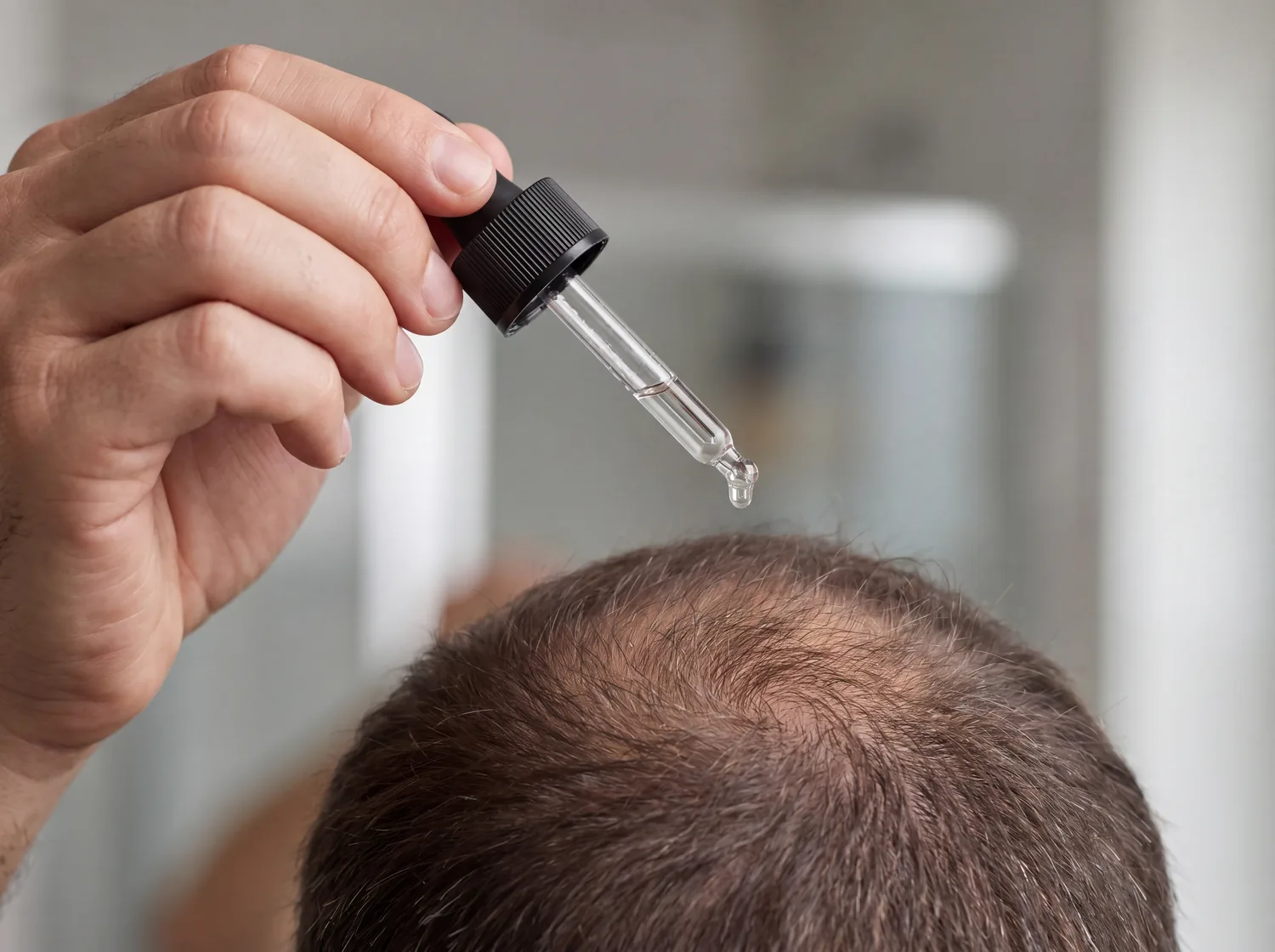
Second, regulatory guidance at the time emphasized the vertex as the primary efficacy endpoint, in part because pattern hair loss progression in men typically begins or becomes most prominent at the crown in many of the Norwood stages. Trials that focused on vertex regrowth had a clearer signal-to-noise ratio than trials that tried to assess hairline change.
The result is that the labeling, the package inserts, and the body of clinical literature for topical minoxidil are heavily weighted toward crown response. This is not a limitation of the drug; minoxidil also works elsewhere on the scalp. It's a feature of how the evidence was generated.
Why crown follicles are particularly receptive to minoxidil
Beyond the regulatory history, there are pharmacological reasons that crown response tends to be strong.
A larger pool of receptive follicles
The crown typically has a high density of follicles that are still alive and cycling but have begun to miniaturize. These miniaturized follicles produce shorter, finer, less-pigmented hairs and spend more of their time in the resting phase. Minoxidil's main mechanism, shortening telogen and extending anagen, is most useful when there are many such follicles available to be pushed back toward a fuller cycling pattern. The article on follicle miniaturization covers this process in more detail.
Surface area for absorption
The crown presents a large, relatively flat surface area where topical medication can be applied evenly and absorbed efficiently. Compared with the hairline, where the drug can run off onto the forehead or be diluted by sweat, the vertex retains topical formulations more effectively. This applies to both foam and liquid minoxidil.
Vascular supply
The vasodilatory effect of minoxidil may matter more in regions of the scalp where local blood flow is a meaningful factor in follicle support. The crown's vascular supply, while not dramatically different from other parts of the scalp, is well-suited to benefit from increased perfusion in early-to-moderate thinning.
Sulfotransferase activity
Minoxidil is converted to its active form, minoxidil sulfate, by sulfotransferase enzymes in the scalp. There is some evidence that sulfotransferase activity varies across scalp regions and across individuals, and that crown tissue tends to show consistent enzymatic conversion in users who respond. Researchers continue to study whether differences in this enzyme explain part of the variability in regional response.
Realistic timelines for crown response
Crown response to minoxidil follows the same broad timeline as other regions of the scalp, but the degree of visible improvement at the crown is often more pronounced.
Months 0 to 3
The first three months are dominated by the shedding phase and the gap before new growth becomes visible. Crown coverage during this period may temporarily look slightly worse than baseline because synchronized telogen exit removes some of the existing thin hairs before the new ones have grown in. This can be discouraging if you don't know it's coming.
Months 3 to 6
By month 4 to 6, new anagen hairs from awakened follicles have grown to a length where they begin to contribute to visible coverage. Crown improvement at this stage is often subtle but measurable on standardized photos. Hair caliber begins to thicken, and the overall density of the vertex begins to increase. This is also when many users first notice a slowing or stopping of further loss.
Months 6 to 12
The 6-to-12-month window is when crown regrowth typically becomes visually obvious. Clinical trial data and clinical experience both show that the most meaningful gains in vertex hair count and density appear during this period. For users who respond well, the swirl pattern at the crown may begin to look denser, the previously visible patch of scalp may close in, and overall coverage at the vertex may approach or in some cases exceed pre-thinning appearance.
Beyond 12 months
After 12 months of consistent use, gains tend to plateau but maintain. Continued treatment is generally needed to keep what's been regrown. Stopping minoxidil leads to a return to baseline cycling over 3 to 6 months, as covered in what happens if you stop treatment.
Why hairline response is more variable
It's worth understanding why response at the hairline differs from response at the crown, since this question comes up frequently.
The hairline involves a different population of follicles. Frontal scalp follicles are more sensitive to dihydrotestosterone (DHT), so DHT-driven miniaturization tends to be deeper and more advanced by the time hairline recession is visible. Once a follicle has been miniaturized for a long time, its capacity to respond to anagen-extending drugs like minoxidil is reduced. The follicle may simply not have enough remaining biological responsiveness for minoxidil's mechanism to produce visible change.
The hairline is also a region where DHT-blocking medications like finasteride tend to perform comparatively better than they do at the crown. This is one reason combination therapy is often used: minoxidil to drive crown regrowth, finasteride to address the DHT-mediated miniaturization that's affecting the hairline and the rest of the scalp. The comparison guide minoxidil vs. finasteride covers this pairing in more depth.
Who tends to respond well at the crown
Crown response to minoxidil tends to be strongest in users who fit a few clinical patterns:
Earlier-stage thinning
Users in the earlier stages of hair loss, where miniaturization at the crown is present but not advanced, generally see the strongest response. The corresponding article on crown thinning specifically walks through what early crown thinning looks like.
Visible follicle activity
If the thinning area still has visible fine, short hairs (sometimes called vellus or intermediate hairs) rather than completely smooth bare scalp, that's a sign of active but underperforming follicles. These follicles are exactly the population minoxidil is best suited to work on.
Recent onset
Users whose crown thinning has progressed over months to a few years tend to respond more reliably than users whose crown has been thin for a decade or more. This is consistent with the biology: long-standing miniaturized follicles can eventually become non-cycling and lose their ability to respond.
Younger age at treatment
Younger patients tend to have more biologically active follicles and respond more strongly to minoxidil. This is not an absolute rule, and many older patients do respond, but the trend is consistent across observational data.
Combination therapy where indicated
Users who combine minoxidil with a DHT-blocking medication often see better crown outcomes than those using minoxidil alone, because the underlying miniaturization driver is being addressed at the same time as the cycling shift.
How to track crown progress with photos
The crown is one of the few regions of the scalp where standardized photography genuinely captures change well, but only with consistent technique.
Photo protocol for the crown
A reproducible protocol typically includes:
- A top-down angle with the chin tucked toward the chest, so the vertex faces directly up at the camera
- The same camera height and distance each time (a phone propped on a consistent shelf works)
- Even, indirect lighting, ideally natural light from a window
- Dry, clean hair, brushed in your typical resting direction with no styling product
- The same time of day, since hair appearance varies with sweat and oil through the day
- Once-monthly cadence on roughly the same date
What to look for over time
Three measures are particularly useful for crown progress:
- Density at the swirl: how visible the underlying scalp is at the natural whorl
- Diameter of the visible scalp patch: any open area of scalp becomes a measurable shape over time
- Hair caliber: even without counting hairs, you can often see whether the existing hairs look fuller or finer compared with prior months
The most common error is comparing one bad-lighting day to another good-lighting day. Standardized monthly photos make the underlying signal visible. Looking at month 1 and month 6 side by side will show change that day-to-day mirror checks would miss.
Considering medical assessment
If your thinning is concentrated at the crown, a clinician can confirm the diagnosis (crown thinning is most often androgenetic alopecia, but other conditions can present similarly), evaluate the stage, and recommend whether topical minoxidil alone, combination therapy, or oral minoxidil is the most appropriate starting point. They can also discuss expected timelines and the relative role of DHT-blocking medications for users whose pattern extends beyond the crown.
Earlier intervention generally produces better crown outcomes, since follicles still in the early stages of miniaturization respond more strongly than follicles that have been thinning for many years. The Curekey how it works page describes the consultation process and the kinds of treatment plans that are typically considered for crown-predominant pattern hair loss.
Related reading
- Crown thinning
- Thinning crown stage
- Follicle miniaturization
- How minoxidil treats hair loss
- Oral vs. topical minoxidil
- Minoxidil overview
- Minoxidil shedding
- Norwood stages
Key references
- Olsen EA et al. J Am Acad Dermatol, 2002. A randomized clinical trial of 5% topical minoxidil versus 2%.
- Vañó-Galván S et al. J Am Acad Dermatol, 2021. Safety of low-dose oral minoxidil for hair loss: a multicenter study.
- Randolph M, Tosti A. J Am Acad Dermatol, 2021. Oral minoxidil treatment for hair loss: a review.