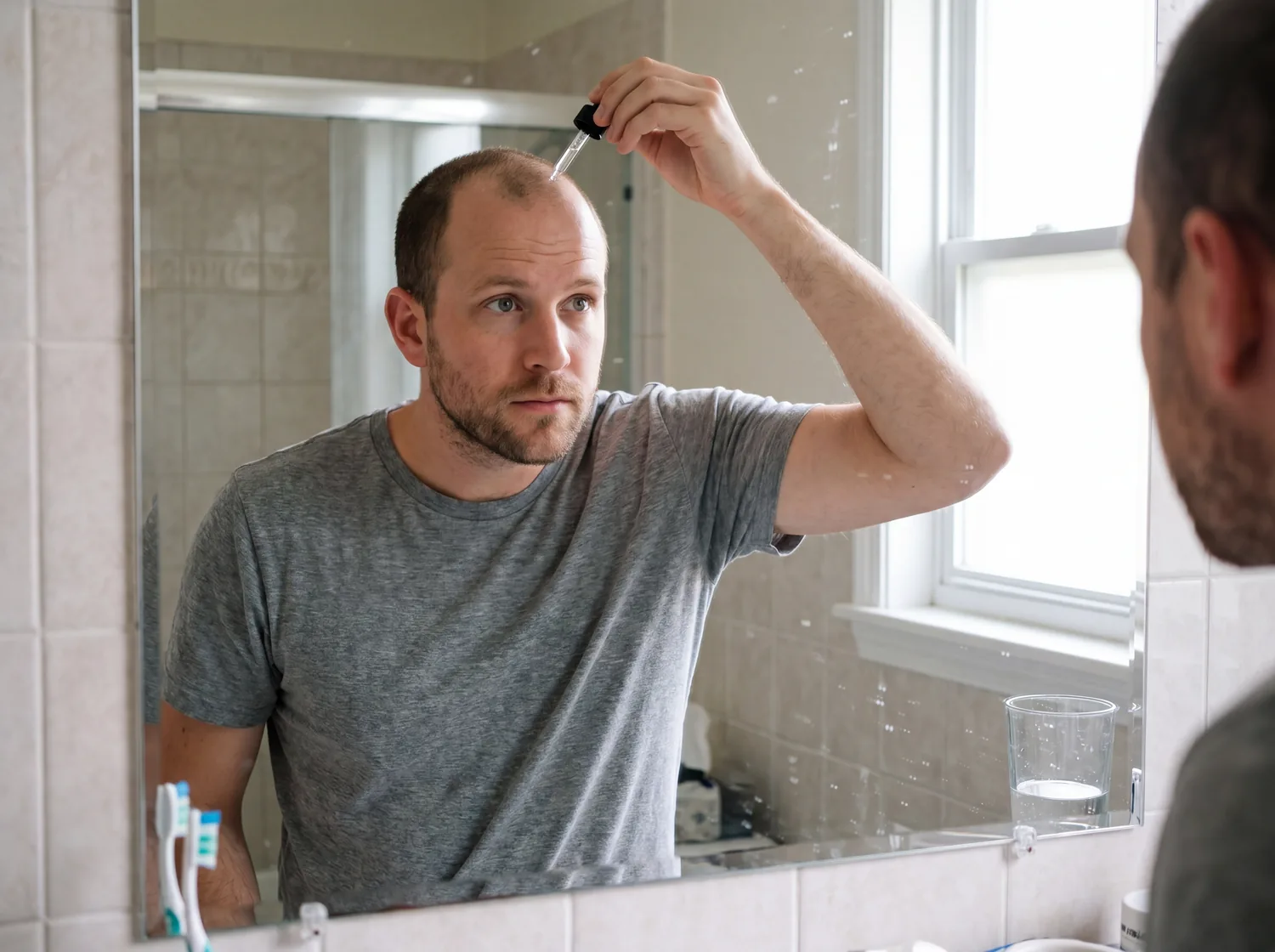

The hairline is usually the first place men notice change. Photos from five years ago suddenly look different. A hat that fit fine now sits a little higher. The temples seem to be moving back.
The question almost everyone asks is the same: is this just my hairline maturing, or am I going bald?
The honest answer is: sometimes one, sometimes the other, sometimes both. This page walks through how to tell the difference, when to act, and what treatments work specifically for the temple area, which is the hardest part of the scalp to regrow once it's lost.
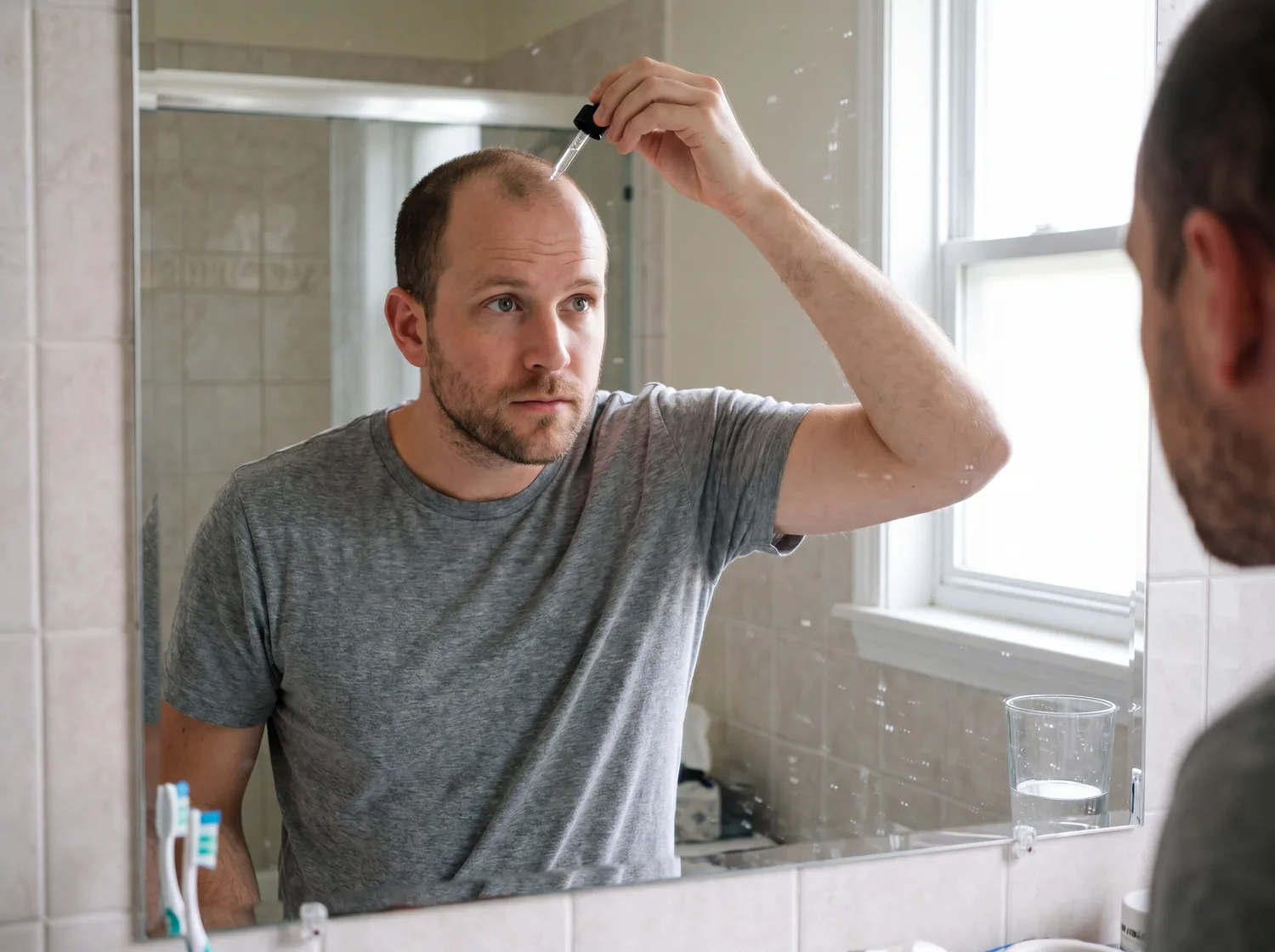
Maturation vs. true recession: the difference
Most men's hairlines pull back a bit between roughly age 17 and 25. The "juvenile" hairline that you had as a kid (low, straight across the forehead, with rounded corners at the temples) settles into the "adult" or "mature" hairline. The mature hairline:
- Sits roughly finger-width above the highest forehead crease when you raise your eyebrows.
- Has slightly receded corners at the temples, often forming a soft "V" or shallow "M" shape.
- Is stable once it's reached.
This maturation is normal. It doesn't progress further. Plenty of men with a mature hairline keep it for the rest of their lives.
True androgenetic recession looks different:
- It continues progressing past the maturation point.
- The temples deepen into a more pronounced "M" or "U" shape.
- Often pairs with thinning at the crown or along the part.
- Hair in the recession zone visibly thins (becomes finer/lighter) before it disappears entirely.
The single best test: photographs over time. A hairline that hasn't moved between Year 1 and Year 3 is mature and stable. A hairline that's continued to recede is undergoing pattern loss.
When recession started: what age tells you
Age at first recession is one of the best predictors of how the rest will play out.
- Recession that starts in your late teens to early 20s and keeps going past age 25: strongly suggestive of androgenetic alopecia (AGA). Likelihood of significant pattern loss over the next decade is high without intervention.
- Recession that occurs in your late teens / early 20s and then stabilizes by 23-25: usually maturation. Doesn't necessarily progress further.
- Recession that starts in your late 30s or later and progresses gradually: AGA, but typically slower-progressing. Treatment can be highly effective.
- Sudden, dramatic recession over months: unusual for AGA. Worth ruling out other causes (telogen effluvium, traction alopecia, alopecia areata).
Family history also informs the read. AGA is highly heritable. Bald fathers, uncles, and grandfathers raise the probability that progressive recession is the start of pattern loss.
What's happening at the follicle (temple-specific)
The temple area is part of the genetically vulnerable zone in androgenetic alopecia. The follicles there have receptors that bind DHT (dihydrotestosterone) readily, and DHT triggers progressive miniaturization of those follicles. Over each hair cycle:
- The active growth phase shortens.
- The hair grows shorter and thinner.
- The follicle itself shrinks.
- Pigmentation often fades.
This is why early-stage recession often shows hair that's still there but becoming finer and lighter. Eventually, the follicles produce only "vellus" (peach-fuzz) hairs that are barely visible, and the area appears bald.
For the deeper biology, see our male pattern baldness page.
Why temples are hard
Most men with pattern hair loss find that their temple recession is the most stubborn area to treat. There are a few reasons:
- The temples often progress first, meaning by the time treatment starts, follicles in that area have been miniaturizing the longest. They're closer to the "no-return" point.
- Density at the temples is naturally lower than at the crown, so a small amount of loss reads visually as a bigger change.
- Topical minoxidil is generally less effective at the hairline than at the crown. Clinical trials consistently show stronger regrowth at the crown than at the frontal area.
This doesn't mean treatment doesn't work for receding hairlines. It does, but expectations should be modest: stopping or slowing further recession is realistic; meaningful regrowth of an established receded hairline is harder, especially in older men.
Treatments that target temple recession
Finasteride (1 mg oral, daily). This is the most effective single treatment for stopping further hairline recession. By blocking DHT systemically, it removes the hormonal driver that's pushing temple follicles into miniaturization. Roughly 90% of men on consistent finasteride see slowed or stopped progression. Some see modest temple regrowth, but the primary value at the hairline is preservation, not reversal.
Dutasteride. A more potent DHT-blocker than finasteride, sometimes used off-label for men whose hairlines continue receding on finasteride. Stronger DHT suppression sometimes helps stubborn frontal/temporal areas.
Minoxidil (topical or oral). Less effective at the temples than at the crown but still helpful, especially as part of a combination plan. Topical 5% applied twice daily to the temple/hairline area can support follicles still producing visible hair. Oral minoxidil at low doses also works systemically.
Microneedling. A 0.5mm to 1.5mm dermaroller used 1-2 times per week may improve absorption of topical minoxidil and stimulate follicle activity. Adjunctive evidence specifically for the frontal scalp is encouraging but not conclusive.
Hair transplants. For men whose hairlines have stabilized on medication but who want to lower the hairline visually, transplants can be effective. Surgeons take DHT-resistant follicles from the back of the scalp and place them at the desired hairline. This works only after medical stabilization; transplanting before treating the underlying loss leaves you chasing ongoing recession.
The strongest evidence-based combination for an actively receding hairline: finasteride + topical minoxidil + microneedling, all started early.
What's NOT going to work
A short list of things commonly tried for receding hairlines that don't have evidence:
- Caffeine shampoos, rosemary oil rinses, and most over-the-counter hair products. None reach the dermal papilla in concentrations that meaningfully affect the cycle.
- Biotin and other "hair vitamin" supplements for someone without a deficiency. They don't reverse pattern loss.
- Massages and scalp brushes as a standalone treatment. Some increased blood flow probably doesn't hurt, but it won't stop DHT-driven miniaturization.
- Trying to "regrow" hair in long-bald areas. Once a follicle has stopped producing visible hair for years, it's typically beyond what medication can recover. Transplants are the option there.
The case for not wasting time on these: every month spent on an unproven approach is a month the underlying loss continues. The evidence-based treatments above start working within months, and the earlier they start, the more hair they can save.
How to tell if your hairline is "just maturing" or actually receding
Practical steps:
- Take photos. Front view, both temples in clear lighting, neutral expression, hair dry. Save them.
- Repeat every 3 months for a year. Compare side-by-side.
- Track other signs. Is the hair in the recession zone getting visibly thinner? Is your part widening? Is there new thinning at the crown? Multiple signs together suggest pattern loss.
- Check family history. Do your father, uncles, or grandfathers (both sides) have pattern hair loss? Higher likelihood of inheriting the susceptibility.
- Consult a physician if you're seeing progression. The earlier you act, the better the outcome.
A Curekey consultation is designed exactly for this kind of question. The physician reviews your photos, asks about your timeline and family history, and gives you a clinical opinion on whether what you're seeing is maturation, AGA, or something else.
What a treatment plan typically looks like for early recession
For a man in his 20s or 30s with a receding hairline that's clearly progressed past maturation, a common plan is:
- Topical minoxidil 5%, applied to the affected area twice daily, OR low-dose oral minoxidil.
- Finasteride 1 mg daily, oral.
- Optional microneedling with a 0.5mm or 1.0mm dermaroller, 1-2 times per week.
- 6-month check-in with photo review to assess progress.
- Adjustment if needed: increasing dose, switching formulations, adding dutasteride, etc.
Curekey provides this through licensed U.S. physicians, with the specific combination chosen based on your case.
What to expect over 12 months
A realistic 12-month picture:
- Months 1-3: foundation. No visible change, possibly a temporary shedding phase from minoxidil.
- Months 3-6: stabilization. Hair loss progression slows or stops.
- Months 6-9: early regrowth at the temples. Often subtle. Photographs are the only reliable way to see it.
- Months 9-12: more visible thickening. Some men see partial filling-in of the M-shape, others see stabilization with no further loss but limited regrowth.
The biggest determinant of outcome: how early you started, and how consistently you stuck with it. The first six months are the hardest because the visible change is minimal. Stick with it.
Related reading
- Hair loss overview: the full picture of causes and treatment options
- Male pattern baldness explained: the science of androgenetic alopecia
- Hair loss in men: a practical men-focused guide
- Thinning hair: early signs and action: catching loss before it's obvious
- How to stop hair loss: treatment decision framework
- How minoxidil works: the science behind the treatment
- What to expect in your first 6 months: the realistic timeline