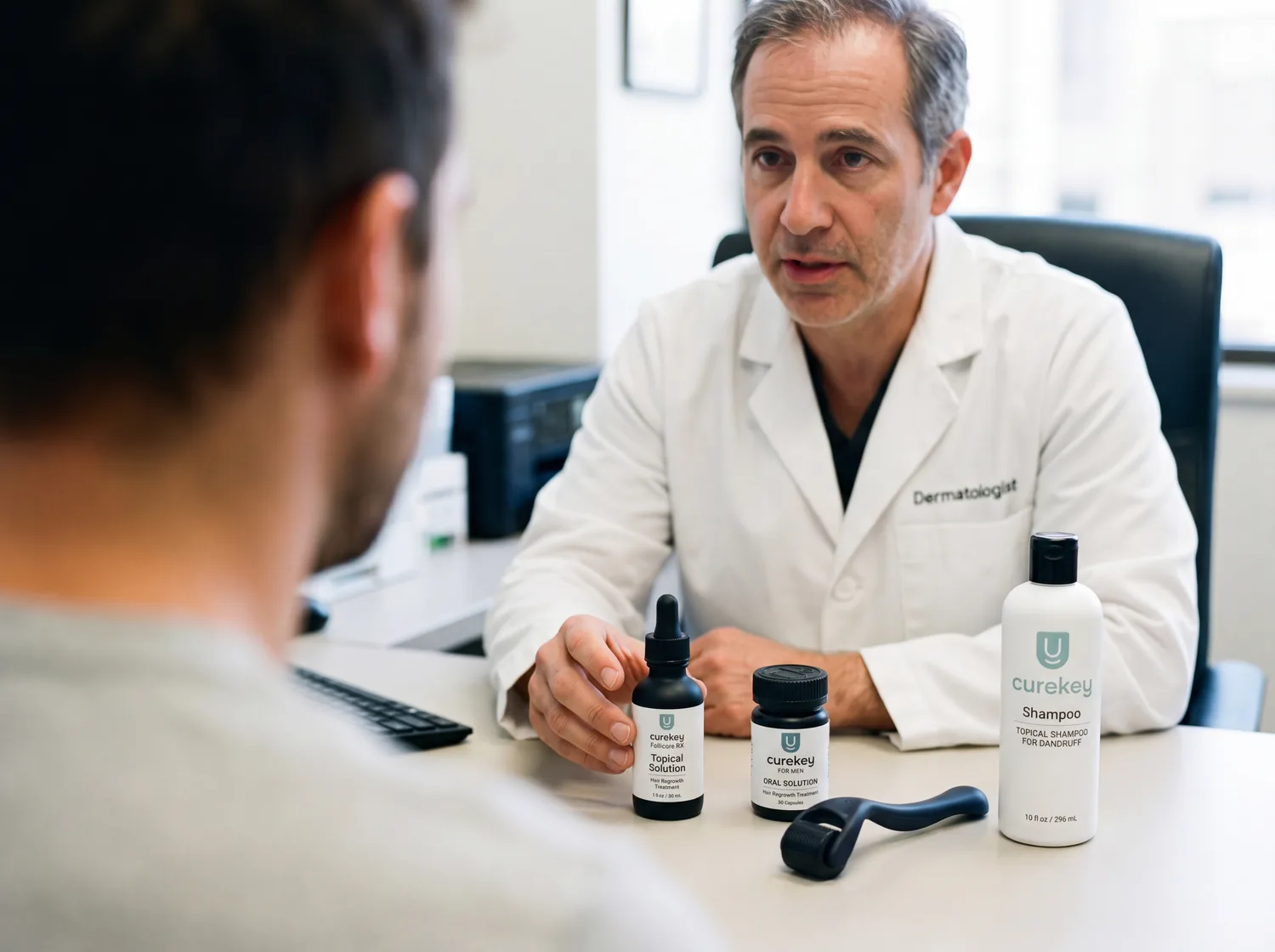
Androgenetic alopecia is the medical term for progressive, genetically driven hair loss that follows a recognisable pattern. It is the most prevalent form of hair loss worldwide and affects an estimated 50% of men by age 50 and approximately 40% of women by age 70. Despite its prevalence, the condition is often misunderstood, and the gap between effective medical treatment and widely marketed remedies remains wide.
This page explains what androgenetic alopecia is, why it occurs, how it typically progresses, and what treatment approaches are clinically supported.

What androgenetic alopecia is
Androgenetic alopecia, sometimes abbreviated AGA, is a hereditary form of hair loss caused by sensitivity of scalp hair follicles to a hormone called dihydrotestosterone, or DHT. In genetically predisposed individuals, DHT progressively shortens the active growth phase of affected follicles and causes them to produce thinner, shorter, and less pigmented hair over time. This process is called follicle miniaturization.
The condition is also referred to as:
- Male pattern hair loss in men, when the loss follows the typical frontal and crown distribution
- Female pattern hair loss in women, where diffuse thinning across the central scalp is more common
- Pattern hair loss, a sex-neutral term
Unlike conditions such as alopecia areata or telogen effluvium, androgenetic alopecia is not autoimmune and is not triggered by acute stress. It is a slow, chronic process driven by hormones acting on genetically susceptible follicles.
Causes
The condition results from an interaction between two factors: genetic predisposition and androgen exposure.
Genetic predisposition
Heritability studies suggest a strong genetic component, with susceptibility inherited from both maternal and paternal sides. The pattern is polygenic, meaning multiple genes contribute, rather than a single dominant or recessive trait. Family history is the strongest predictor of whether and when androgenetic alopecia will develop.
Androgen exposure
DHT is produced when the enzyme 5-alpha reductase converts testosterone into its more potent form. In hair follicles on the top and front of the scalp, DHT binds to androgen receptors and triggers a cascade of cellular changes that gradually weaken the follicle. Follicles on the sides and back of the scalp are largely DHT-resistant, which is why those areas typically retain hair throughout the progression of pattern loss.
It is important to note that androgenetic alopecia is not caused by elevated testosterone levels. Most affected individuals have normal hormone levels. The condition is driven by follicular sensitivity to DHT, not by hormone overproduction.
Progression
Androgenetic alopecia is a progressive condition. Without treatment, it tends to advance over years to decades, though the rate varies significantly between individuals. Typical patterns include:
- In men: gradual recession of the frontal hairline (the temples), thinning at the crown, and eventual merging of these areas
- In women: diffuse thinning along the central part, often without the dramatic frontal recession seen in men
The Norwood-Hamilton scale is the standard system used to describe progression in men, ranging from minimal recession (Stage 1) to extensive baldness with only a horseshoe of hair remaining (Stage 7). The Ludwig scale is the equivalent system for women. A more detailed walkthrough of the men's classification is available on our stages of pattern hair loss page.
Earlier age of onset generally correlates with more advanced eventual loss. Loss that begins in the late teens or early twenties tends to progress further than loss beginning later in life.
How it is diagnosed
In most cases, androgenetic alopecia can be diagnosed by a clinician based on history and visual examination of the scalp. The pattern of loss, age of onset, and family history are usually sufficient. In ambiguous cases, additional steps may include:
- A pull test to assess active shedding
- Trichoscopy (dermatoscopic examination of the scalp) to visualise hair shaft diameter variation, a hallmark of miniaturization
- Blood work to rule out contributing factors such as iron deficiency, thyroid dysfunction, or vitamin D deficiency
- A scalp biopsy in atypical presentations
Differentiating androgenetic alopecia from telogen effluvium, traction alopecia, or scarring alopecias is clinically important because treatment approaches differ.
Treatment overview
Several treatments have established clinical evidence for slowing, halting, or partially reversing androgenetic alopecia. None of them cure the condition, and ongoing use is required to maintain results.
First-line medications
Minoxidil is a topical or oral medication that extends the active growth phase of the hair cycle and increases follicle size. It does not directly address DHT but supports follicle activity and is one of the most studied hair loss treatments. Both topical 2-5% solutions and low-dose oral formulations are used.
Finasteride is an oral medication that inhibits 5-alpha reductase, lowering scalp DHT levels by roughly 60-70%. It is approved for use in men with androgenetic alopecia and works by addressing the hormonal driver of the condition. A side-by-side discussion of these two medications is available on our minoxidil vs finasteride page.
Combination therapy
Clinical evidence suggests that combining minoxidil and finasteride produces better outcomes than either treatment alone, because they work through complementary mechanisms. This is the approach most commonly recommended for men with progressing pattern loss when medically appropriate.
Additional options
Dutasteride is a more potent inhibitor of 5-alpha reductase, used off-label in some cases when finasteride is insufficient or to maximise DHT suppression. The trade-offs are discussed in our finasteride vs dutasteride page.
Spironolactone is an anti-androgen used in women with androgenetic alopecia, particularly those with elevated androgen markers. It is not appropriate for women who are pregnant or attempting to conceive.
Microneedling with a 0.5 to 1.5 mm dermaroller has shown adjunctive benefit in some clinical studies, particularly when used alongside topical minoxidil.
Hair transplantation is a surgical option for individuals with established loss who have sufficient donor density on the back and sides of the scalp. Medical treatment is typically continued after transplantation to preserve non-transplanted hair.
Why early intervention matters
Hair follicles affected by androgenetic alopecia can recover function in the early stages of miniaturization, but follicles that have been dormant for extended periods may not respond to treatment. Earlier intervention generally produces better outcomes, and treatment is most effective when started before significant cosmetic loss has occurred. This pattern is discussed further in our overview of how hair loss treatment timelines work.
What does not work
Several widely marketed approaches lack convincing clinical evidence for treating androgenetic alopecia:
- Biotin supplementation, unless the individual has a documented deficiency
- Saw palmetto, marketed as a natural alternative to finasteride but with weak supporting data
- Caffeine shampoos, due to insufficient contact time for active ingredients
- Most hair growth serums without a recognised active ingredient on the label
- Scalp massage devices and brushes, which do not address the underlying mechanism
Time and money spent on these approaches is time during which the underlying loss continues to progress. For people who want to address androgenetic alopecia, the clinically supported medications listed above remain the most effective starting point.
Speaking with a physician
Because androgenetic alopecia is a chronic, hormonally driven condition, treatment should be guided by a physician who can:
- Confirm the diagnosis and rule out other causes of hair loss
- Screen for contraindications and risk factors before prescribing systemic medications
- Recommend an evidence-based treatment plan based on stage and medical history
- Provide ongoing physician access for questions throughout your treatment
Curekey is a HIPAA-compliant telehealth platform where licensed U.S. physicians review each case and prescribe treatment only when it is medically appropriate. Medications are fulfilled by licensed pharmacies. The process is outlined on our how it works page, and the full range of causes and treatments is covered on our hair loss overview.
Considering medical assessment
Pattern hair loss responds best to early, evidence-based intervention. If you are noticing changes at the hairline, crown, or central scalp, a structured medical assessment can clarify whether the loss is androgenetic in origin and whether prescription treatment is appropriate for your case. A Curekey consultation includes history review, photo evaluation, and physician oversight.
Related reading
- Hair loss overview
- Male pattern baldness
- How DHT causes hair loss
- Stages of male pattern hair loss
- Follicle miniaturization explained
- Minoxidil vs finasteride
- How long does hair loss treatment take
- How Curekey works