
In this article (8 sections)
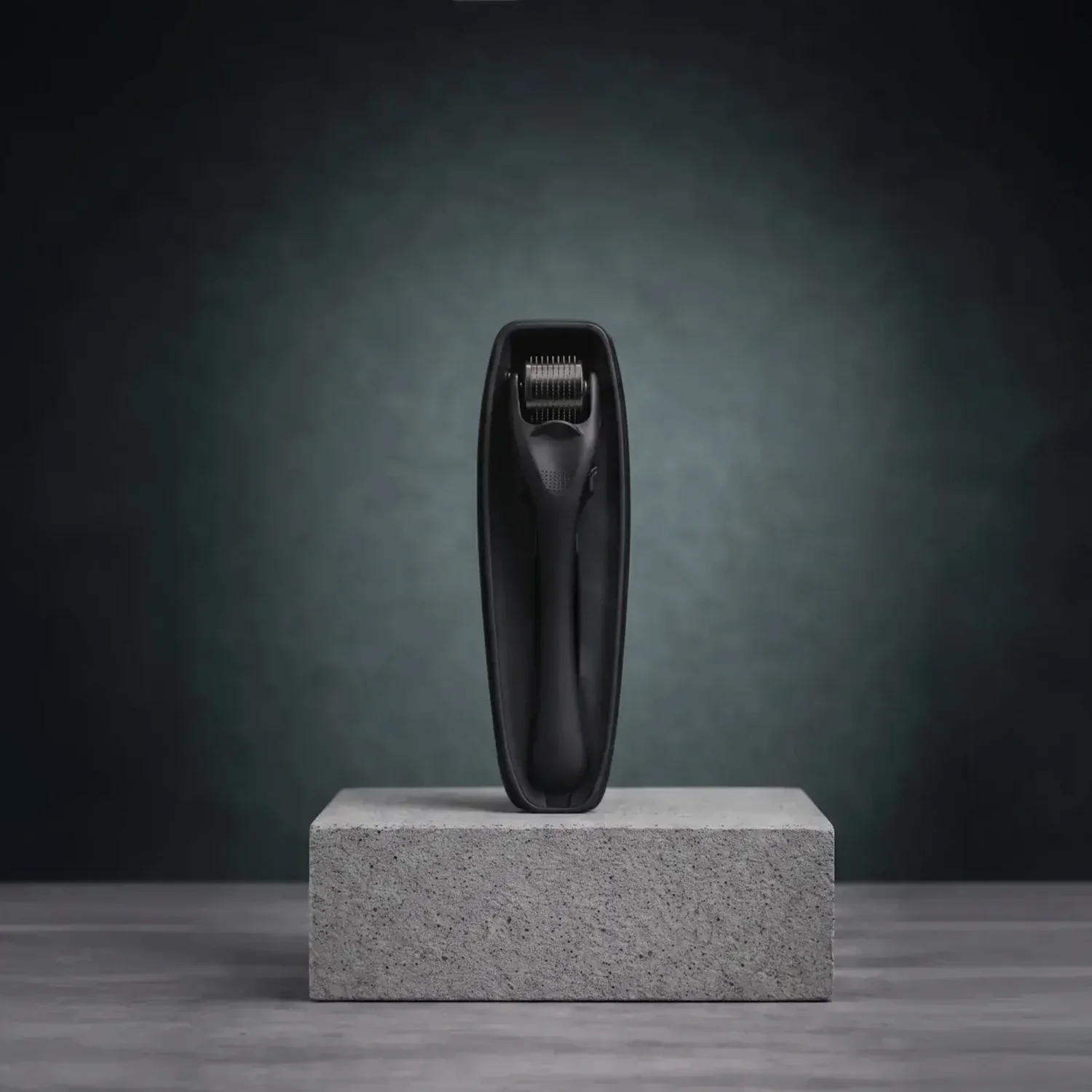
Microneedling for hair loss involves rolling or stamping a device with fine-gauge needles across the scalp to create controlled micro-injuries. The device most people use at home is a derma roller, a small barrel studded with needles that is rolled across the thinning area. The mechanism is both direct (wound-healing signals that recruit growth factors to the affected area) and indirect (enhanced absorption of topical medications applied afterward, particularly minoxidil). It is one of the better-supported adjunctive approaches for androgenetic alopecia, with several small randomized trials showing meaningful additive benefit when combined with topical minoxidil.
The short answer on needle length and frequency
Most of the practical questions about microneedling come down to three numbers. The published trials and common clinical guidance line up as follows:
- Needle length: 0.5 to 1.5 mm. The trials that showed the clearest benefit used a 1.5 mm derma roller on the scalp. Devices shorter than 0.5 mm do not reliably reach the dermis, where the follicle sits. Home users starting out generally stay at the lower end of that range.
- Frequency: once per week. More often does not appear to improve results and may irritate the scalp, which needs time between sessions to complete its wound-healing cycle.
- Topical minoxidil timing: within about an hour afterward, while the micro-channels are still open and absorption is enhanced. The combination, not microneedling on its own, is what carries the evidence.
These figures describe what the studies used. They are not a substitute for guidance from a clinician, and anyone with a scalp condition, a clotting disorder, or a history of keloid scarring should get medical advice before microneedling at home. The sections below cover the reasoning, the evidence, and the technique errors that undo the benefit.
What the procedure does
The needles in a typical scalp microneedling device are 0.5 to 1.5 millimeters in length. They penetrate the epidermis and reach into the upper dermis, where the hair follicle's bulge and bulb regions sit. The controlled micro-injury triggers a localized wound-healing cascade that includes:
- Release of platelet-derived growth factor (PDGF), vascular endothelial growth factor (VEGF), and other growth factors from disrupted cells
- Activation of stem cells in the bulge region of the follicle
- Increased local microcirculation
- Upregulation of Wnt signaling pathways, which are involved in follicle cycling
In parallel, the small channels created by the needles substantially increase the permeability of the scalp to topically applied medications. Minoxidil applied within an hour of microneedling penetrates more efficiently than minoxidil applied to an intact scalp.
The result of the two mechanisms (direct follicle stimulation and enhanced topical absorption) is what gives combination microneedling-plus-minoxidil its evidence base.
What the evidence shows
The most influential study in this area was a 12-week randomized trial of 100 men with androgenetic alopecia, comparing topical 5 percent minoxidil alone to 5 percent minoxidil plus weekly microneedling with a 1.5 mm dermaroller (Dhurat et al., Int J Trichology, 2013). The combination group showed substantially higher hair counts at 12 weeks (mean increase of 91 hairs per cm² vs 22 hairs per cm² for minoxidil alone), with corresponding improvements in patient satisfaction and investigator-rated outcomes.
Subsequent smaller trials and case series have generally supported the combination benefit, with consistent findings:
- Microneedling plus topical minoxidil outperforms minoxidil monotherapy.
- The effect appears in both men and women with androgenetic alopecia.
- Patients who had not responded adequately to minoxidil monotherapy often respond when microneedling is added.
- The benefit takes three to six months to be visibly apparent, similar to the timeline of other hair-loss interventions.
A 2022 systematic review that pooled the available studies concluded that microneedling shows promise for androgenetic alopecia, particularly alongside minoxidil, while noting that the trials are small, variable in protocol (needle depth and frequency differ widely), and at meaningful risk of bias (Gupta et al., J Cosmet Dermatol, 2022).
The evidence for microneedling as monotherapy (without topical minoxidil) is weaker. The mechanism that produces the strongest signal is the combination, not microneedling alone.
Technique that matters
Microneedling's benefit depends on doing it correctly. Common technique errors that reduce the benefit:
Needle length too short. Dermarollers shorter than 0.5 mm do not reliably reach the dermis. The published trials used 1.5 mm needles for the scalp. Most clinical recommendations are in the 0.5 to 1.5 mm range; aggressive home use should stay at the lower end.
Frequency too high. Once per week is the standard. More frequent use does not improve results and risks scalp irritation and traumatized recovery. The skin needs time between sessions to complete its wound-healing cycle.
Pressure too aggressive. The roller should pass smoothly across the scalp with light to moderate pressure. Excessive pressure causes bleeding beyond the micro-injury target and can damage tissue.
Inadequate hygiene. Dermarollers must be cleaned with alcohol before and after each use, replaced regularly (typically every 10 to 15 uses), and stored in a clean container. Infection at injury sites is rare but possible with poor hygiene.
Topical minoxidil timing. The standard recommended approach is to apply minoxidil within an hour of microneedling, when the channels are open and absorption is enhanced. Waiting until the next day defeats much of the absorption benefit.
Equipment and cost
Microneedling for hair loss is one of the more accessible adjuncts financially. A quality dermaroller costs $30 to $100 and lasts several months with proper care. Replacement rollers are typically $20 to $40. Annual cost is generally under $200, substantially less than PRP, red light therapy devices, or in-office procedures.
The trade-off is time and consistency. Weekly sessions of 5 to 10 minutes, combined with the daily topical minoxidil routine, require a level of commitment that some patients find harder to maintain than a once-daily oral medication.
Where microneedling fits
The reasonable use cases:
- As an adjunct to topical minoxidil for patients who want to optimize the response. This is the most evidence-supported use.
- As an adjunct for patients who have had a partial response to topical minoxidil alone and want to amplify it.
- For patients combining topical minoxidil with finasteride (or low-dose oral minoxidil), microneedling can be added as the additional adjunct most likely to produce incremental improvement.
- As a relatively low-cost first add-on before considering more expensive interventions like PRP.
Less reasonable use cases:
- Microneedling without topical minoxidil. The evidence for monotherapy is much weaker.
- Microneedling at home for patients who have a known clotting disorder, are on anticoagulants, or have active scalp infection or significant scalp disease.
- Microneedling as a replacement for prescription therapy. The combination is the evidence-supported use; substitution is not.
Side effects
Side effects are typically mild and self-limited:
- Scalp redness and sensitivity for 12 to 24 hours after sessions
- Pinpoint bleeding at needle insertion sites
- Occasional small areas of bruising
- Rarely, scalp infection at injury sites
Most patients adapt to the procedure within the first few sessions. Patients with active inflammatory scalp disease, recent scalp surgery, keloid history, or clotting disorders should avoid home microneedling and discuss with a clinician before any scalp procedure.
Putting it together
Microneedling is one of the best-evidence adjunctive approaches for androgenetic alopecia, particularly when combined with topical minoxidil. The cost is modest, the time commitment is real but manageable, and the technique is straightforward enough that most patients can do it safely at home. For patients already on topical minoxidil who want to optimize the response without changing the medication regimen, weekly microneedling is one of the highest-value adjuncts available.
For broader treatment planning, see the alternatives pillar for the wider context, and the minoxidil overview for the medication side. To start a structured evaluation with a U.S.-licensed physician, Curekey's hair assessment is one starting point.