
Oral minoxidil is the same drug as the familiar scalp solution, taken as a small daily tablet or capsule instead. It was first approved decades ago as a blood pressure medication at much higher doses; at the low doses used for hair loss it has become one of the most discussed options in hair medicine, because it removes the daily scalp routine and, in trials so far, performs about as well as the topical form. Its use for hair loss is off-label, and it is prescribed by a physician who checks that it is safe for you.
This page covers how oral minoxidil works for hair, the doses that have been studied, what the evidence shows, its side effects, who should not take it, and how physicians decide between oral and topical. If you mainly want the side-by-side comparison, the oral vs topical minoxidil page sets it out.
How oral minoxidil works on hair
Minoxidil widens blood vessels and opens potassium channels in the cells around the follicle. For hair, the effects that matter are that it prolongs the growth (anagen) phase and enlarges follicles that have started to shrink, so they produce longer and thicker hairs. It does not lower DHT, which is why it is so often paired with a DHT blocker.
Minoxidil only works once the body converts it into its active form, minoxidil sulfate, using an enzyme called sulfotransferase. Scalp levels of that enzyme vary a great deal between people, which is one reason some people respond poorly to the topical solution. Taken by mouth, minoxidil is converted mainly in the liver, so the activity of the scalp enzyme matters less. That is part of the reason some people who did little on topical minoxidil respond to the oral form.
Doses used for hair loss
When minoxidil is used for blood pressure, daily doses can reach 10 to 40 mg. The doses studied for hair loss are a small fraction of that, generally between about 0.25 mg and 5 mg a day. In practice, physicians usually start low and choose a dose based on sex, body size, blood pressure, other medications, and how much the possible side effects matter to the patient. Higher doses within that range tend to produce more growth on average and more side effects, particularly unwanted body hair.
The dose is a medical decision rather than something to adjust on your own. Splitting higher-strength blood pressure tablets to approximate a hair-loss dose is not a safe substitute for a prescription at the intended strength.
What the evidence shows
Head to head with topical minoxidil. In a randomized, double-blind trial of 90 men, 5 mg of oral minoxidil daily was compared with 5% topical minoxidil applied twice daily for 24 weeks. Overall results were similar; the oral group did better on hair density at the crown, while the topical group had more scalp irritation. The trial lost a number of participants during the pandemic, so it shows no clear winner rather than proving the two are equivalent (Penha et al., JAMA Dermatology, 2024).
Safety in large real-world use. A study of 1,404 patients across ten centers in six countries, most taking low doses for pattern hair loss, found that side effects were generally mild and dose-related, and that very few people stopped treatment because of them. No life-threatening effects were seen (Vañó-Galván et al., J Am Acad Dermatol, 2021). The numbers from that study appear in the side-effects section below.
Combined with a DHT blocker. Because minoxidil and DHT blockers work through different mechanisms, they are commonly used together. A 12-month comparison of topical minoxidil, finasteride and the two combined found greater hair density with the combination than with either alone (Khandpur et al., J Dermatol, 2002). The same logic is applied to oral minoxidil with finasteride or dutasteride, although direct long-term trials of those oral combinations are still limited.
As with every hair-loss medication, results vary between people. Most need at least three months before any change is visible, and the effect is usually judged at six to twelve months.
Side effects of oral minoxidil
In the 1,404-patient study, about one in five people reported a side effect of some kind. Those reported most often were:
| Side effect | How often | What usually helps |
|---|---|---|
| New hair on the face or body (hypertrichosis) | About 15% | Often reduces at a lower dose; reverses after stopping |
| Lightheadedness | About 1.7% | Dose review; checking blood pressure |
| Fluid retention (ankle or leg swelling) | About 1.3% | Medical review; may need a lower dose or a different treatment |
| Faster heartbeat | About 0.9% | Medical review |
| Headache | About 0.4% | Usually mild |
| Swelling around the eyes | About 0.3% | Medical review |
Two other effects are worth knowing about:
- Early shedding. Like topical minoxidil, the oral form can cause a temporary increase in shedding in the first weeks, as follicles move from the resting phase into a new growth phase. It usually settles within two to three months. See why hair sheds when you start treatment.
- Facial hair in particular. Because the drug reaches every follicle through the bloodstream, new hair can appear on the cheeks, forehead, sideburns and arms rather than only where topical product might run. The guide to minoxidil and facial hair covers what to expect and what reverses.
Rare but serious problems, such as fluid around the heart, have been reported with minoxidil, mostly at the high doses used for blood pressure. Any chest pain, shortness of breath, rapid weight gain or marked swelling should be reported to a doctor promptly.
Who should not take it
Oral minoxidil is not appropriate for everyone. A physician will usually avoid it, or take particular care, in people with:
- Heart failure, significant heart disease, or a history of fluid around the heart
- Low blood pressure, or blood pressure medication that could combine with minoxidil's effect
- Pheochromocytoma, a rare adrenal tumour (listed as a contraindication on the label)
- Significant kidney or liver disease
- Pregnancy or breastfeeding
This is why the medical history in an assessment matters: the questions about heart health, blood pressure and current medications are what make low-dose oral minoxidil a reasonable option for some people and the wrong one for others.
Oral or topical: how physicians decide
Neither form is better for everyone. Oral minoxidil tends to be considered when daily scalp application is impractical, when topical minoxidil irritated the scalp, or when the response to topical treatment was limited. Topical minoxidil tends to be preferred when someone wants to avoid any systemic medication, has a heart or blood pressure condition, or is particularly concerned about body hair. Some people end up with a DHT blocker by mouth and minoxidil on the scalp, or the reverse. The oral vs topical minoxidil page goes through those trade-offs in detail.
Oral minoxidil in CoreCapsuleRX
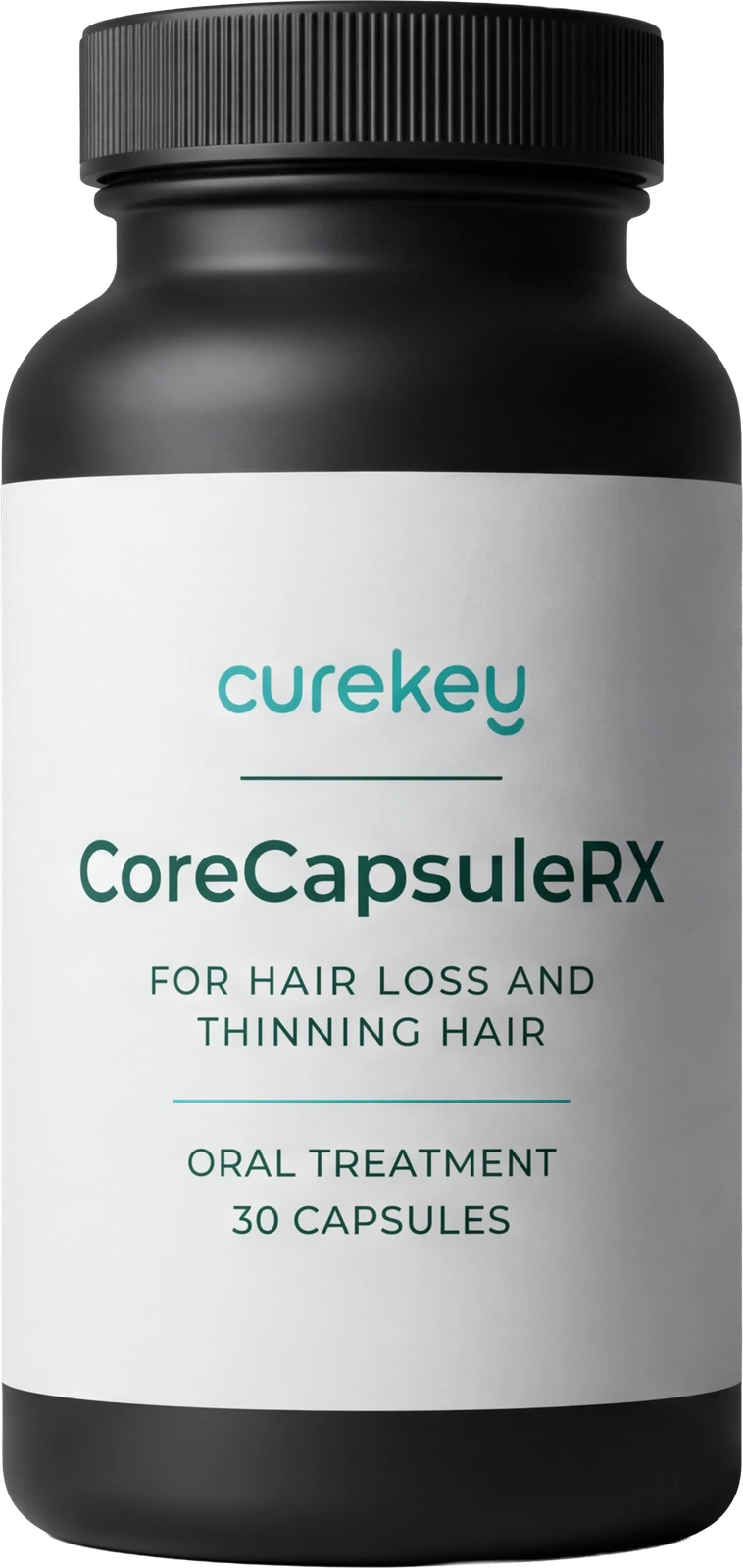
Curekey's oral option, CoreCapsuleRX, combines low-dose oral minoxidil with dutasteride and vitamin D3 in one daily capsule, so the minoxidil and the DHT blocker are taken together. It is compounded by a licensed U.S. pharmacy; each active ingredient is used in FDA-approved medicines, but the combination is not itself FDA-approved, and using minoxidil and dutasteride for hair loss is off-label. A U.S.-licensed physician reviews your assessment, including heart health, blood pressure and medications, before anything is prescribed, and you are not charged unless a prescription is approved.
Considering medical assessment
Oral minoxidil is one of the few hair-loss medications where the medical history decides as much as the hair does. Heart health, blood pressure, current medications and how much unwanted body hair would bother you all shape whether it is a reasonable choice, and at what dose. A physician who reviews those details can also explain whether pairing it with a DHT blocker fits your stage of loss. Curekey's how it works page sets out how that review happens online.
Related reading
- Oral vs topical minoxidil
- Minoxidil overview
- Common minoxidil side effects
- Minoxidil and facial hair
- Finasteride vs dutasteride
- Hair loss treatment for men: options compared
Key references
- Penha MA et al. Oral minoxidil vs topical minoxidil for male androgenetic alopecia: a randomized clinical trial. JAMA Dermatology, 2024.
- Vañó-Galván S et al. Safety of low-dose oral minoxidil for hair loss: a multicenter study of 1404 patients. J Am Acad Dermatol, 2021.
- Randolph M, Tosti A. Oral minoxidil treatment for hair loss: a review. J Am Acad Dermatol, 2021.
- Khandpur S et al. Comparison of minoxidil, finasteride and combination therapy. J Dermatol, 2002.