Topical dutasteride is dutasteride applied to the scalp as a solution rather than swallowed as a capsule. The idea is simple: lower DHT where it damages follicles while keeping the amount that reaches the rest of the body small. The early trials are encouraging, but they are smaller and newer than the evidence for oral dutasteride, and topical dutasteride is not FDA-approved for hair loss. In the United States it is prepared by compounding pharmacies and prescribed off-label by physicians.
This page covers what the medication does, what the studies so far show, how it compares with the oral form and with finasteride, the side effects worth knowing about, and how a prescription works.
What dutasteride does at the scalp
In androgenetic alopecia, follicles that are genetically sensitive to DHT gradually shrink with each growth cycle, producing finer and shorter hairs until some stop producing visible hair at all. That process is called follicle miniaturization, and DHT is the hormone that drives it.
DHT is made from testosterone by an enzyme called 5-alpha reductase, which exists in two main forms. Finasteride blocks one of them (Type 2). Dutasteride blocks both Type 1 and Type 2. Taken by mouth, dutasteride lowers circulating DHT by roughly 90 percent, compared with about 60 to 70 percent for finasteride, which is why it is often described as the stronger of the two.
Applying dutasteride to the scalp aims to keep that enzyme blocked in the skin around the follicle. Because the drug is fat-soluble and binds tightly in tissue, a small amount on the scalp can have a local effect, while far less reaches the bloodstream than with a daily capsule.
What the studies show so far
The evidence for topical dutasteride is promising but early. Readers should weigh the points below with that in mind.
A 24-week randomized trial in 135 men. In a phase II study published in 2025, men with pattern hair loss used a dutasteride solution at three strengths, oral finasteride 1 mg, or a placebo. All three topical strengths increased hair count and hair width at the crown compared with placebo, with larger gains at higher strengths, and the strongest solution outperformed oral finasteride on hair count at 24 weeks. Blood hormone changes were smaller in the topical groups than with finasteride, and no scalp irritation was reported in the active groups (Cureus, 2025). The authors work for the company developing the product, so independent replication matters.
Studies that deliver dutasteride into the skin. Several small trials have injected dilute dutasteride into the scalp (mesotherapy) or paired a dutasteride solution with microneedling. These generally found improved hair counts or photographic scores compared with placebo, and are summarised in recent reviews (Dermatology, 2024). They support the idea that dutasteride can act locally, though delivery by injection is not the same as a daily solution.
What reviewers conclude. A 2025 review of topical formulations describes dutasteride as a well-established DHT blocker whose topical use is still being refined, with much of the current research focused on formulations that hold the drug in the scalp and limit how much is absorbed (Therapeutic Delivery, 2025). Larger phase III trials are under way.
In short: the mechanism is well understood, the early numbers point in the right direction, and the long-term data that exist for oral dutasteride do not yet exist for the topical form.
Topical vs oral dutasteride
The two forms use the same drug in different ways, and the trade-off is mostly about how much reaches the rest of the body.
| Topical dutasteride | Oral dutasteride | |
|---|---|---|
| How it is used | Solution applied to the scalp | Capsule taken by mouth |
| Where it acts | Mainly the scalp | Throughout the body |
| Effect on blood DHT | Smaller, depending on strength and amount applied | About 90% reduction |
| Strength of evidence for hair loss | Early, smaller trials | Larger randomized trials, including head to head with finasteride |
| FDA status for hair loss | Not approved; compounded | Not approved; used off-label |
| Main practical issue | Daily application, possible scalp irritation | Systemic side effects, long half-life |
The oral form has the deeper evidence base. In a randomized trial of 917 men, oral dutasteride increased hair count and hair width more than finasteride over 24 weeks (Gubelin Harcha et al., J Am Acad Dermatol, 2014). The topical form is generally considered by people who want DHT suppression at the scalp with less exposure elsewhere, or who prefer to keep their whole routine topical. The finasteride vs dutasteride page covers the oral comparison in more depth.
Topical dutasteride vs topical finasteride
Topical finasteride is the closer comparison, since both aim for local DHT suppression with lower systemic exposure. Topical finasteride has more published trial data at this point, and some formulations have been studied in larger groups. Topical dutasteride blocks both forms of the enzyme rather than one, which is the reason for interest in it, but whether that translates into a meaningful advantage when applied to the scalp has not yet been tested in large head-to-head trials. For now, the choice between them usually comes down to the prescribing physician's judgement, what a pharmacy can prepare, and how a patient has responded to previous treatment.
Side effects and who should avoid it
Most reported side effects with topical dutasteride are local and mild:
- Scalp irritation, such as redness, dryness, or itching, which can also come from the other ingredients in a combined solution.
- Temporary shedding in the first weeks of a new regimen, especially when the solution also contains minoxidil.
- Sexual side effects. Because some dutasteride is absorbed, the effects reported with oral DHT blockers (lower libido, erection or ejaculation changes) are possible, though they are expected to be less common with scalp application. Any change should be reported to the prescribing physician.
Some people should not use it at all:
- Women who are or may become pregnant should not use or handle dutasteride, because it can affect the development of a male fetus. The same caution applies to anyone in the household handling the solution.
- Anyone with a known allergy to dutasteride or other 5-alpha reductase inhibitors.
Dutasteride can also lower PSA test results, which are used to screen for prostate problems. This effect is well documented with the oral form; with topical use it is likely smaller, but it is worth telling any doctor who checks your PSA that you use it. People who have used dutasteride are also usually asked not to donate blood for several months after stopping.
How long it takes
Like every treatment for pattern hair loss, topical dutasteride works on the hair growth cycle, which is slow. Most people need at least three months of consistent daily use before any change is visible, and results are usually judged at six to twelve months. Benefits last only as long as the treatment continues; stopping allows DHT to return to its previous levels at the scalp. The how long does hair loss treatment take page explains the timeline in more detail.
How Curekey uses topical dutasteride
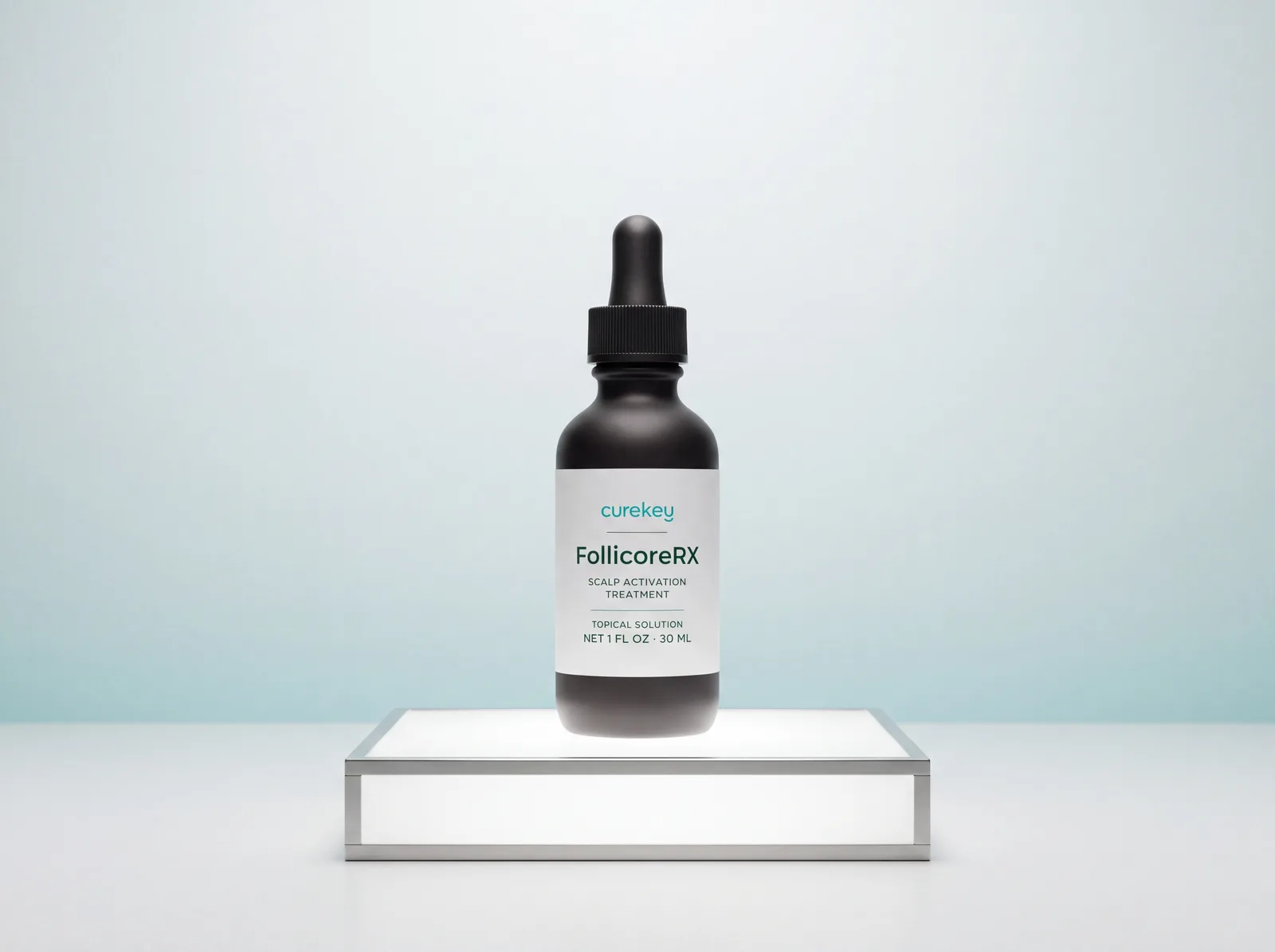
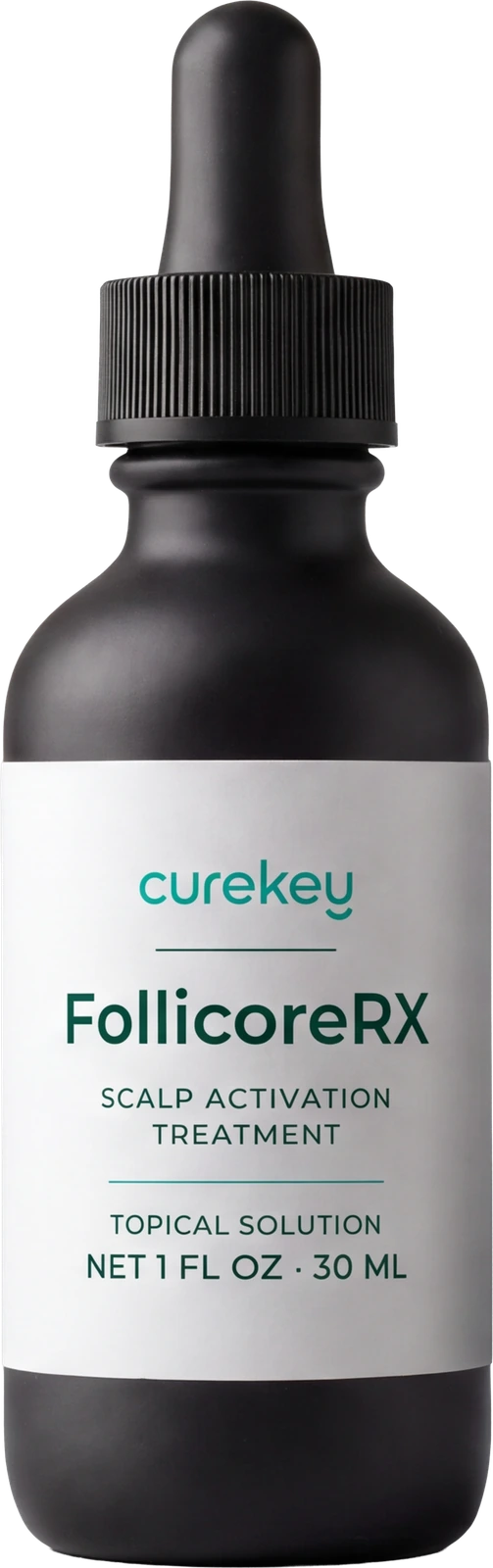
Curekey's topical, FollicoreRX, combines dutasteride with minoxidil, tretinoin and cetirizine in a single once-daily solution. The pairing follows the logic of combination therapy: dutasteride addresses the DHT that drives miniaturization, while minoxidil supports the growth phase of the follicles that remain. Tretinoin may increase how much minoxidil passes into the scalp, and cetirizine has been studied as a topical for pattern hair loss in small trials.
FollicoreRX is compounded by a licensed U.S. pharmacy. Each active ingredient is used in FDA-approved medicines, but the combination itself is not FDA-approved. It is prescribed only after a U.S.-licensed physician reviews your assessment, and you are not charged unless a prescription is approved.
Using it alongside other treatments
Topical dutasteride is usually paired with minoxidil rather than another DHT blocker, because the two work through different mechanisms. Adding it on top of oral finasteride or oral dutasteride is not a standard approach; whether any combination of DHT blockers makes sense is a judgement for the prescribing physician, based on your history and how you have responded so far. Curekey does not prescribe topical dutasteride to women.
Considering medical assessment
Topical dutasteride requires a prescription, and the useful first step is a medical assessment rather than a choice of product. It should cover your hair loss pattern, how long it has been progressing, your other medications, and any reproductive or prostate considerations. A physician then decides whether a topical, an oral option, a combination, or no medication is appropriate, and explains the off-label status of whatever is recommended. Curekey's how it works page describes that process step by step.
Related reading
- Finasteride vs dutasteride
- DHT and hair loss
- Androgenetic alopecia
- Hair loss treatment for men: options compared
- Minoxidil vs finasteride
- How it works
Key references
- Phase II randomized trial of dutasteride topical solution in men with androgenetic alopecia. Cureus, 2025.
- Dutasteride for the treatment of androgenetic alopecia: an updated review. Dermatology, 2024.
- Topical dutasteride for androgenic alopecia: current state and prospects. Therapeutic Delivery, 2025.
- Gubelin Harcha W et al. Dutasteride versus finasteride and placebo in men with androgenetic alopecia. J Am Acad Dermatol, 2014.