Utah's high-altitude, arid climate and outdoor lifestyle shape how patients here describe what they notice about their hair and scalp. Salt Lake City and the Wasatch Front sit at elevation, where the air is dry and UV exposure is high. The southern part of the state, around St. George and Moab, is desert. Adults in Utah tend to spend significant time outdoors, whether hiking, skiing, or working. None of those climate factors drive the biology of hair loss, but they do affect scalp care, sun exposure on thinning areas, and the way patients experience the day-to-day reality of pattern hair loss.
The condition that brings most adults to consider treatment is androgenetic alopecia, the genetic and gradually progressive form of pattern hair loss.
Treatments available through Curekey
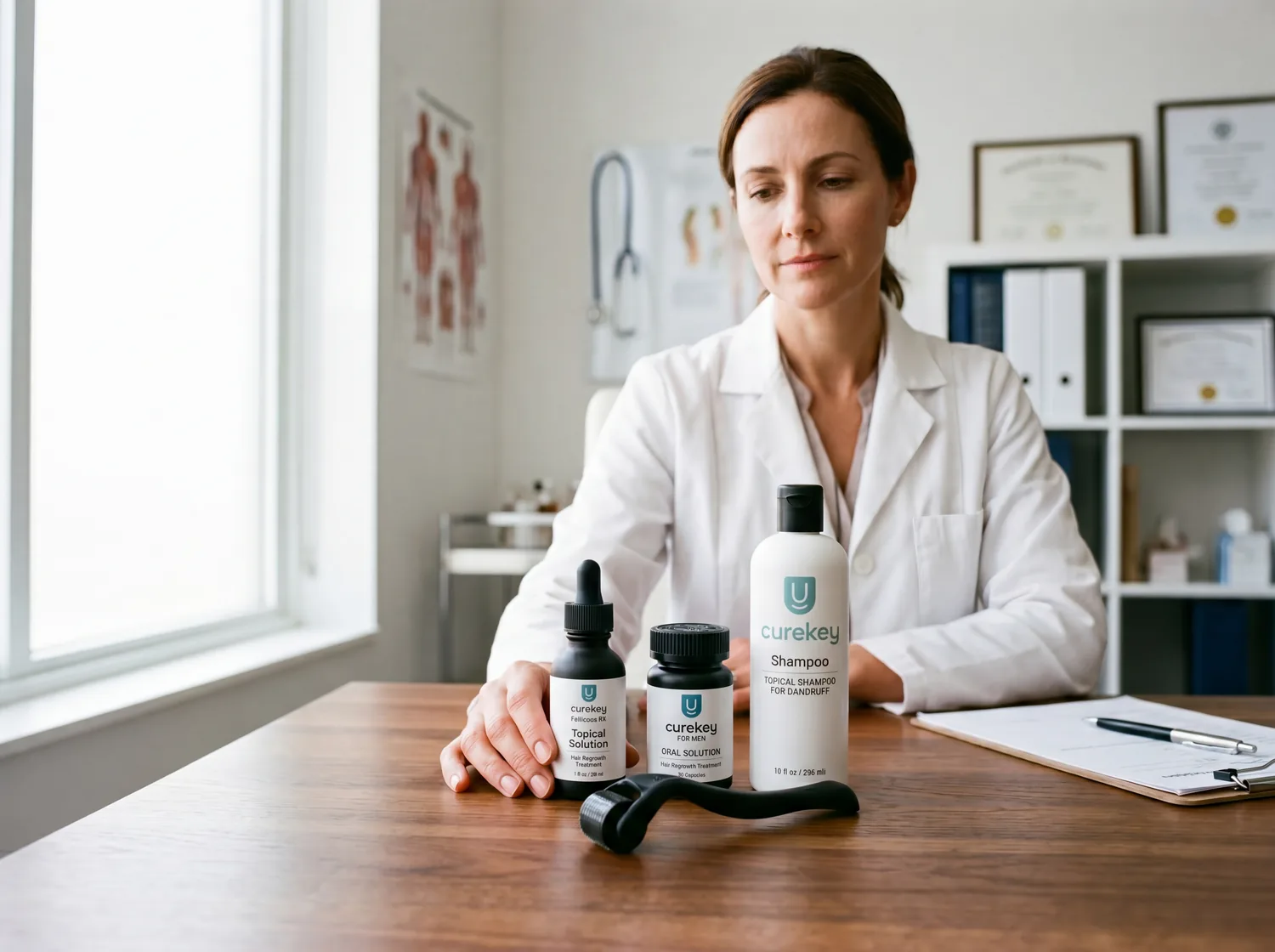
Depending on your assessment, your physician may discuss:
- Topical minoxidil, generally as 5 percent solution or foam
- Oral minoxidil at low doses, when medically appropriate
- Oral finasteride for men with male-pattern hair loss
- Dutasteride in selected cases, under physician supervision
- Spironolactone for women's pattern hair loss, when medically appropriate
The medications themselves are FDA-approved or used in evidence-based off-label dosing.
How telehealth hair loss care works in Utah
Curekey works with physicians licensed to practice in Utah. The state's medical-practice rules require that the prescribing physician on your case hold an active Utah license at the time of consultation, and that requirement is met for every Curekey case originating in the state, whether you are along the Wasatch Front, in Provo, Ogden, St. George, Logan, or any of the smaller communities throughout Utah.
The Curekey assessment is structured to gather what a physician needs to evaluate pattern hair loss without an in-person visit. You complete an online intake covering medical history, current medications, family history of hair loss, and goals. You upload photographs of your scalp from several angles. The physician reviews the case, follows up by secure message if needed, and prepares a treatment plan or refers you to in-person dermatology if findings are atypical.
What is the same as in-person care: the medications, the dosing, the standard of evidence, and the monitoring approach. What is different: the physician evaluates pattern and density from photographs.
Common patterns of hair loss
In men, frontal recession at the temples and crown thinning are the most common visible patterns. In women, the typical pattern is a widening center part with diffuse thinning at the top of the scalp. The stages of hair loss page describes the typical course in more detail.
What to expect
Hair grows on a slow biological clock. Most patients see early signs of stabilization between three and six months in, with continued change through twelve months. Some experience a temporary increase in shedding in the first weeks, which is generally considered an expected part of the cycle adjusting. For more, see how long hair loss treatment takes.
A practical Utah consideration: the high-altitude UV exposure means thinning areas of the scalp can sunburn easily. A hat or scalp-formulated sunscreen is generally a sensible addition during outdoor activity, regardless of treatment status.
Cities and regions Curekey serves in Utah
Most of Utah's population is concentrated along the Wasatch Front, a narrow corridor running roughly from Brigham City in the north through Ogden, Layton, Salt Lake City, and on south to Provo and Orem. That corridor holds the majority of the state's specialty medical infrastructure, with academic medicine in Salt Lake City and a network of clinics through the surrounding suburbs of Davis, Weber, Salt Lake, and Utah counties. Even within this corridor, scheduling a hair and scalp evaluation with a dermatologist can take weeks, particularly in winter when other dermatologic concerns push specialty calendars further out.
Outside the Wasatch Front, the practical geography shifts quickly. St. George and the broader Washington County area anchor the southwest, with the surrounding canyon country of Zion, the Arizona Strip, and the small towns along Interstate 15 reaching adults far from in-person specialty care. Logan and Cache Valley sit at the north end of the state. The Uinta Basin, the central Utah counties, and the southeast around Moab and Monticello have the lowest specialist density in the state.
For an adult in any of these areas, the Curekey workflow runs the same way. There is no required in-person visit, no driving from southern Utah or the Basin to the Front for an initial consultation, and the follow-up messaging built into the platform means questions about a new prescription or an unexpected change in shedding do not require booking a separate appointment.
Cities Curekey serves in Utah
Curekey's telehealth model covers the whole state, but a few metros account for most of our Utah caseload. The city-specific pages below cover the geographic, lifestyle, and access context that matters for adults considering treatment from those areas.
- Salt Lake City: physician-prescribed hair-loss care for adults in the Salt Lake City area.
Getting started in Utah
The workflow is the same across the state. You complete the online intake, upload your photographs, and a Utah-licensed physician reviews your case. If treatment is appropriate, the prescription is sent to a partner pharmacy and shipped to your address. Follow-up messaging is part of the service.
For more on the workflow, see how it works.