Pennsylvania spans a wide range of geography and climate, from the urban density of Philadelphia and Pittsburgh to the small towns and farmland of the central counties to the cold, forested expanses of the northern tier. Specialty dermatology and hair-restoration care is concentrated in the major metros, while large parts of the state's interior have fewer specialists and longer specialty waits. The seasonal climate, with cold winters and humid summers, creates the kind of year-round variation that affects scalp comfort even when the underlying biology of hair loss has not changed.
For most adults considering treatment, the underlying condition is androgenetic alopecia, the genetic and gradually progressive form of pattern hair loss. It is the most common form and the most amenable to telehealth-based care.
How telehealth hair loss care works in Pennsylvania
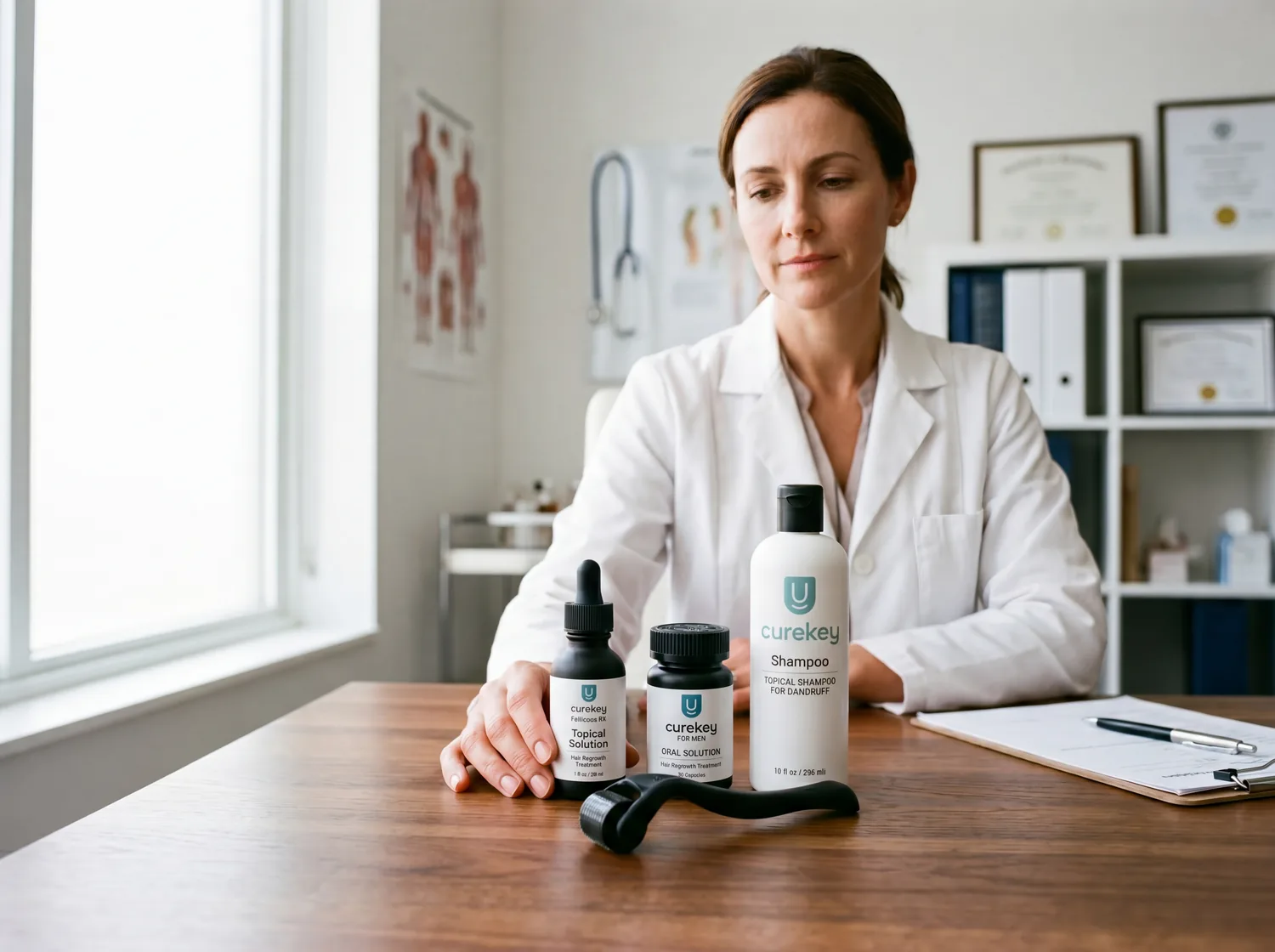
Curekey works with physicians licensed in Pennsylvania. Pennsylvania medical-practice rules require that the prescribing physician on your case hold an active state license at the time of consultation, and that requirement is met for every Curekey assessment in the state.
Your assessment begins with a structured online intake covering medical history, current medications, family history, and your goals. You upload clear photographs of your scalp from several angles. The physician reviews the case, follows up by secure message if needed, and prepares a treatment plan or refers you to in-person dermatology if findings are unusual.
What is the same as in-person care: the medications, dosing, evidence base, and monitoring approach. What is different: the physician evaluates pattern and density from photographs.
Common patterns of hair loss
Pattern hair loss progresses gradually. In men, frontal recession at the temples and crown thinning are most common. In women, diffuse thinning across the top of the scalp with a widening center part is typical. The stages of hair loss page describes the typical course.
Treatments available through Curekey
Depending on the assessment, your physician may discuss:
- Topical minoxidil, generally as 5 percent solution or foam
- Oral minoxidil at low doses, when medically appropriate
- Oral finasteride for men with male-pattern hair loss
- Dutasteride in selected cases, under physician supervision
- Spironolactone for women's pattern hair loss, when medically appropriate
Treatment is individualized. The medications are FDA-approved or prescribed in evidence-based off-label dosing.
What to expect
The hair growth cycle is slow. Most patients see early signs of stabilization or modest regrowth between three and six months in, with continued change through twelve months. Some experience a temporary increase in shedding in the first weeks, which is generally considered part of the cycle adjusting. For more on what is realistic to expect, see how long hair loss treatment takes.
Side effects are typically mild and are discussed in advance. The platform supports follow-up messaging, so questions can be raised between check-ins.
Cities and regions Curekey serves in Pennsylvania
Pennsylvania's hair-loss patients come from a mix of urban, suburban, and deeply rural communities, and the telehealth workflow is designed to work the same way in each.
In the southeast, the Philadelphia metro extends across the city itself and into Bucks, Chester, Delaware, and Montgomery counties, with adjacent suburbs and the Lehigh Valley around Allentown, Bethlehem, and Easton. In the southwest, the Pittsburgh region covers Allegheny County and pushes out into the surrounding hill country toward Washington, Westmoreland, and Beaver counties. Between the two, the south-central counties hold the state capital at Harrisburg along with York, Lancaster, and the agricultural towns of the Susquehanna Valley.
Further out, smaller population centers anchor large rural service areas. State College sits in the geographic center of the state. Erie holds the northwest along the lake. Scranton and Wilkes-Barre anchor the northeast, with the Pocono region and the Endless Mountains stretching north from there. The northern tier, including communities along the New York border, has the longest drives to specialty dermatology.
For an adult in any of these areas, the Curekey assessment runs the same way: an online intake, photographs, and physician review by a Pennsylvania-licensed clinician. There is no required in-person visit, no driving to a metro for an initial consultation, and no waiting weeks for a specialist appointment to start the conversation. For patients who do need an in-person evaluation, the physician can refer accordingly.
Cities Curekey serves in Pennsylvania
Curekey's telehealth model covers the whole state, but a few metros account for most of our Pennsylvania caseload. The city-specific pages below cover the geographic, lifestyle, and access context that matters for adults considering treatment from those areas.
- Philadelphia: physician-prescribed hair-loss care for adults in the Philadelphia area.
- Pittsburgh: physician-prescribed hair-loss care for adults in the Pittsburgh area.
Getting started in Pennsylvania
Whether you are in Philadelphia, Pittsburgh, Harrisburg, Allentown, Erie, Scranton, the Pocono region, or any of the rural counties between, the Curekey workflow is the same. You complete the online intake, upload your photographs, and a Pennsylvania-licensed physician reviews your case. If treatment is appropriate, the prescription is sent to a partner pharmacy and shipped to your address.
For more on the workflow, see how it works.