
In this article (7 sections)
Phoenix is the fifth-largest city in the United States, and the Valley of the Sun's combination of extreme heat, year-round UV exposure, and a fast-growing population creates a distinctive backdrop for hair-loss care. Whether you live in Arcadia, Ahwatukee, North Phoenix, Desert Ridge, or the surrounding Maricopa County communities of Scottsdale, Tempe, Mesa, Chandler, Gilbert, and Glendale, the daily reality is the same: high sun, low humidity, and long stretches of the year when an exposed scalp burns within minutes. That climate context tends to make thinning more noticeable, and it brings many Phoenix adults to telehealth assessment earlier than they might otherwise consider it.
Most adults pursuing treatment are dealing with androgenetic alopecia, the genetic, progressive pattern that accounts for the large majority of hair loss in both men and women. It is well-suited to remote evaluation by a physician trained to assess scalp photographs, medical history, and pattern of progression.
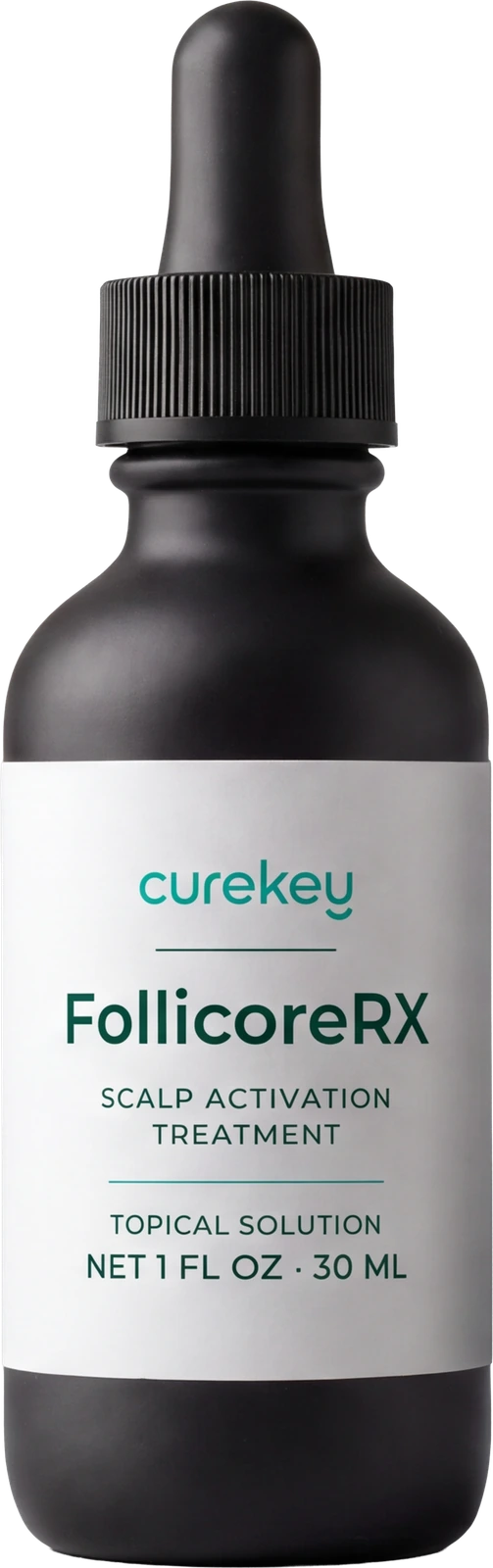
Treatments available through Curekey
Phoenix sits inside one of the country's fastest-growing metros, with Maricopa County adding new residents at a pace that has outstripped local specialty-care capacity for several years. A patient pursuing hair-loss treatment here is typically choosing between waiting for an in-person dermatology slot at a Banner, HonorHealth, or Mayo Clinic Phoenix-affiliated practice, or starting an evidence-based medication plan through telehealth in the meantime. The medications used by Curekey physicians are the same generic, well-studied options a Valley dermatologist would consider in clinic. Depending on your assessment, options that may be discussed include:
- Topical minoxidil, most often the 5 percent formulation
- Oral minoxidil at low doses, when medically appropriate
- Oral finasteride for men with male-pattern hair loss
- Dutasteride in selected cases, under physician supervision
- Spironolactone for women's pattern hair loss, when medically appropriate
The right plan is individualized: medical history, examination findings, current scalp pattern, and tolerance all feed into what the physician recommends. Most Phoenix patients are looking at a six- to twelve-month horizon before judging whether a chosen treatment is working.
How telehealth hair-loss care works in Arizona
Curekey works with physicians licensed to practice in Arizona, and your prescribing physician must hold an active Arizona license at the time of your consultation. The Arizona Medical Board applies the same standard-of-care expectations to a virtual visit that it applies to an in-person dermatology appointment at a Camelback Road clinic or a Mayo Clinic Phoenix campus follow-up.
Practically, the assessment is built around a structured intake plus scalp photographs of the hairline, crown, mid-scalp, and overall density. Most Phoenix patients photograph themselves under indoor lighting since the harsh outdoor light here washes out the contrast a physician needs to evaluate miniaturization. The physician reviews the photographs and history together, and either builds a treatment plan or, when there is a finding that requires hands-on examination such as suspected scarring alopecia or an unusual progression pattern, recommends an in-person dermatology referral.
Wait times at Valley dermatology practices have grown in step with the population. Patients in Ahwatukee or the far East Valley often report two to three months between calling and seeing a board-certified dermatologist for a cosmetic concern. Telehealth assessment compresses the diagnostic step to a few days, which matters most when a patient is in the early, treatable window of progression.
Phoenix-specific geographic and lifestyle context
The Valley's climate is the single biggest day-to-day factor in scalp care here, and it operates on two separate channels. The first is sun protection. Phoenix records roughly five months a year of daytime highs over 100 degrees, surface temperatures on exposed concrete that exceed 140 degrees in the worst summer afternoons, and more than 300 days of sun. Thinning areas of the scalp burn within minutes of unprotected exposure on a July walk from a Sky Harbor terminal to a parking shuttle, or on a Saturday round at one of the Valley's roughly 200 golf courses. A wide-brim hat or a scalp-formulated sunscreen is sun-safety advice, not a hair-loss intervention, but it comes up often in follow-up messaging because protecting the skin on a thinning scalp is its own concern.
The second is humidity. The dry desert air dries topical formulations quickly, which most Phoenix patients find convenient, though scalp dryness and flaking can be a separate complaint that informs which vehicle (solution, foam, oral) a physician considers. None of this changes the underlying biology of pattern hair loss, but it shapes how patients describe their experience.
Maricopa County's commute geography matters too. A patient living in Queen Creek or Buckeye and working in Tempe or central Phoenix can easily spend two hours a day in the car. Telehealth assessment removes the round trip from the equation, and ongoing follow-ups happen through secure messaging rather than a second drive.
Common patterns of hair loss
The Valley's demographic split shows up in the cases Curekey physicians see. Phoenix has a large young-professional workforce in healthcare, finance, semiconductor manufacturing along the Loop 101 corridor, and aerospace, and patients in their twenties and thirties often present with early frontal recession or initial crown miniaturization. The East Valley and Sun City communities anchor one of the country's largest retiree populations, and patients in their sixties and seventies more often present with long-standing crown thinning and broader diffuse density loss. The biology is the same: this is androgenetic alopecia at different points along its course. What differs is the stage at which the patient is seeking care, and what realistic expectations look like at that stage. The stages of hair loss page covers the trajectory in more detail.
What to expect
The Phoenix calendar can work against patient patience: an outdoor city with strong "before-and-after" visual culture tends to push expectations forward by a few months. Hair biology does not move that fast. The first few weeks on a regimen will not show in a mirror or a photograph, because the follicle cycle responds on a months-long timescale. Most Phoenix patients see early signs of stabilization or modest regrowth in the third-to-sixth-month window, with continued change running through month twelve. Some patients see a temporary increase in shedding in the first weeks of starting a treatment, which is generally considered an expected part of how some medications shift the hair cycle.
Side effects, when they occur, are usually mild and are discussed at the assessment stage so you know what to watch for in the Arizona summer (when scalp irritation can be confused with heat-related skin changes) and in the cooler months. Ongoing communication with your physician through the Curekey platform means questions about a new symptom or a tweak to the regimen can be answered without booking a new appointment.
Getting started in Phoenix
Whether you are in central Phoenix, Paradise Valley, Scottsdale, Tempe, Chandler, Gilbert, Mesa, Glendale, Peoria, or one of the further Valley communities like Surprise, Queen Creek, or Buckeye, the workflow is the same. Patients commuting in from outside the metro, including Prescott, Flagstaff, Casa Grande, and the Tucson corridor, use the same assessment path. You complete the intake, upload your photographs, and an Arizona-licensed Curekey physician reviews your case. If treatment is appropriate, prescriptions are sent to a partner pharmacy and shipped to your address.
For background on the assessment process and what a typical treatment journey looks like, see how it works and the guide on how long hair loss treatment takes.