The most common question asked about minoxidil is also the hardest one to answer in a single line: "how fast does it work?" Hair grows slowly, and minoxidil acts on a cycle that does not produce overnight change. What people typically want to know is when the first visible signs appear, when full effect can be evaluated, and what a normal week-by-week experience looks like. The honest timeline is that meaningful visible change appears around the four-to-six-month mark for most responders, but the underlying mechanism starts working from the first dose. This guide walks through the realistic stages, what is happening biologically at each one, and how to interpret what you see in the mirror.
How minoxidil acts on the hair cycle
To understand the timeline, it helps to know the biology. The hair growth cycle has three phases: anagen (active growth, lasting 2 to 6 years), catagen (a brief transition), and telogen (a 2 to 4 month rest before the hair sheds and a new one begins growing). In pattern hair loss, follicles spend less time in anagen, and the hairs they produce are progressively thinner and shorter. Minoxidil acts at the follicle level to shorten the telogen phase and extend the anagen phase, which over time produces denser, thicker hair.
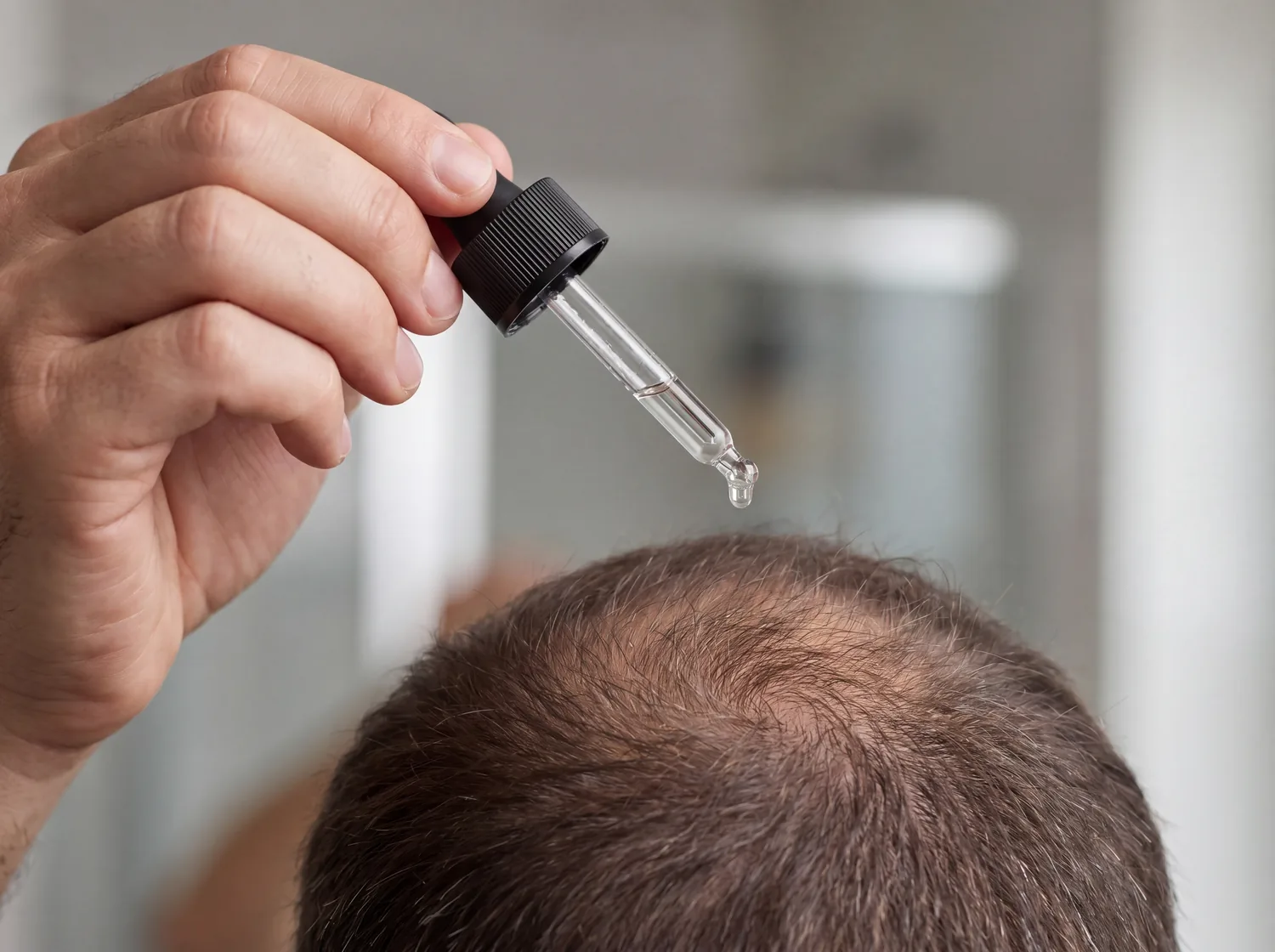
That mechanism is the reason the timeline cannot be compressed. Even when minoxidil is working perfectly from week one, the visible result is gated on how long it takes a follicle to cycle. The fastest changes you can see are the result of cycles that were already in progress when you started.
Weeks 1 to 4: foundation
In the first month, almost nothing is visible. Some users notice slight changes in scalp feel or moisture on the application site, and a small minority experience early irritation or itchiness from the vehicle (propylene glycol in liquid formulations, less so in foam). Hair counts have not changed in either direction.
What is happening biologically is that minoxidil is being converted to its active form by the enzyme sulfotransferase in the scalp and is beginning to influence the cycle of follicles already in or near a transition point. This is also when the routine matters most: minoxidil works only with consistent application, and missing doses in this phase tends to delay the entire timeline rather than just shift it.
Weeks 4 to 12: the shedding phase
Many patients see an apparent increase in daily shedding starting somewhere between weeks four and twelve. This is the phenomenon often called "minoxidil shed" and is covered in detail in why hair sheds when you start treatment. The mechanism is that follicles in the late telogen phase release their old hair earlier than they otherwise would have, making room for a new growth phase to begin. The shed is real, the volume can be unsettling, and it is generally understood to reflect the medication acting on the cycle rather than accelerating loss. It does not, by itself, predict how well you will respond.
The shed typically peaks within a few weeks of onset and resolves within one to two months. Continuing through it is part of the protocol; stopping at this stage means losing both the medication's effect and any benefit from the cycle change already in progress.
Months 3 to 4: stabilization
By the end of the third month into the fourth, most users notice that daily hair fall is closer to their baseline than during the shedding phase. The mirror still does not look meaningfully different from where you started; what has changed is that the cycle has shifted and short, fine "vellus-like" regrowth hairs are beginning to emerge along the hairline and in thinning patches. These are easiest to see under bright, direct light at the temples or in the part. They are not always obvious to the patient and are often easier for a partner or a comparison photo to catch.
Standardized photos taken in the same lighting, angle, and hair length at month 0 and month 4 are the most reliable way to track this stage. Memory is unreliable across that interval; photos are not.
Months 4 to 6: early visible regrowth
This is the phase most patients describe as "when it started working." The fine regrowth hairs from months three and four have thickened and lengthened. Density at the part begins to look more even. Patients with crown thinning often notice the change first in the crown, where the contrast between miniaturized and terminal hairs is visually starkest.
In the major clinical trials of topical 5% minoxidil, the 16-to-24-week window is where placebo and treatment groups separated in measured hair count, and where investigator and patient self-assessment scores began to favor the active medication (Olsen et al., J Am Acad Dermatol, 2002). This is the empirical basis for the "four-to-six months" answer you will see in most physician guidance.
Months 6 to 12: full effect
By six months, response can be evaluated; by twelve months, it is essentially final. Hair counts continue to climb modestly between months six and twelve, but the rate of change slows. The phrase "this is what you have to work with" is appropriate at the twelve-month mark.
Roughly 60 to 70% of users on topical 5% minoxidil experience either stabilization or visible regrowth at twelve months (Olsen et al., J Am Acad Dermatol, 2002). A minority experience non-response. A small fraction continue to lose hair despite the medication, although the rate of progression is usually slower than it would have been without treatment.
What "non-response" actually means
There is a temptation to label a treatment a failure at the three-month mark when shedding is high and visible regrowth is not yet evident. That is too early. The honest definition of non-response is no visible change in standardized photos at six to nine months of consistent application at the correct dose.
When response is genuinely low at the six-month mark, the conversation with a physician usually covers:
- Application technique and consistency. Twice-daily application at the correct dose is the most common variable.
- Formulation. Foam may be tolerated better than liquid for some patients; some patients on liquid switch to foam for usability rather than efficacy.
- The role of oral vs. topical minoxidil. Low-dose oral minoxidil is an alternative for selected patients who do not respond to or tolerate topical, but it is a prescription decision that involves additional considerations.
- Combination therapy with finasteride, which addresses the underlying DHT signal rather than the cycle mechanism that minoxidil targets, and which the two-drug combination evidence shows often outperforms either monotherapy (Khandpur et al., J Dermatol, 2002).
These are decisions to make with a physician rather than alone.
What happens if you stop
Minoxidil works only while you are using it. If you stop the medication, the follicles that had been shifted into longer growth phases gradually return to their previous cycle, and the gained density is lost over the following 6 to 12 months. This is the most important point about the timeline that often gets missed: the fastest part of minoxidil's effect is the part that disappears the fastest if the medication is discontinued. The decision to start is also a decision to continue; the conversation about what happens if you stop treatment is worth having before you begin rather than after.
Realistic expectations summary
If you start minoxidil today, a realistic mental model is: nothing visible for the first three months, possible increased shedding around the second or third month, fine regrowth detectable in the fourth month, density visibly different in the mirror by month five or six, and a meaningful assessment of total response at month twelve. The medication will not work as fast as you want it to. It will, for most users with androgenetic alopecia, work.
If you are weighing whether topical minoxidil is the right starting point for your situation, the topical treatment flow at Curekey begins with a brief medical assessment and a physician review before any prescription is issued. The physician can speak to dose, formulation, and whether combination therapy is appropriate from the start.
Related reading
- How minoxidil treats hair loss: the underlying mechanism and dosing.
- Why hair sheds when you start treatment: the cycle-based explanation for the early shed.
- What to expect in the first 6 months of treatment: the month-by-month overview for both minoxidil and finasteride.
- Minoxidil topic pillar: reference content on dose, formulation, and side effects.
- How long does hair loss treatment take?: the broader timeline question across treatment classes.