Hair loss shampoos occupy an uncomfortable middle ground between proper medical treatment and pure cosmetic care. The shelf at any pharmacy includes products that promise to thicken, strengthen, regrow, or prevent the loss of hair. Most of them do not work in any clinically meaningful way. A small number contain ingredients with real, if modest, evidence behind them. This guide separates the two and is honest about how much realistic benefit a shampoo can provide for someone with pattern hair loss or shedding.
What a shampoo can and cannot do
A shampoo is in contact with the scalp and follicles for typically a minute or two before being rinsed off. That is a very short window for an ingredient to penetrate the scalp, reach the follicle, and have a biological effect. By comparison, topical minoxidil is left on the scalp for hours at a time, twice daily, every day. The difference in contact time is one of the main reasons that shampoos struggle to match the efficacy of leave-on treatments.
What a shampoo can plausibly do:
- Reduce scalp inflammation if it contains an active anti-inflammatory ingredient.
- Reduce fungal load (dandruff, seborrheic dermatitis) if it contains an antifungal.
- Make existing hair look thicker by coating individual strands.
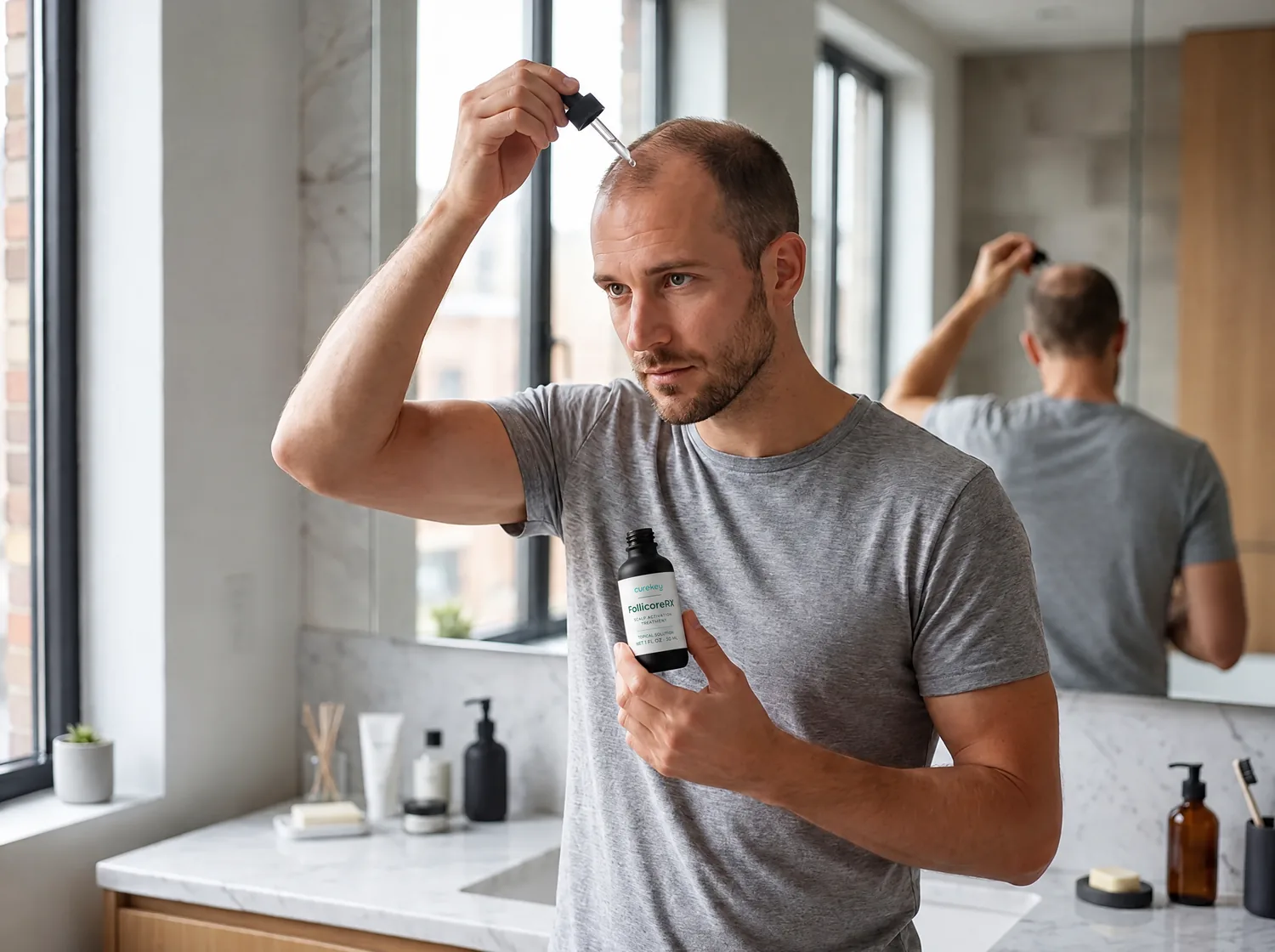
What a shampoo cannot meaningfully do:
- Reverse androgenetic alopecia on its own.
- Regrow significant amounts of hair the way prescription topical or oral medications can.
- Replace a medical assessment when hair loss is progressing.
This is the realistic frame. With that in mind, the question becomes: which ingredients have meaningful clinical evidence?
The ingredient with the most evidence: ketoconazole
Ketoconazole 2% is an antifungal traditionally used to treat dandruff and seborrheic dermatitis. It also appears to have a measurable effect on hair density in pattern hair loss, both because reducing scalp inflammation is itself helpful for follicle health and because ketoconazole has weak anti-androgenic activity that may reduce local DHT signaling at the follicle.
The clinical evidence is modest but real. A frequently cited study compared ketoconazole 2% shampoo to a non-medicated shampoo and to topical minoxidil 2% in men with androgenetic alopecia, and reported that ketoconazole produced hair density improvements that approached, though did not equal, those of minoxidil (Piérard-Franchimont et al., Dermatology, 1998). Subsequent smaller studies have generally supported a modest effect.
The bottom line is that ketoconazole 2% shampoo is the one over-the-counter hair loss shampoo with clinical evidence worth taking seriously. It is covered in detail in the dedicated ketoconazole shampoo guide.
A few practical notes:
- Most pharmacies sell 1% ketoconazole shampoo over the counter; 2% is typically prescription in the U.S. The 1% concentration has weaker but probably real effect.
- Twice-weekly use, left on the scalp for 3 to 5 minutes before rinsing, is the standard protocol.
- It is well-tolerated for most users; some report dryness or mild scalp irritation.
Ingredients with weaker evidence
Several ingredients commonly found in "hair loss shampoos" have a small evidence base, mostly from older or smaller studies. Take any single-study claim with caution.
Saw palmetto is sometimes included for its proposed weak 5-alpha-reductase inhibition (the same enzyme that finasteride blocks). The topical evidence in shampoo form is thin; a few small studies have reported modest improvements, but the effect appears much smaller than oral finasteride and the consistency of the evidence is poor.
Caffeine in topical form has been studied at higher concentrations than appear in most shampoos. In vitro studies show caffeine can stimulate follicle growth, but the translation to leave-on caffeine shampoo in real users is weak. Calling a caffeinated shampoo a "hair loss treatment" overstates what the data supports.
Biotin in shampoo form is largely theatre. Biotin works systemically when there is a deficiency; topical application in a wash-off product has no plausible mechanism to deliver clinically relevant amounts to the follicle.
Niacinamide, panthenol, and various peptide blends are mostly cosmetic. They may improve how individual strands look or feel but do not have evidence for affecting the rate of hair loss.
Anti-dandruff shampoos and hair shedding
A small but real subset of "hair loss" caused by scalp inflammation can be improved by treating the underlying scalp condition. If you have visible dandruff, scalp itching, redness, or flaking alongside thinning, treating the scalp condition (with ketoconazole, zinc pyrithione, selenium sulfide, or coal tar shampoos) is worth doing in parallel with any other hair loss treatment. The thinking is not that the shampoo is regrowing hair, but that an inflamed scalp is a worse environment for follicle health than a healthy one.
For scalp inflammation specifically, scalp care for thinning hair covers a fuller approach.
Shampoos that claim to "block DHT"
A common marketing claim is that a shampoo "blocks DHT." This is technically true in some narrow sense (some ingredients do bind to or inhibit 5-alpha-reductase in vitro), but it overstates what the product can achieve. Oral finasteride at 1 mg daily reduces scalp DHT by 60 to 70%; topical ketoconazole 2% may modestly reduce local DHT activity. The difference is large. A shampoo is not a substitute for the medications that have actually been shown in placebo-controlled trials to halt or reverse hair loss. It can be a useful adjunct.
The full comparison of minoxidil vs. finasteride is useful context for understanding what real DHT reduction looks like clinically.
Practical recommendation
For a typical patient with mild to moderate pattern hair loss who asks "should I use a hair loss shampoo?", the practical answer is:
- A ketoconazole-based shampoo (1% over-the-counter or 2% by prescription) is the one worth using, twice weekly, alongside other treatments.
- A non-medicated "hair loss shampoo" with a long ingredient list and bold claims is probably not worth the markup over a regular gentle shampoo.
- Shampoo on its own is not a substitute for the prescription treatments that have decades of trial evidence. If hair loss is progressing, a medical assessment is the right step.
A reasonable scalp care routine combined with appropriate medical treatment outperforms a complicated shelf of single-ingredient shampoos.
What to skip
A few patterns are worth recognizing and skipping:
- "Dermatologist recommended" without specifics. Many shampoos use this phrase loosely. The relevant question is which dermatologists, in what context, and what specific evidence they were citing.
- Patient testimonials in the absence of trial data. Telogen effluvium resolves on its own; pattern hair loss can be slow enough that small short-term changes are hard to interpret. Testimonials over months are unreliable evidence.
- Combination products with 20 ingredients. A long ingredient list does not equal efficacy. The shampoo with the most evidence for hair loss is a relatively simple ketoconazole-based formulation.
Related reading
- Ketoconazole shampoo for hair loss: the one shampoo ingredient with meaningful evidence, in depth.
- Scalp care for thinning hair: daily care practices that support follicle health.
- How minoxidil treats hair loss: the leave-on topical with much stronger evidence than any shampoo.
- Do hair loss supplements work?: the parallel question about oral supplements.
- How it works: Curekey's assessment, physician review, and prescription treatment flow.