Hair loss treatment for women is an area where the evidence base is meaningful but smaller than the corresponding evidence in men, and where the right plan depends heavily on the underlying cause. The same medication that helps one woman with female pattern hair loss may be inappropriate for another whose hair loss is being driven by an iron deficiency or a thyroid issue. The same medication that is reasonable for a post-menopausal woman may be contraindicated for a woman who could become pregnant. This page walks through the medications and supportive measures most often used, the patterns of hair loss they are designed to address, and the trade-offs that shape real-world prescribing decisions.
The discussion is general and educational. Specific treatment decisions are made in collaboration with a physician who has examined the scalp, taken a history, and reviewed laboratory results.
Why diagnosis comes before treatment
Several conditions can produce diffuse thinning or shedding in women, and they do not all respond to the same approach.
- Female pattern hair loss is treated with medications that slow miniaturization, particularly minoxidil and, in selected cases, anti-androgens like spironolactone.
- Postpartum telogen effluvium is largely self-limited. The right approach is reassurance, evaluation of contributors, and watchful waiting rather than starting a long-term medication.
- Thyroid-related hair loss improves when the thyroid is treated. Hair-specific medication on top of an untreated thyroid issue will not produce its full benefit.
- Iron deficiency responds to iron repletion. Adding hair medications without correcting the underlying deficiency leaves a contributor in place.
- PCOS-related hair loss often benefits from a combination of an anti-androgen, minoxidil, and addressing insulin resistance when relevant.
- Scarring alopecias require dermatologic evaluation and treatment specific to the inflammatory or autoimmune process; standard pattern-loss treatments are not the right answer.
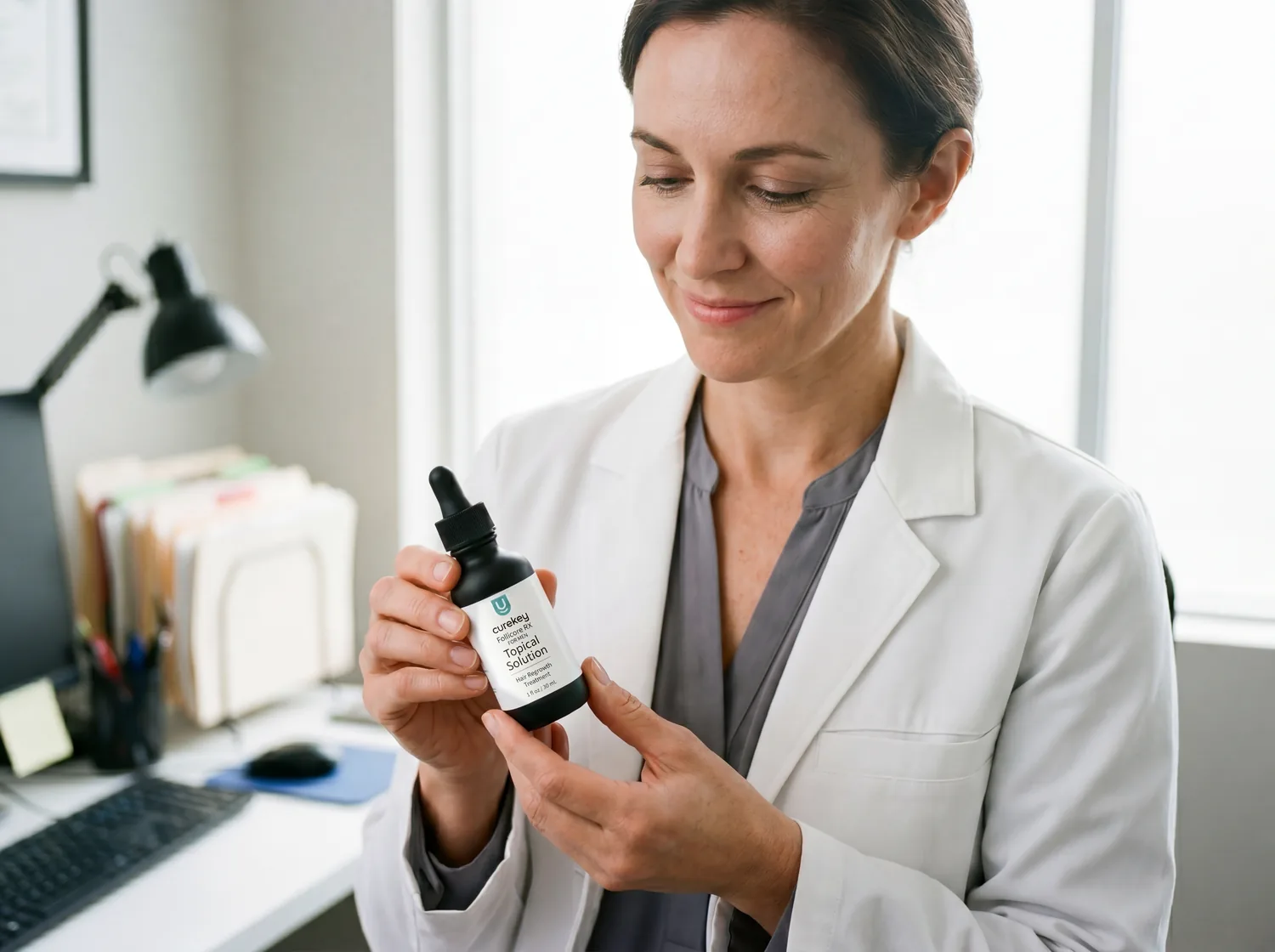
A focused medical evaluation, with appropriate laboratory testing, is usually the first step. The hair loss in women overview describes the broader categories, and the diffuse hair thinning page covers the differential when the pattern is not obvious.
Minoxidil for women
Minoxidil is the most established medical treatment for female pattern hair loss and is also used in some other settings under physician supervision.
Mechanism
Minoxidil prolongs the anagen (active growth) phase of the hair cycle and partially reverses follicle miniaturization. The result is that hairs grow longer and thicker before transitioning to telogen, and follicles that have been declining can produce more substantial hairs than they were producing recently. The mechanism is covered in more depth on the how minoxidil treats hair loss guide.
Topical formulations
Topical minoxidil is available in 2% solution and 5% foam (and 5% solution in some markets). For women, both 2% twice daily and 5% once daily have been studied. The 5% foam once daily formulation is widely used: it dries faster, tends to cause less scalp irritation, and the once-daily schedule helps with consistency. The 2% solution remains an option, particularly when the 5% strength causes irritation or unwanted facial hair growth at the periphery of application.
Practical considerations:
- Apply to a dry scalp at the area of thinning, then leave undisturbed.
- A "shedding phase" in the first one to three months is common and represents resting follicles entering a new growth cycle. It is expected and not a sign of failure.
- Visible improvement typically appears at four to six months.
- Full benefit is evaluated at twelve months.
- Stopping treatment leads to gradual return to the pre-treatment trajectory. See what happens if you stop treatment.
Low-dose oral minoxidil
Low-dose oral minoxidil is used by some physicians for women who cannot tolerate topical use, who have not responded adequately, or who prefer a once-daily oral medication. Doses used in this context are far lower than the historical antihypertensive doses. Considerations include screening for cardiovascular contraindications, monitoring for fluid retention, and managing the higher likelihood of unwanted hair growth on the face or body compared with topical use. The topical vs oral minoxidil guide compares the two routes in detail. For broader context, the minoxidil topic page gives an overview.
Side effects
Common side effects of topical minoxidil include scalp irritation, dryness, and unwanted hair growth on the face if the medication migrates. Common minoxidil side effects more broadly are covered on the common minoxidil side effects guide.
Spironolactone
Spironolactone is an oral medication that blocks androgen receptors and modestly reduces androgen production. It was originally developed as a potassium-sparing diuretic and is used in dermatology for androgen-driven conditions in women, including female pattern hair loss and androgenic acne.
Where it fits
Spironolactone is most useful in women whose hair loss appears to have a meaningful androgen-driven component. This includes:
- Female pattern hair loss, particularly with associated signs of androgen excess (acne, oily skin, increased facial or body hair).
- PCOS-related hair loss, often combined with topical minoxidil. See the PCOS and hair loss page for the broader picture.
- Post-menopausal women with female pattern hair loss when androgen blockade is judged appropriate.
Dosing and timeline
Doses for hair loss are typically lower than doses used for blood pressure or fluid management, and physicians usually start at the lower end and titrate. Effects on hair are gradual. Four to six months of consistent use is the minimum to evaluate response, with the full benefit assessed at twelve months.
Contraindications and side effects
- Pregnancy is a contraindication because of the risk of feminization of a male fetus. Women of reproductive age who use spironolactone for hair loss generally need reliable contraception.
- Hyperkalemia (high potassium) is a known risk, particularly when combined with ACE inhibitors, ARBs, certain potassium-containing supplements, or in people with reduced kidney function. Periodic potassium and basic kidney function monitoring is standard.
- Menstrual irregularity can occur and is sometimes addressed by combining spironolactone with a combined oral contraceptive.
- Breast tenderness and breast enlargement are reported.
- Diuretic effects (increased urination, mild blood pressure changes) are usually modest at the doses used for hair loss.
When it is not appropriate
Spironolactone is not the right choice when hair loss is being driven primarily by a non-androgenic process (telogen effluvium, iron deficiency, thyroid disease) and when the underlying issue has not been addressed. It is also generally avoided in women with significant kidney impairment, baseline elevated potassium, certain endocrine tumors, or adrenal insufficiency.
Why finasteride and dutasteride are used cautiously in women
Finasteride and dutasteride reduce DHT by inhibiting 5-alpha reductase. They are first-line treatments for male pattern hair loss and have a strong evidence base in men. In women, the picture is more complex.
Pre-menopausal women
These medications carry teratogenic risk, particularly to a male fetus, and women who could become pregnant are generally not prescribed them outside of carefully managed circumstances. Limited evidence in pre-menopausal women shows mixed results, and other options (minoxidil, spironolactone) are usually preferred.
Post-menopausal women
Without pregnancy as a consideration, finasteride and dutasteride may be considered off-label in some post-menopausal women with female pattern hair loss, particularly those who have not responded adequately to first-line measures. Evidence in this population is more limited than in men, and practice varies widely. Decisions are individualized.
The finasteride topic page covers the medication in more depth for context. Side-effect considerations relevant in some patients are covered on the sexual side effects of finasteride guide, with the caveat that much of that literature is in male populations.
Supportive care: iron, thyroid, vitamin D, and basic health
Several conditions are common contributors to hair thinning in women and should be evaluated and addressed when present.
Iron
Low ferritin is a frequent contributor to diffuse shedding, particularly in menstruating women, vegetarians and vegans, and those with heavy menses. Some dermatologists target a ferritin above 40 to 70 ng/mL when iron is felt to be a contributor, though optimal targets remain debated. Iron repletion is treatment for iron deficiency, not a stimulant for hair growth in women whose iron is already adequate.
Thyroid
Both hypothyroidism and hyperthyroidism can cause diffuse hair loss. Treatment of the thyroid condition usually leads to improvement in hair density, though it may take many months for the cycle to fully recover.
Vitamin D
Deficiency is common and may play a supporting role. Repletion is reasonable when documented. Routine high-dose supplementation in the absence of deficiency does not have strong evidence for hair benefit.
General nutrition and lifestyle
Adequate protein, regular meals, and reasonable management of stress are non-specific but real contributors to hair health. The diet and hair loss guide covers what the evidence does and does not show. The scalp care for thinning hair guide covers daily care that protects hair while it is fragile.
Medications and substances
Several medications can cause hair shedding, including some hormonal therapies, anticonvulsants, beta-blockers, and others. Reviewing the medication list is part of a thorough evaluation. Stopping a culprit medication, when feasible, may resolve the issue without adding hair-specific treatment.
Realistic timelines
A consistent message across hair loss treatments is that change is slow.
- The hair growth cycle takes years from start to finish.
- An effective medication does not produce visible results in weeks.
- Four to six months is a reasonable minimum to begin evaluating response.
- Twelve months is a reasonable point to evaluate full benefit.
The how long does hair loss treatment take page goes deeper into the timing question. Photographs taken in consistent lighting are far more useful for tracking progress than memory.
Considering medical assessment
The right hair loss treatment plan for a given woman depends on the pattern of loss, the underlying contributors, the medical history, and the personal context (reproductive plans, other medications, ability to use a topical consistently). A medical consultation puts these together rather than treating any single piece in isolation. How Curekey works describes the process. The hair loss in women overview and the female pattern hair loss page provide the broader context for what these medications are addressing.
Hair loss is treatable for many women, but the most common reason a treatment fails to deliver is that it was not the right treatment for what was actually happening. Diagnosis first, then a plan, then time.