If you've spent any time researching pattern hair loss, you've probably noticed that minoxidil and finasteride almost always come up together. There's a reason for that. They're the only two medications with a specific FDA indication for androgenetic alopecia, and they work through completely different mechanisms. When patients respond well to medical treatment, it's often because they're using both.
Here's a clear-eyed look at why combination therapy tends to outperform either drug on its own, what the clinical evidence says, and how to think about whether pairing the two makes sense for you.
Two drugs, two different jobs
Minoxidil and finasteride are not interchangeable. They're complementary, and the reason they work well together is that each one addresses a different part of the hair loss process.
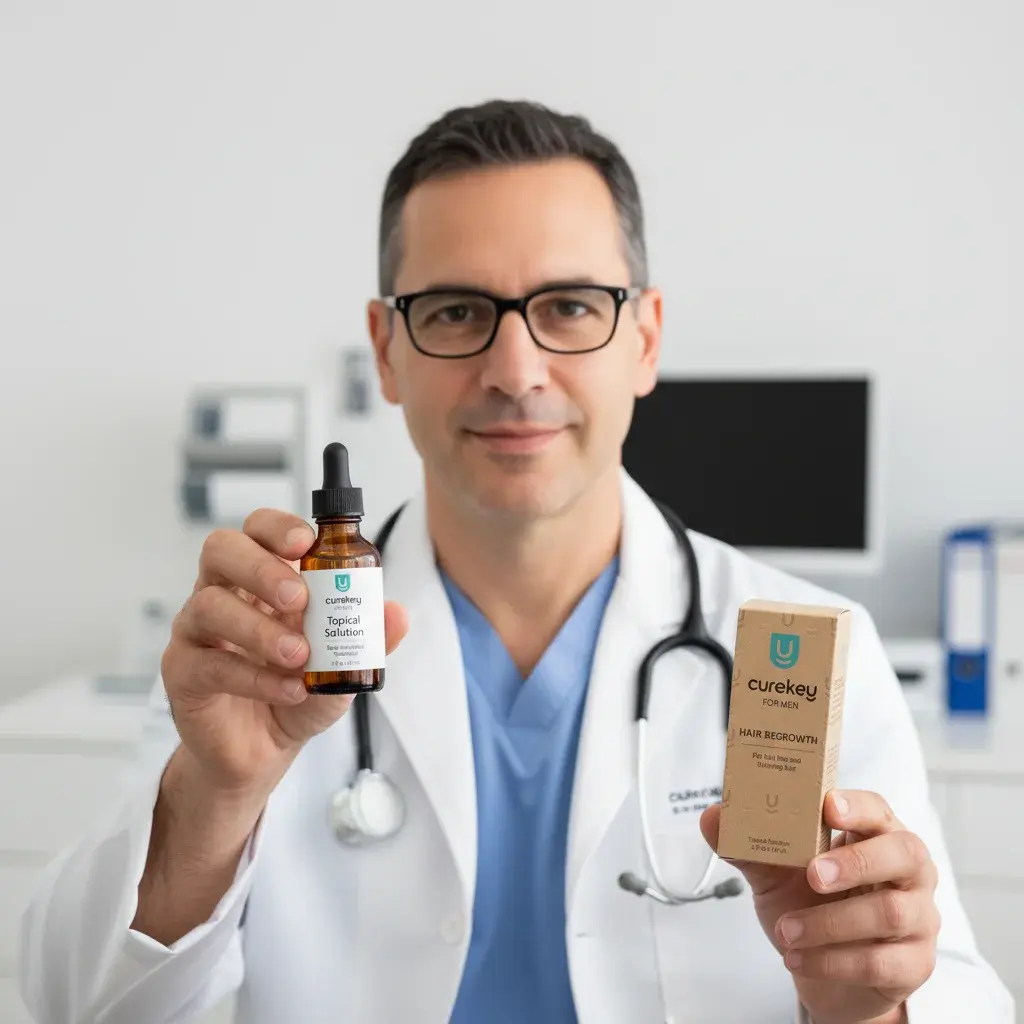
Finasteride is a 5-alpha-reductase inhibitor. It blocks the enzyme that converts testosterone into dihydrotestosterone (DHT), the hormone that drives follicle miniaturization in genetically susceptible scalps. Lowering scalp DHT by roughly 60 to 70% halts or reverses the underlying biological process of androgenetic alopecia (Drake et al., J Am Acad Dermatol, 1999). For more on the mechanism, see our guide on how finasteride treats hair loss.
Minoxidil works downstream. It doesn't touch DHT. Instead, it acts directly on the follicle, prolonging the growth (anagen) phase of the hair cycle, increasing follicle size, and improving local blood flow to the scalp. The net effect is more time spent producing hair, and thicker hair while it's growing. Our companion guide on how minoxidil treats hair loss covers this in more detail.
Put simply: finasteride takes the foot off the brake. Minoxidil pushes on the accelerator. Used together, you get both effects at once.
What the evidence actually shows
Combination therapy has been studied directly in several head-to-head trials. The findings are remarkably consistent.
A study of men with androgenetic alopecia compared minoxidil 5% topical, finasteride 1 mg oral, and the combination of both. After 12 months, the combination group showed greater improvements in hair density and patient-reported satisfaction than either monotherapy group (Khandpur et al., J Dermatol, 2002).
A more recent meta-analysis pooling data across multiple randomized trials reached a similar conclusion: combination therapy with topical minoxidil and oral finasteride produces meaningfully better hair count and density outcomes at 6 to 12 months than either drug alone, with no significant increase in side effect rates beyond what each medication carries on its own (Hu et al., Drug Des Devel Ther, 2015).
A few headline numbers worth knowing:
- On finasteride alone, about 80 to 90% of men stop losing hair, and roughly 65% see measurable regrowth at 2 years.
- On minoxidil alone, about 60% of men see slowed loss or modest regrowth.
- On the combination, response rates climb above 90%, and the magnitude of regrowth is larger, particularly in the crown and mid-scalp.
The takeaway is not that combination therapy is a guarantee. It's that the response curves for the two drugs together are shifted upward across the board.
Why the two-pronged approach makes biological sense
Pattern hair loss is not a single problem. It's a cascade. DHT triggers miniaturization, miniaturized follicles spend less time in anagen, the hair shaft thins, and over years the visible hair density on the scalp declines.
Treating only the hormone, with finasteride, addresses the cause but does not directly stimulate the follicles that have already been struggling. Treating only the follicle, with minoxidil, can produce thicker hairs but doesn't change the hormonal environment that caused the problem in the first place. If a patient stops minoxidil, miniaturization continues unchecked.
Layering both means you're slowing the hormonal driver while simultaneously coaxing the follicles back toward a longer, more productive growth phase. This is also why patients often see their best results during the first 12 months of combination therapy: both mechanisms are reinforcing each other at the same time.
How combination therapy is typically prescribed
There's no single regimen that fits every patient, but a few common patterns:
- Oral finasteride 1 mg daily plus topical minoxidil 5% twice daily. This is the most studied combination and the one most clinical guidelines reference.
- Oral finasteride 1 mg daily plus oral minoxidil at low dose. Low-dose oral minoxidil (typically 1.25 to 5 mg) is increasingly used off-label, especially for patients who find topical application inconvenient or who get scalp irritation from the topical version. Our overview of topical vs. oral minoxidil walks through that comparison.
- Topical combination products that pair both medications in a single solution are an emerging option, though long-term data is still catching up.
The right regimen is a clinical decision that depends on your goals, your medical history, your scalp's tolerance for topicals, and how you want to take medication day to day. A physician walks through this with you, rather than you assembling it yourself.
What to expect on the timeline
Combination therapy follows the same general timeline as either drug alone, but tends to produce more visible change at each milestone:
- Months 1 to 3: Most patients see no improvement yet, and many notice an initial increase in shedding. This is the synchronized shift of follicles into a new growth cycle, not the medication failing. Our guide on why hair sheds when you start treatment explains the mechanism.
- Months 3 to 6: Shedding subsides. Existing hairs begin to thicken. Patients often report that their hair "feels" different before they can see a clear visual change.
- Months 6 to 12: Visible improvement in density and coverage, particularly in the crown. This is when most men, and the people around them, can tell something has changed.
- Year 1 and beyond: Continued maintenance and incremental gains. Stopping either medication causes most of the gains to reverse within 12 months.
For a deeper look at the realistic arc, see what 12 months on hair loss treatment looks like.
Side effects, safety, and the conversation worth having
The two medications have different side effect profiles, and combining them does not appear to amplify each one. Topical minoxidil's side effects are mostly local: scalp dryness, itching, or unwanted facial hair from minoxidil in a small subset of users. Finasteride's are mostly systemic and hormonal, including a small risk of sexual side effects or mood changes. Our guide on common minoxidil side effects and sexual side effects of finasteride cover each in detail.
Combination therapy is not for everyone. Some patients prefer to start with one medication and add the second only if the response is incomplete. Others want both from day one to get the maximum effect during the productive early window. There are reasonable arguments for either approach, and the right answer depends on your priorities and what your physician thinks is appropriate for you.
The bottom line
Minoxidil and finasteride are not competitors. They're collaborators. Decades of clinical evidence point in the same direction: when used together, they produce better outcomes than either one alone, with side effect rates that remain manageable for most patients.
If you're weighing combination therapy, the right next step is a conversation with a licensed clinician who can review your situation, discuss whether oral treatment, topical treatment, or both is the right place to start, and help you build a regimen you can actually stick with.
Hair loss is treatable, and the strongest case for combination therapy is the simplest one: two mechanisms, working at the same time, on the same problem.