Hydroxychloroquine is a long-established medication for autoimmune conditions, most commonly systemic lupus erythematosus and rheumatoid arthritis. Patients who notice increased shedding after starting it often wonder whether the drug is responsible. The honest answer is that hair loss is a recognized but uncommon side effect, and that the relationship between this particular medication and the scalp is more layered than for most drugs, because hydroxychloroquine is also used to treat certain types of hair loss. Understanding both directions matters before anyone considers changing a medication that may be controlling a serious disease.
How often it actually happens
Hydroxychloroquine is generally well tolerated, and hair loss is not among its most frequent effects. A systematic review characterizing the drug's dermatologic adverse effects identified hair loss among the reported reactions, but it appeared in a relatively small number of documented cases compared with the medication's overall use (Sharma et al., J Am Acad Dermatol, 2020). In other words, most people taking hydroxychloroquine do not lose hair because of it, and when shedding does occur it is the exception rather than the rule.
When hair loss is linked to the drug, it usually follows the pattern of telogen effluvium: a diffuse, all-over thinning caused by a larger-than-normal share of follicles shifting into their resting phase at once. This is the same mechanism behind shedding from illness, stress, and many other medications, and it is covered in depth in stress and hair loss: telogen effluvium. Telogen effluvium is typically reversible once the trigger is addressed, and the shed follicles are not permanently destroyed.
Why the underlying illness muddies the picture
One reason it is hard to pin shedding on hydroxychloroquine specifically is that the conditions it treats can cause hair loss on their own. Systemic lupus is well known for producing both diffuse shedding and, in some cases, scarring hair loss. So a lupus patient who sheds after starting hydroxychloroquine faces a genuine question of attribution: is the medication doing it, or is the disease activity, or a flare, or the stress of being unwell? This is exactly the kind of situation where a prescribing physician's judgment matters more than a general rule, because the answer changes what should be done next.
The two-directional twist
Here is what makes hydroxychloroquine unusual among medications associated with hair loss. It is also used as a treatment for several hair-loss conditions, particularly scarring alopecias driven by inflammation, such as lichen planopilaris and discoid lupus affecting the scalp, and it is studied in conditions like central centrifugal cicatricial alopecia covered on the CCCA page. A retrospective review specifically examined adverse events in patients taking oral hydroxychloroquine for cicatricial alopecia, underscoring that it is a recognized part of the treatment toolkit for these scarring conditions (Errichetti et al., J Am Acad Dermatol, 2022).
So the same drug can be implicated in shedding for one patient and prescribed to protect the hair of another. That apparent contradiction makes sense once you separate the mechanisms: hydroxychloroquine can occasionally trigger reversible telogen shedding, while its anti-inflammatory action is what makes it useful against the inflammation that destroys follicles in scarring alopecia.
What recovery typically looks like
When shedding is driven by a reversible telogen effluvium, the reassuring part is that the follicles are not destroyed. They have shifted into a resting phase prematurely and shed, but they remain capable of producing hair again once whatever pushed them there resolves. Recovery is gradual rather than immediate. Visible regrowth usually takes several months, because hair grows slowly and each follicle has to re-enter and complete a new growth phase. During that window it is common to see short, fine regrowth hairs along the hairline and part before density returns. If shedding continues well beyond six months, or if you notice patches, scaling, redness, or scarring of the scalp, that points away from simple telogen effluvium and toward something that needs in-person evaluation.
What to do if you suspect it
The single most important point is not to stop hydroxychloroquine on your own. It is a disease-controlling medication, and abruptly discontinuing it can allow an autoimmune condition to flare, which is a far more serious problem than reversible shedding. If you notice increased hair loss after starting the drug, the right move is to raise it with the physician who prescribed it. They can weigh whether the timing fits a medication effect, whether disease activity is the more likely culprit, and whether anything in your regimen should change.
It is also worth ruling out the common, treatable contributors that often travel alongside autoimmune disease, including iron deficiency and thyroid dysfunction, which are discussed across the drug-induced hair loss and broader cluster pages. If the shedding turns out to be ordinary telogen effluvium, it generally recovers over several months once the trigger settles.
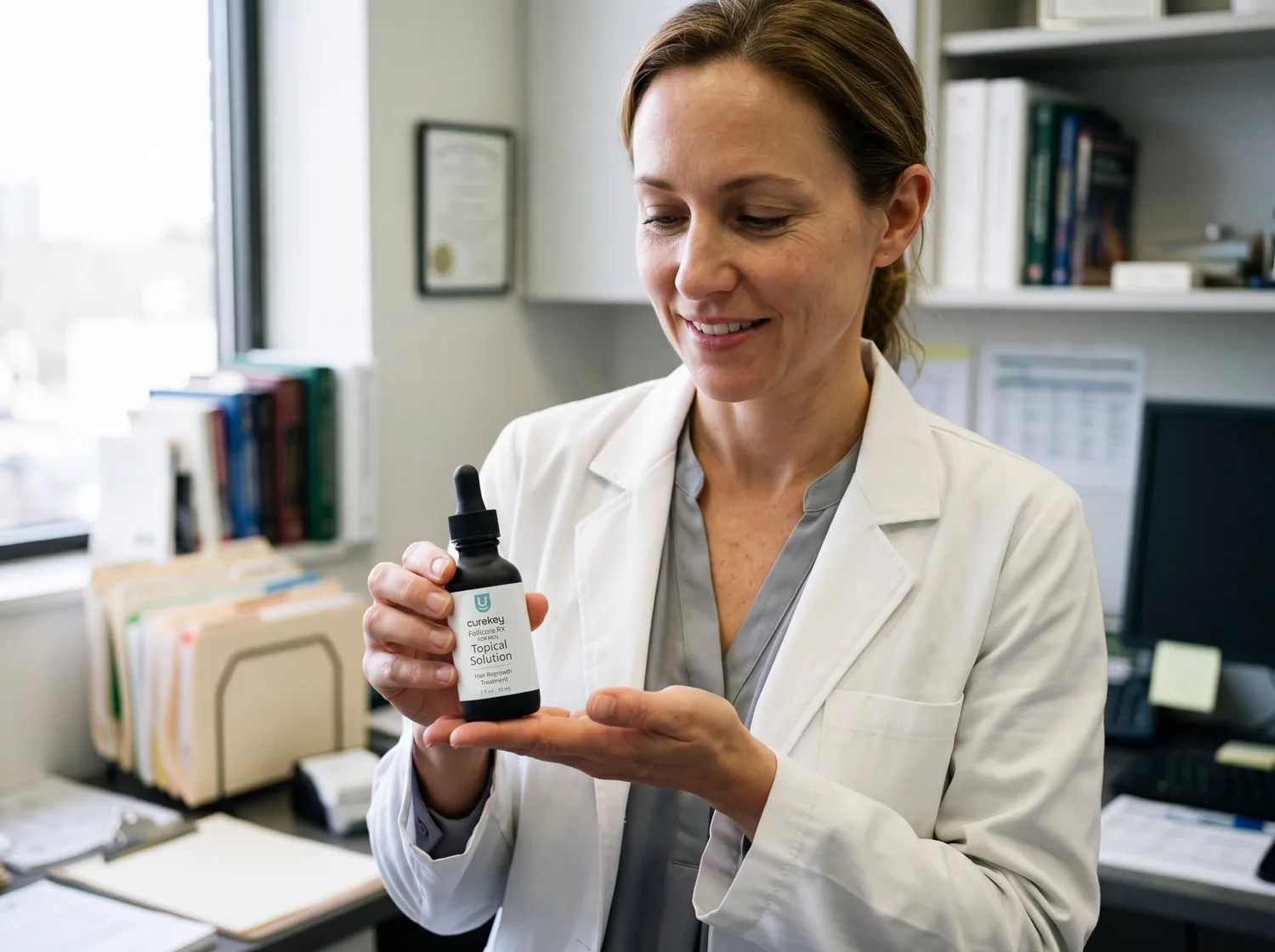
If your hair loss is unrelated to your medication and instead follows the gradual, patterned thinning of androgenetic alopecia, that is a separate process with its own evidence-based treatments. Curekey's hair assessment is one way to have a US-licensed physician review the full picture, though anything tied to lupus, rheumatoid arthritis, or a scarring alopecia belongs first with your treating specialist.