Oral finasteride has been the standard medical treatment for pattern hair loss in men since the late 1990s, with two decades of clinical data behind it. But for some patients, the prospect of a daily systemic medication is a sticking point, particularly when the concern is about potential sexual or mood-related side effects. Topical finasteride emerged as a way to deliver the same active drug, but applied to the scalp rather than swallowed.
It's a newer option, the evidence base is still growing, and the formulation varies between compounding pharmacies. Here's an honest look at how topical finasteride works, what the clinical research currently shows, and how it compares to the oral version most people are familiar with.
What topical finasteride is
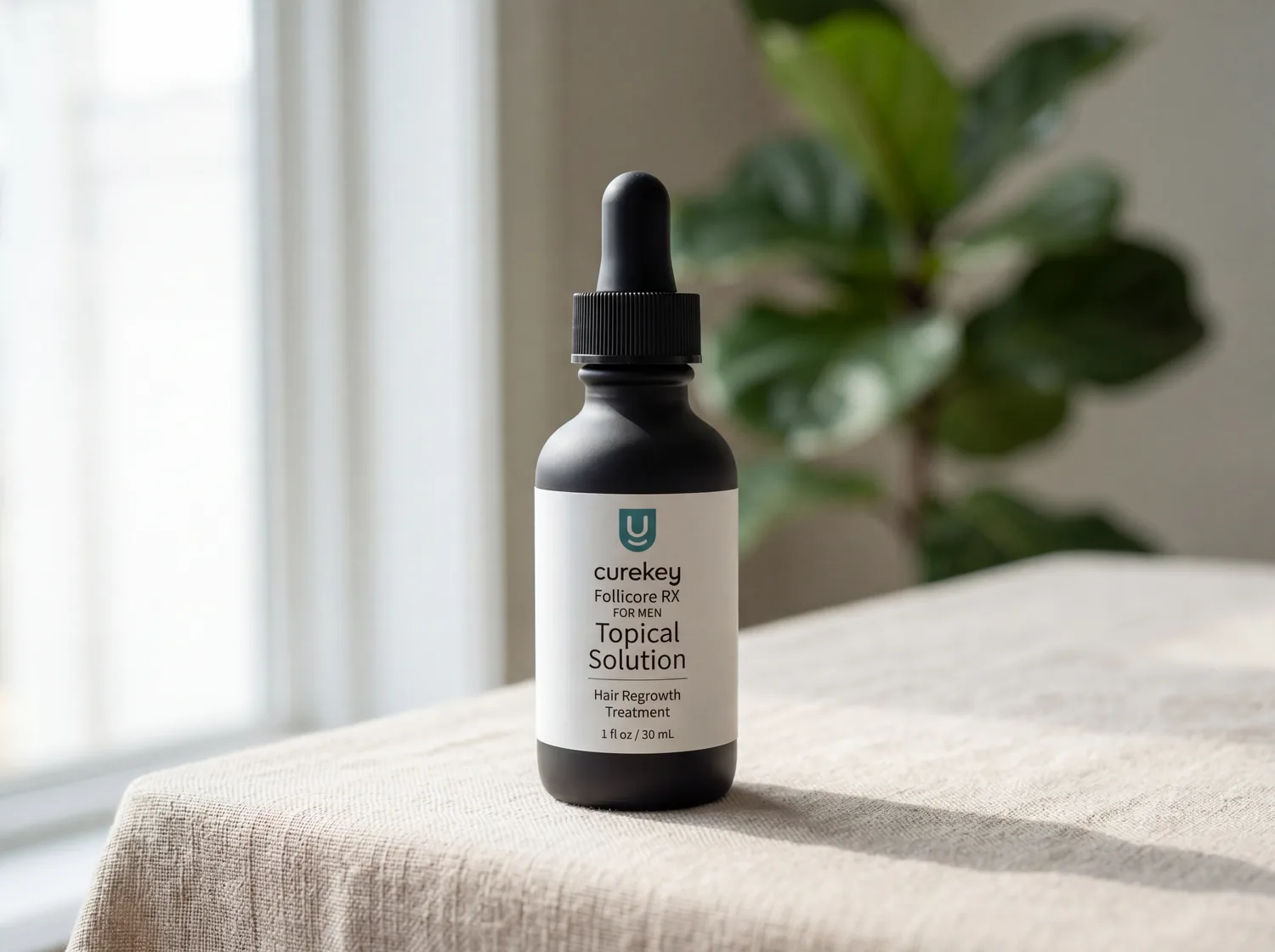
The active ingredient is the same molecule used in oral finasteride. The difference is the delivery: instead of a 1 mg tablet taken once a day, topical finasteride is formulated as a solution, gel, or spray that is applied directly to the scalp, typically once or twice daily.
The goal of the topical approach is straightforward. By applying the medication locally, the intent is to inhibit the enzyme responsible for converting testosterone into dihydrotestosterone (DHT) in the scalp, while keeping systemic absorption (and therefore systemic DHT suppression) lower than it would be with an oral dose. For background on why DHT matters for pattern hair loss, see our overview of how finasteride treats hair loss.
Topical finasteride is not currently approved by the FDA as a stand-alone product in the United States. It is generally prescribed off-label and prepared by compounding pharmacies, often in combination with topical minoxidil. Outside the U.S., a few branded topical finasteride products have received regulatory approval in select markets.
How it works at the scalp level
Pattern hair loss is driven by DHT binding to receptors in genetically susceptible follicles, which over years triggers the gradual miniaturization of those follicles. Oral finasteride at 1 mg per day reduces scalp DHT by roughly 60 to 70%, which is enough to halt or partially reverse miniaturization in most men (Drake et al., J Am Acad Dermatol, 1999).
Topical finasteride aims to achieve a similar local effect on scalp DHT, but with a different pharmacokinetic profile. A randomized study comparing topical and oral finasteride found that both formulations significantly reduced scalp DHT, with the topical formulation producing scalp DHT suppression comparable to the oral version, while resulting in lower (though not zero) suppression of DHT in the bloodstream (Piraccini et al., J Eur Acad Dermatol Venereol, 2022).
A few important caveats sit underneath that finding:
- Systemic absorption is reduced, not eliminated. Skin is a permeable barrier, and a portion of topically applied finasteride does enter the bloodstream. The degree depends on the vehicle (alcohol-based solutions tend to absorb more than thicker gels), the surface area treated, and individual skin biology.
- Formulations are not standardized. A topical finasteride from one compounding pharmacy may differ in concentration, vehicle, and absorption profile from another. This makes cross-study comparison harder and means clinical guidance should come from a physician familiar with the specific formulation prescribed.
- Long-term data is more limited than for the oral version. The largest body of evidence on oral finasteride spans more than 20 years of post-approval use. The topical evidence base, while encouraging, is younger and includes fewer long-duration trials.
What the evidence shows
The clinical literature on topical finasteride has expanded substantially in the last decade. The headline findings:
- Comparable efficacy at the scalp. In the Piraccini et al. trial cited above, men using topical finasteride spray showed hair count improvements similar to those on oral finasteride 1 mg at 24 weeks, with both groups significantly outperforming placebo.
- Lower systemic DHT suppression. Across multiple studies, topical formulations produced less reduction in serum DHT than oral finasteride, which is the mechanism most often credited with the lower systemic side effect potential.
- Side effects appear less frequent than with oral finasteride, but are not zero. Reported rates of sexual side effects in topical trials have generally been lower than in oral trials, though direct head-to-head comparisons with adequate power are still limited. Local side effects (mild scalp irritation, itching, dryness) are more common with topical than oral.
- Combination with topical minoxidil is common. Many prescribers combine topical finasteride and minoxidil in a single solution, which can simplify a daily routine. The clinical rationale is the same as it is for oral combination therapy: the two medications target different parts of the hair loss process.
How it compares to oral finasteride
For most men, the practical question is whether to start with oral finasteride, topical finasteride, or skip finasteride entirely in favor of minoxidil alone. A few honest comparisons:
- Evidence base. Oral finasteride has substantially more long-term safety and efficacy data. Topical is well supported in shorter trials but the long-term picture is less complete.
- Convenience. A daily pill is simpler than a topical solution that has to dry and be timed around showering, hair products, and pillow contact. On the other hand, men who already use topical minoxidil can often combine both into one application.
- Side effect profile. Topical finasteride appears to reduce, but not eliminate, the risk of systemic side effects. For patients who are particularly concerned about sexual or mood-related effects, this is the central reason to consider it.
- Cost and access. Because topical finasteride is generally compounded, the cost and consistency can vary. Oral finasteride has been off-patent for years and is widely available as a generic.
For a closer look at the topical-versus-oral comparison in the related minoxidil context, our guide to topical vs. oral minoxidil walks through similar trade-offs.
Who might be a candidate
Topical finasteride is generally considered when medically appropriate for men with androgenetic alopecia who:
- Have been advised that finasteride is a reasonable part of their treatment plan, but prefer to minimize systemic exposure.
- Have experienced side effects on oral finasteride that they want to try to mitigate, under physician supervision.
- Are already using topical minoxidil and would benefit from a combined formulation.
It is not appropriate for women who are pregnant, may become pregnant, or who handle the medication for someone else without precautions, because of risks to a developing male fetus. As with oral finasteride, this is a prescription decision that should follow a clinical conversation, not a self-directed switch.
The bottom line
Topical finasteride is a credible newer option in the medical hair loss toolkit. The mechanism is the same as oral finasteride, the early efficacy data is encouraging, and the systemic absorption appears meaningfully lower than the oral version, though not zero. Long-term data is still maturing, formulations vary between pharmacies, and the appropriate choice depends on a physician's review of your history, goals, and side effect priorities.
If topical finasteride sounds like it might fit your situation, the right next step is a consultation with a licensed clinician who can assess whether a topical regimen, an oral approach, or a combination is most appropriate for you. Hair loss is treatable, and the strongest results tend to come from a plan that matches the medication to the person.