Hair loss is one of the most common reasons people end up in a dermatologist's office, and for good reason. Dermatologists are the medical specialists trained in the skin, hair, and nails, which means they spend years learning to tell apart the many conditions that can thin, shed, or scar the scalp. The catch is that not every case needs that level of specialist attention, because those conditions are not all equally common. The most frequent cause by a wide margin is pattern hair loss, which is largely a visual and historical diagnosis. Knowing what a dermatologist actually does, and which situations genuinely call for one, helps you choose the right starting point rather than defaulting to the longest or most expensive path.
This guide covers the tools a dermatologist uses to diagnose hair loss, the presentations that benefit most from a hands-on specialist visit, and the cases where physician-led telehealth is a reasonable entry point.
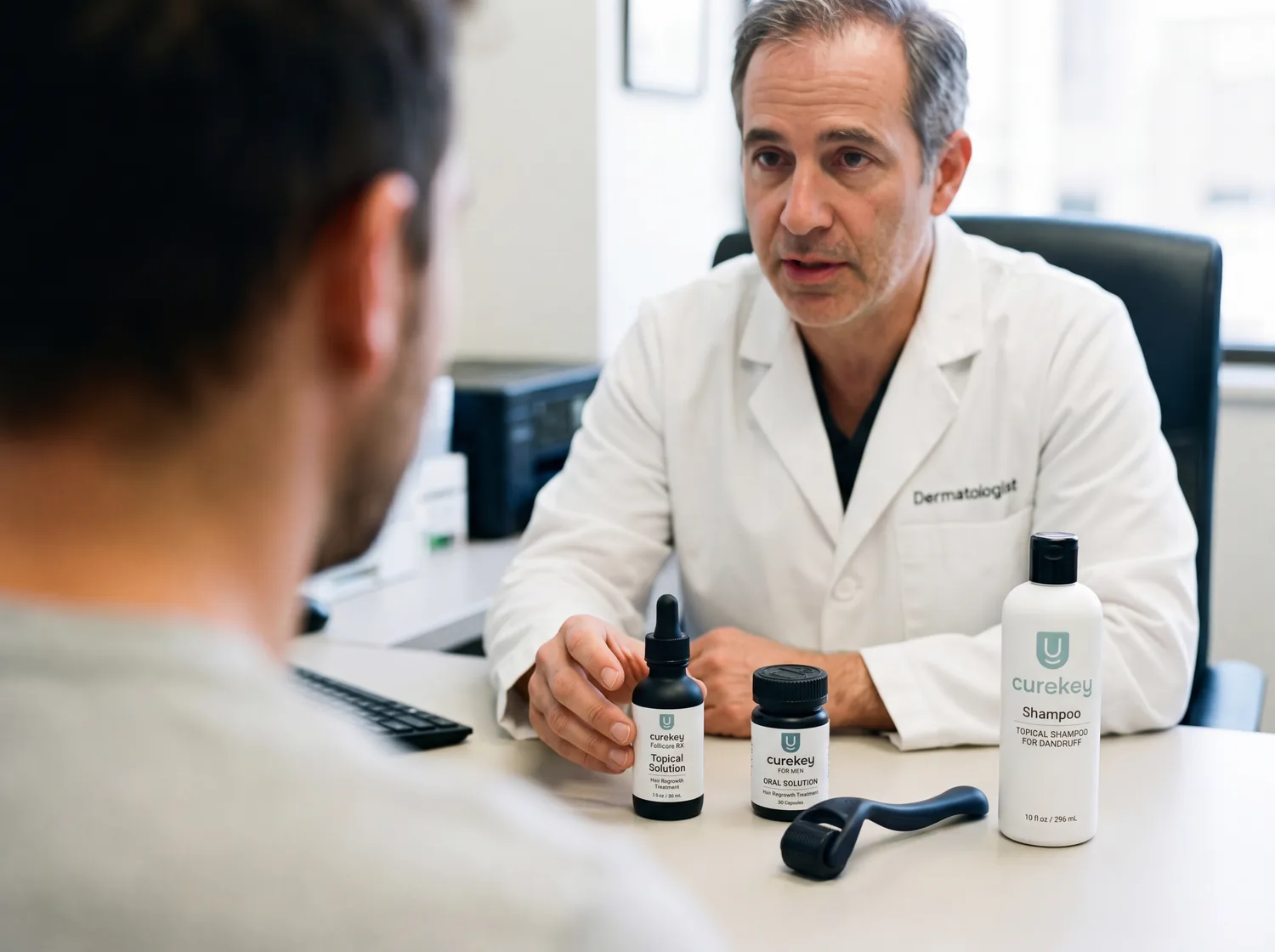
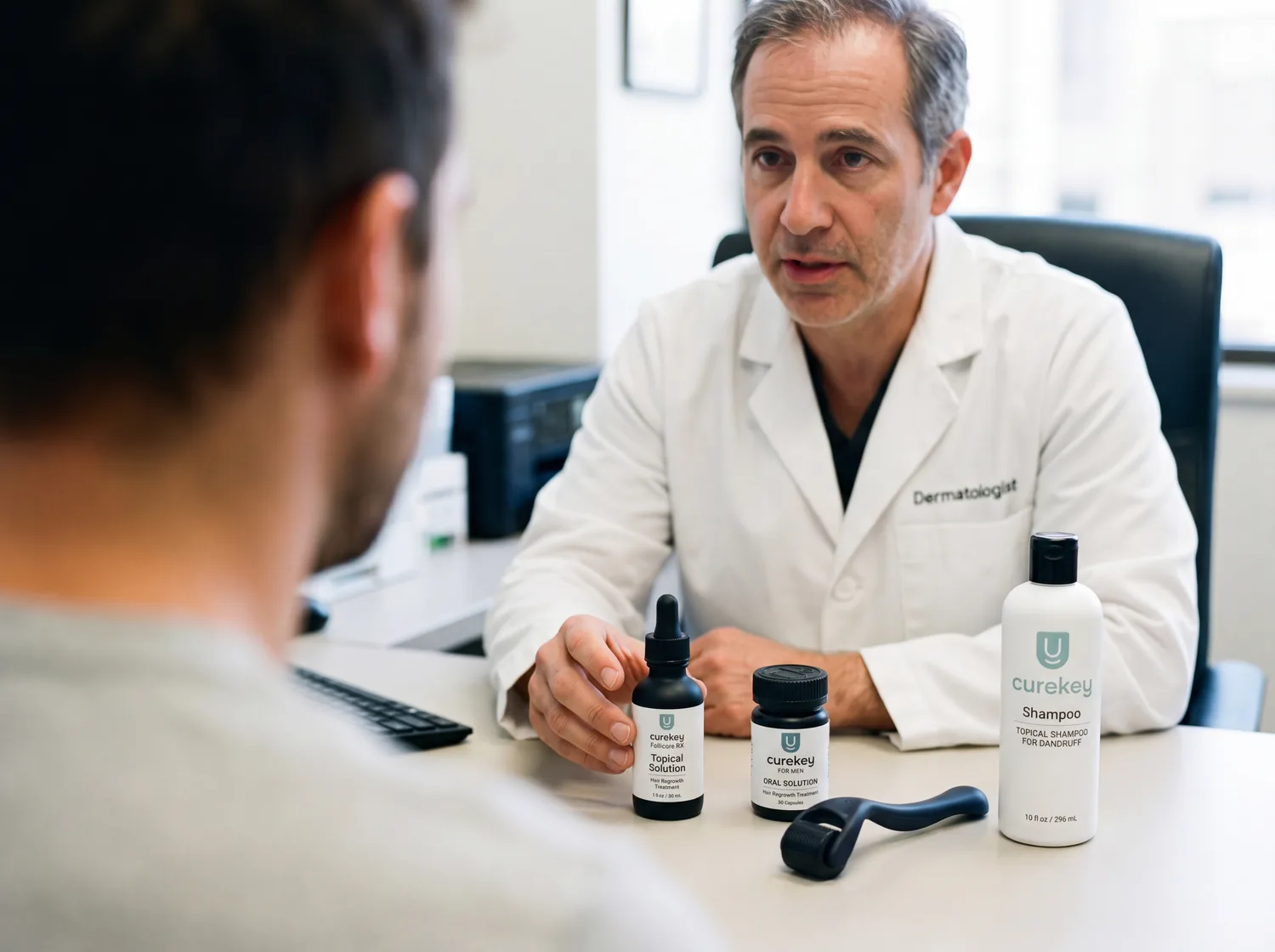
What a dermatologist actually does for hair loss
A dermatology evaluation for hair loss is more systematic than most people expect. The visible thinning is only the surface; the work is in figuring out why it is happening.
History and physical examination
The visit usually opens with a detailed history: how long the loss has been going on, whether it came on gradually or suddenly, where on the scalp it is most noticeable, your family history, your medications, recent illness or stress, and any symptoms like itching or pain. A dermatologist then examines not just the thinning area but the whole scalp, and often the nails and other hair-bearing skin, because the broader picture provides clues that a single patch does not. According to the American Academy of Dermatology, this combination of focused questions and a close look at the scalp, nails, and affected areas is the foundation of an accurate diagnosis (American Academy of Dermatology, Hair loss: Diagnosis and treatment, 2024).
The pull test
One simple in-office maneuver is the pull test. The dermatologist gently grasps a small group of hairs near the scalp and applies light traction to see how many release. A handful coming away easily can point toward active shedding, while firm resistance suggests the loss is not in an active shedding phase. The test is quick and painless, and it is hard to self-administer reliably, which is part of why it stays in the clinician's hands.
Trichoscopy and dermoscopy
Many dermatologists now use a handheld dermatoscope, or a digital version, to magnify the scalp and hair shafts. This technique, called trichoscopy, has become a central tool in hair clinics because different conditions produce characteristic patterns under magnification. A review in the Journal of the American Academy of Dermatology describes how alopecias can now be classified by their trichoscopic findings, with distinct signs for androgenetic alopecia, alopecia areata, and scarring conditions (Mubki T et al., J Am Acad Dermatol, 2014). It is noninvasive and adds detail the naked eye cannot resolve.
Blood work when indicated
Lab work is not automatic. For a textbook case of pattern hair loss in an otherwise healthy person, blood tests are often unnecessary. When the picture suggests something systemic, such as diffuse shedding that could reflect thyroid disease, iron deficiency, or a hormonal imbalance, a dermatologist may order targeted blood work, and the same logic applies before starting certain medications that warrant baseline monitoring.
Scalp biopsy when the diagnosis is in doubt
In a minority of cases, a dermatologist takes a small scalp biopsy. A review in the Journal of the American Academy of Dermatology puts it plainly: a biopsy should be performed whenever the diagnosis is in doubt, typically using a 4-millimeter punch sample examined under the microscope (Sperling LC, J Am Acad Dermatol, 2023). This matters most for scarring conditions, where the biopsy can distinguish the subtype and confirm whether follicles are being permanently destroyed. A biopsy is a hands-on procedure that, by definition, requires an in-person visit.
When you genuinely need an in-person dermatologist
Some hair loss presentations are not well suited to remote evaluation. They share a common thread: the diagnosis is uncertain, the cause may be serious, or the right next step depends on something only a hands-on exam or a biopsy can provide. If any of the following describe your situation, an in-person dermatologist is generally the more appropriate starting point.
Scarring (cicatricial) alopecia
Scarring alopecias destroy the hair follicle and replace it with fibrous tissue, which means the resulting hair loss is permanent. Early diagnosis is critical because timely treatment can halt the progression before more follicles are lost. These conditions often need a biopsy to confirm, and the treatment differs from anything used for pattern hair loss. Signs that should prompt an in-person visit include a smooth, shiny patch where the follicle openings have disappeared, redness or scaling at the edge of a thinning area, or scalp pain, burning, or tenderness with the loss.
Sudden patchy loss
Hair that falls out in discrete round or oval patches, rather than thinning diffusely or in the typical pattern, can suggest alopecia areata, an autoimmune condition with its own diagnostic features and treatment pathway. Sudden, well-defined bald patches deserve a clinician who can examine the scalp directly and look for the characteristic trichoscopic signs.
Unclear or rapidly progressing loss
Hair loss that does not fit a recognizable pattern, that is advancing unusually fast, or that has you genuinely confused is exactly the situation a specialist exam is built for. Our guide on how to tell if you're losing hair can help you characterize what you are seeing, but if the picture stays murky, an in-person evaluation removes the guesswork.
Signs of systemic illness
When hair loss comes with other symptoms, such as fatigue, unexplained weight changes, skin rashes, joint pain, or changes in nails, the hair may be a clue to a broader medical issue. These cases benefit from a clinician who can examine you in person and coordinate the workup, sometimes alongside a primary care physician.
Where physician-led telehealth fits
The most common cause of hair loss, by a wide margin, is androgenetic alopecia, the gradual, genetically influenced thinning that follows recognizable patterns: receding temples and crown thinning in men, and a widening central part in women. This condition is diagnosed largely from the pattern of loss, the timeline, and the family history, which is precisely the kind of information that travels well through a structured questionnaire and good scalp photographs.
For straightforward pattern hair loss in an otherwise healthy adult, physician-led telehealth is a reasonable entry point. A licensed physician reviews the same history, photos, and pattern that an in-person clinician would assess, then decides whether prescription treatment is medically appropriate. The evidence-supported options, including topical or oral minoxidil, finasteride, dutasteride, and spironolactone in certain women, are the same medications a dermatologist would consider. Our walkthrough of what to expect at a first telehealth visit describes how that review works, and how it works outlines the full process.
Telehealth does not replace in-person dermatology, and a responsible service recognizes its own limits. If the intake or photos suggest a scarring alopecia, patchy loss, an unclear diagnosis, or signs of an underlying condition, the appropriate response is to decline to prescribe and refer the patient to an in-person clinician rather than treat blindly. The two paths are complementary: telehealth handles the common, visually recognizable case quickly, and in-person dermatology handles the uncertain or serious case with the tools that require hands on the scalp.
How to decide where to start
A few questions can help you sort which path fits your situation. Is the loss following a recognizable pattern that has developed gradually over months or years, with a family history of similar thinning? That profile points toward pattern hair loss, where a telehealth assessment is a practical first step. Is the loss patchy, sudden, painful, accompanied by scalp changes or other symptoms, or simply confusing? Those features point toward an in-person dermatologist who can examine the scalp directly and biopsy if needed.
If you are unsure, there is no harm in starting with the lower-friction option and escalating. A thoughtful telehealth review will flag anything that warrants in-person care. When you are ready to begin, you can start a free hair assessment and let a physician review your case. Before committing to any treatment, our list of questions to ask before starting treatment is worth reading so the conversation works in your favor.
The bottom line
Dermatologists can absolutely help with hair loss, and for scarring conditions, sudden patchy loss, rapidly progressing or unexplained loss, and hair loss tied to broader illness, an in-person specialist is the right call. For the most common scenario, gradual pattern hair loss with a recognizable shape and a family history, a physician-led telehealth assessment covers the same diagnostic ground and gets you to a treatment decision faster. The goal is not to choose between dermatology and telehealth as rivals, but to match the path to the problem.
Related reading
- What to Expect at Your First Telehealth Hair Loss Visit: how a remote evaluation works, step by step.
- How to Tell If You're Losing Hair: distinguishing normal shedding from progressive thinning.
- Questions to Ask Before Starting Treatment: a practical checklist for your first visit.
- Androgenetic Alopecia: the most common cause of hair loss and how it is recognized.
- Hair Loss Glossary: plain-language definitions for the medical terms used across these guides.